

I love making art. It’s where I go to unplug, to drain my brain of all the technology for a while. So I took a drawing and painting class, the idea being I’d make pieces to decorate the house.
I could’ve gone to the store and bought prints. Easy. But I wanted something that was mine. Something I’d put my own blood, sweat, and tears into.
But painting is hard work. It takes time, and it takes talent. So I found my way around it: paint-by-number, with my own flair on top.
At first I felt weird hanging them up. It’s a paint-by-number. What am I doing putting this on my office wall?
Then people saw them, and nobody knew. Everybody assumed I’d painted them from scratch, which was the craziest thing.
There I was, feeling like a painter imposter for taking the easy way, adding my little bit of flair, passing it off as my own art. When that’s exactly what it was. I was just in my own head about it. Hand me and somebody else the same numbered canvas and the two would still come out different. Nobody looking at it ever saw the numbers underneath. They just saw the picture, and either it caught their eye or it didn’t.
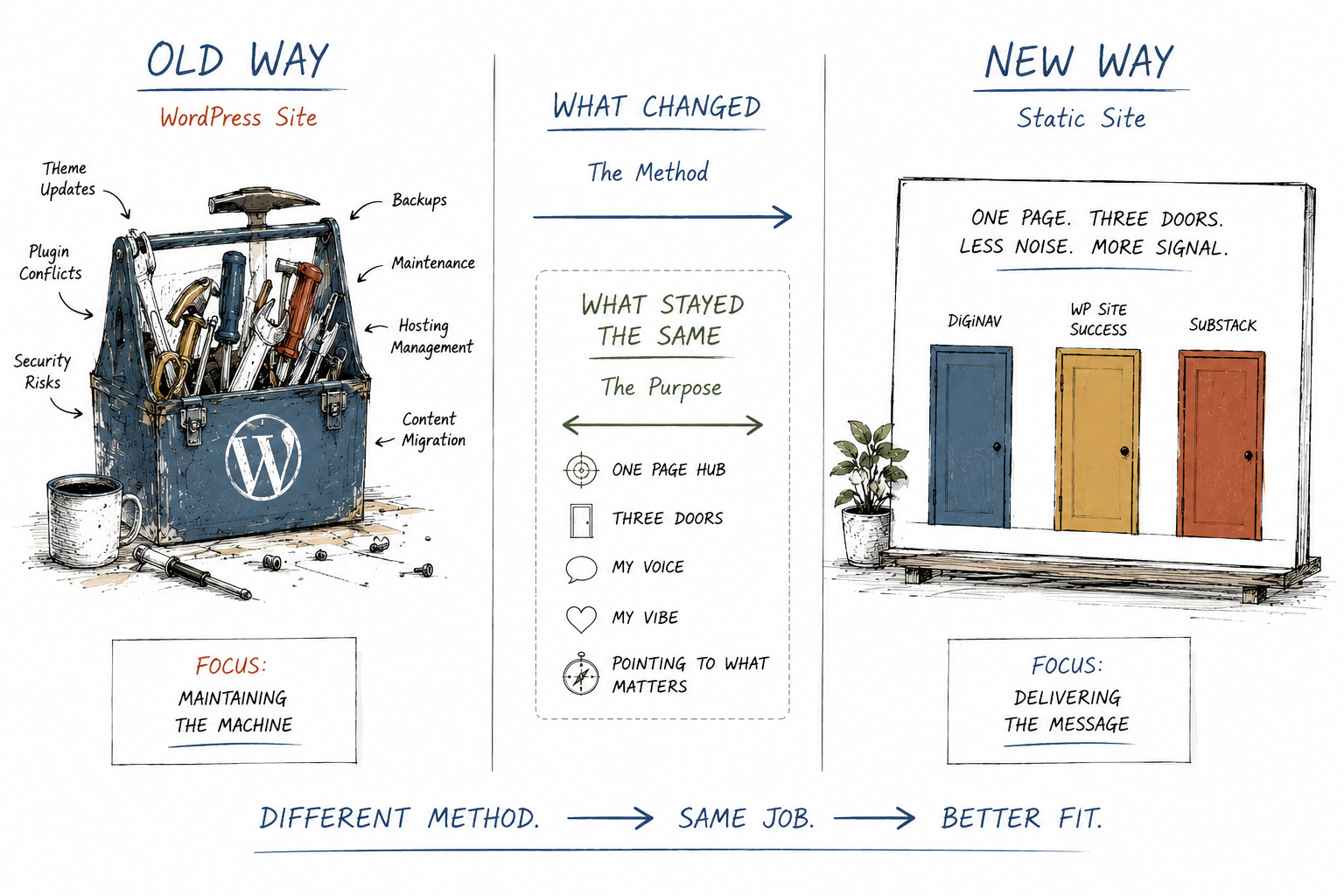
The same thing happened when I decided to move my personal website off WordPress. The site is a hub. It points to my two businesses (DigiNav Compass and WP Site Success) and to where I write on Substack. That’s the whole job — one page, three doors.
✳︎ ✳︎ ✳︎
The decision should have taken a week.
It took six months.
Not because the technology was difficult.
Not because the messaging wasn’t ready.
Not because the design was unfinished.
Those were the reasons I kept giving myself, but none of them held up under scrutiny.
I kept telling myself it was the messaging. Then it was the imagery. Then the design. Then whether I should host it on Vercel or Cloudflare. Every time I solved one question, another appeared.
And every time I got close to launching, I’d find another reason to wait.
Something felt wrong.
At least that’s how I described it at the time.
What I know now is that the feeling wasn’t warning me about the project. It was pointing at something I didn’t want to look at.
For eighteen years, I’d been the WordPress person.
I’ve built sites. Maintained sites. Recommended WordPress to clients. Built an entire business around it.
Now I was putting my own website on something that wasn’t WordPress.
That’s what I was resisting. Not the migration. Not GitHub. Not Cloudflare. Not the code.
The story I had about who I was.
The realization didn’t hit until I was decommissioning the WordPress version of the site. Removing the maintenance plugin. Taking it off the server. Closing the chapter.
That’s when I finally understood why it had dragged on for six months.
I wasn’t evaluating a website decision.
I was grieving an identity.
And once I saw that, I knew what to do.
✳︎ ✳︎ ✳︎
If a client came to me stuck like this, I’d start ruling things out. Is it the messaging? The design? The functionality? The audience? What’s actually broken?
So I turned the questions back on myself.
What evidence am I waiting for that I can only get after launch? If someone else showed me this site today, would I tell them to launch it?
What specifically feels unfinished? If I had to launch this Friday, what would I remove from the checklist?
What am I having trouble letting go of? Which parts of the old site represent years of work rather than current value?
Am I stuck because the site isn’t ready, or because launching forces me to admit who I am now?
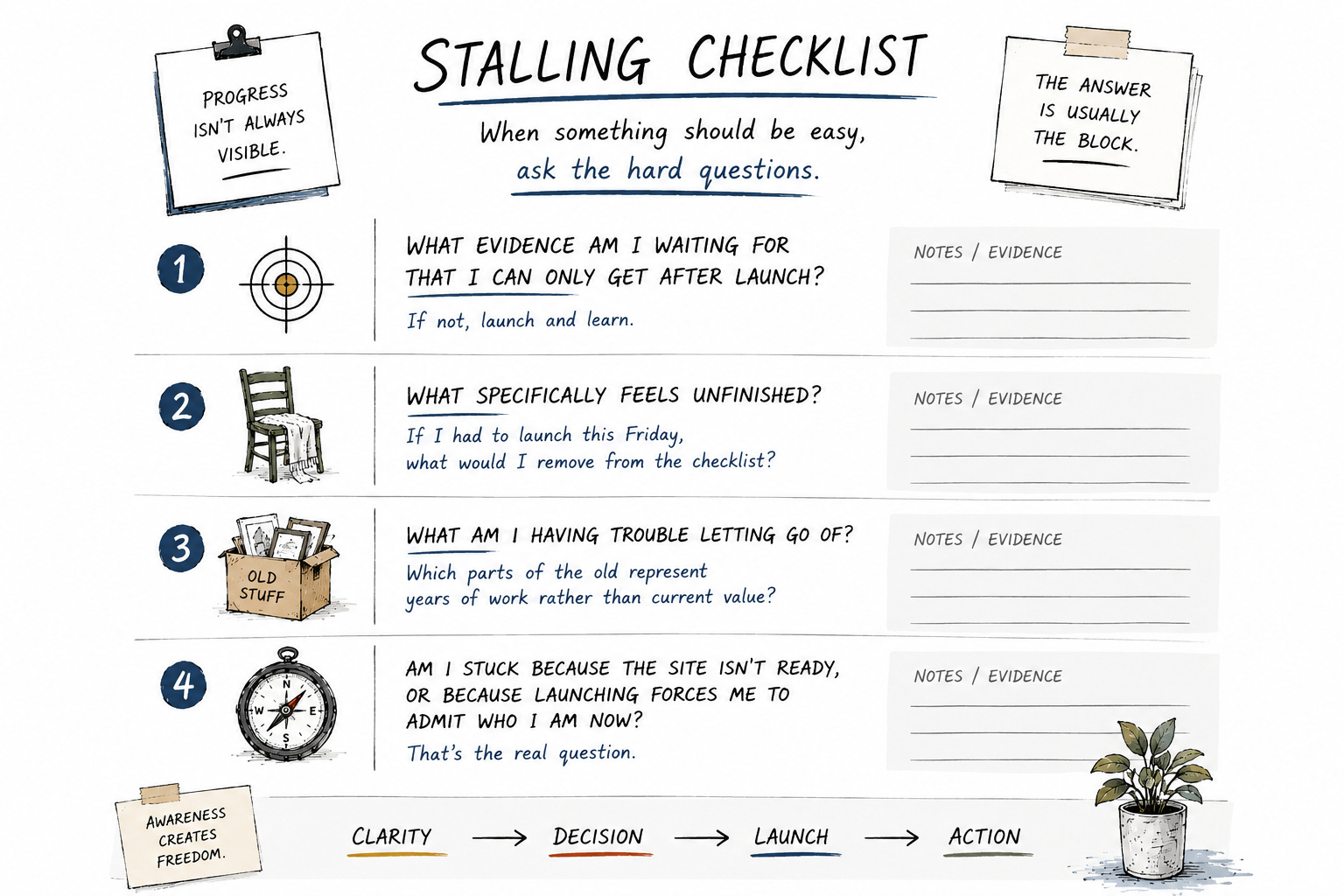
If you’re stalling on something that should be easy, sit with the last one.
That last question was the one.
The site was ready. I wasn’t. Or more accurately, my feelings hadn’t caught up to a decision I’d already made.
✳︎ ✳︎ ✳︎
Here’s the part nobody puts in the articles or the YouTube videos.
Embrace AI. Vibe-code this. Build an app for that. That’s the easy part. The tools are easier than they’ve ever been. The friction isn’t there anymore. You don’t need permission, you don’t need a developer, you don’t need much of a budget.
What nobody talks about is the part that comes before you touch any of it. The part where you have to come to terms with not doing things the way you’ve always done them. Where the method that built your business isn’t the method that fits this job. Where using the easier tool feels like betraying the harder one you’ve spent years on.
That’s the work. Not the tool. The unlearning of who you were before the tool existed.
And the kicker, for me, was that I’d been telling people this for two years. AI should meet you where you’re at. Match the solution to the need. It’s the line I open conversations with. It’s the line I close them with.
I just hadn’t applied it to myself.
The principle didn’t fail. I almost did, because I was so busy walking the walk for everyone else that I forgot the walk includes me.
✳︎ ✳︎ ✳︎
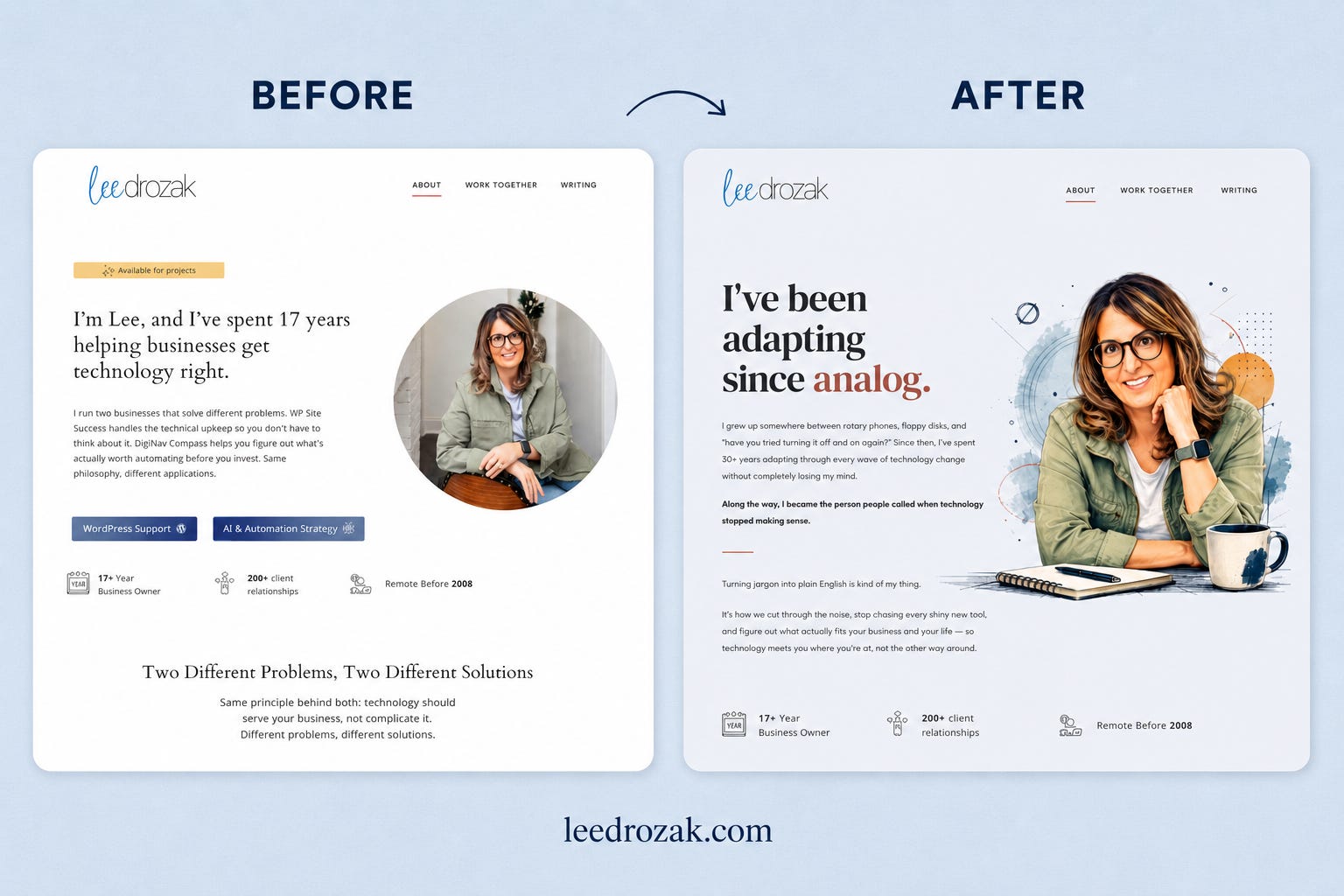
It made its debut on time. Deadline was set and nothing was going to stop the train from leaving the station.
The site is what I’d pictured. Static HTML, no heavy maintenance, hosted on a server I use regularly, pointing to the places I can be found. A routing page doing the job of a routing page, with my voice and my vibe.
What I didn’t expect was the self-doubt rearing its ugly head for that long. I overlooked the imposter, burn-the-bridges feeling I was sitting with for all those months. If I’d asked myself the hard questions in month one or two, month six would never have rolled around.
And if I’d been my own client, I’d have fired myself for the flippy, floppy indecision. The good news is I gave myself a second chance. The better news is I’ve now got a better diagnostic for the put-this-off, pit-of-my-stomach feeling.
✳︎ ✳︎ ✳︎
If this tension feels familiar, you may want to keep exploring from here.
Related Theme
The Last Mile: The final stretch — where the work is done and the only thing left in the way is you.
Continue the conversation:
One thing to site with:
What are you treating as a project problem that might actually be an identity one?
Thinking Through Something?
If you’re sitting with a decision, workflow, tool stack, or AI process that technically works but doesn’t feel quite right, I offer limited advisory sessions for solo business owners trying to sort through the noise without adding more complexity.
I can so relate! I think we forget to give ourselves grace for grieving old identities. Whether it's clothes we no longer like or the big stuff like a career shift. We're constantly adapting. In motion. Congrats on making your decision!