


Last week, I was updating a client's course content. New lessons, revised material, the usual.
The old me would have opened both documents side by side. Gone line by line. Compared, edited, revised. Checked my work. Revised again. It’s how I’ve done content updates for years... because that’s how you do it right.
I caught myself reaching for that familiar process. And then I stopped.
Instead, I uploaded both versions to Claude and asked it to compare them and suggest changes. Ten minutes later, I had a clear summary of what needed updating. But here’s where it got interesting. I grabbed the code from the existing page and asked Claude to make the adjustments directly.
What would have taken me half a day took less than an hour. Same quality. Fraction of the time. Saved my sanity and saved the client money.
That moment stuck with me. Not because of the time saved (though that was nice). Because I almost didn’t do it. My old rules were pulling me back toward the line-by-line approach, even though I knew a better way existed.
“The hardest part of working with AI isn’t learning the new stuff. It’s unlearning the rules I spent years acquiring.”
That line came out of my mouth during a conversation with Kim Doyal. She paused, said it was quite the aha moment, and told me I should share it.
So here I am.
Your experience is the problem.
Here’s what nobody tells you about being good at what you do.
The principles that made you successful? The hard-won knowledge from years of trial and error? The instincts you’ve built through thousands of hours of practice?
They can become the exact things holding you back.
Not because they were wrong. They weren’t. They worked beautifully... in the context where you learned them.
The problem is, context has changed. Dramatically. And we’re still running old programs in a new operating system.
I’ve been in this game for over seventeen years. I remember hand-coding HTML in a text editor. Building databases from scratch. Debugging systems line by line. Every one of those experiences taught me something valuable. Every one of them created a rule in my head about “how things work.”
Rules like:
Research thoroughly before you start anything
Build it yourself if you want to understand it
Follow the established process because that’s how professionals work
These weren’t just habits. They were principles I’d earned. The kind of hard-won knowledge that becomes automatic.
And automatic is exactly the problem.
Here’s what unlearning actually looks like in practice.
You sit down to work. You know there’s a faster, smarter way to approach the problem. You’ve seen it. Maybe even used it once or twice. But something in your brain keeps pulling you back to the familiar path.
That pull isn’t ignorance. It’s experience.
And that’s what makes it so hard to override.
I catch myself doing this constantly. I’ll start a project with every intention of using AI tools to move faster. Halfway through, I’m back in my old patterns. Researching for hours before taking action. Following processes designed for a world that no longer exists.
The wheel spins, but the cart doesn’t move.
What’s actually happening is a conflict between two kinds of knowledge. There’s what I know intellectually (AI can handle certain tasks faster and often better). And there’s what I know in my bones (the accumulated instincts from thousands of hours of doing things a certain way).
When those two conflict? Bone-deep knowledge usually wins. Not because it’s right. Because it’s automatic.
The difference between people who adapt quickly and those who struggle isn’t intelligence or technical skill. It’s having clear context for what you’re actually trying to accomplish.
The breakthrough wasn’t forcing myself to use new tools.
It was building a foundation that made the shift feel natural.
When you know your business deeply (what makes it work, what makes it unique, what problems you’re actually solving), you can evaluate new approaches without losing yourself in them. You can ask, “Does this serve what I’m already doing well?” instead of “Should I do what everyone else is doing?”
That foundation becomes a filter. It helps you decide what to keep from your old playbook and what to let go of. Without it, you’re just grabbing at tactics with no way to evaluate whether they fit.
I’ve been building what I call a context library. A collection of documents that capture the essential context about my business, my approach, and my thinking. Sounds almost too simple to matter.
But here’s what I noticed: When I start a conversation with Claude using that context, the results are dramatically different. Not because the AI is smarter. Because it’s working with material that reflects my actual situation.
The irony?
Building that context library required me to unlearn one of my deepest habits. The assumption that context lives in my head and doesn’t need to be articulated.
For years, I operated with implicit knowledge. Things I understood so well I never bothered to write them down. That worked fine when I was the only one doing the work.
But AI can’t read your mind. It can only work with what you give it.
Catching old patterns is the key.
If you want to start noticing where your old rules might be creating friction, here’s something you can try this week.
Next time you sit down to work on something and feel that familiar pull toward your usual approach, pause. Ask yourself three questions:
1. What rule am I following right now?
Name it out loud. “I need to research this thoroughly before I start.” “I should figure this out myself before asking for help.” “I need to have all the information before I can make a decision.”
Just making the rule visible is half the battle.
2. Was this rule built for this situation?
Most of our rules were built in a different context. The rule might have been perfect for 2015. The question is whether it still fits in 2025.
3. What would I try if I loosened this rule for one hour?
You’re not abandoning the rule forever. You’re experimenting with holding it lightly. What would you do differently if you gave yourself permission to try another way?
Here’s what this looks like in practice.
Say you’re working on a proposal and catch yourself deep in research mode. Gathering information, reading articles, compiling notes.
Pause and name the rule: “I need to understand everything before I can write anything.”
Ask if it fits: “This rule helped me avoid embarrassing mistakes early in my career. But right now, I’m not writing a dissertation. I’m drafting a proposal I’ll revise anyway.”
Try loosening it: “What if I spent 20 minutes talking through my initial thinking with Claude, let it surface questions I haven’t considered, and then did targeted research on the gaps?”
Here’s a prompt you can copy and paste:
I'm working on [describe the task]. Before I dive into research, help me think through this:

1. What are the key questions I should be able to answer?
2. What assumptions am I probably making that I should check?
3. What's the minimum I need to know before I can start a rough draft?

Push back if you think I'm overcomplicating this.
That’s the shift. Not from careful to careless. From automatic to intentional.
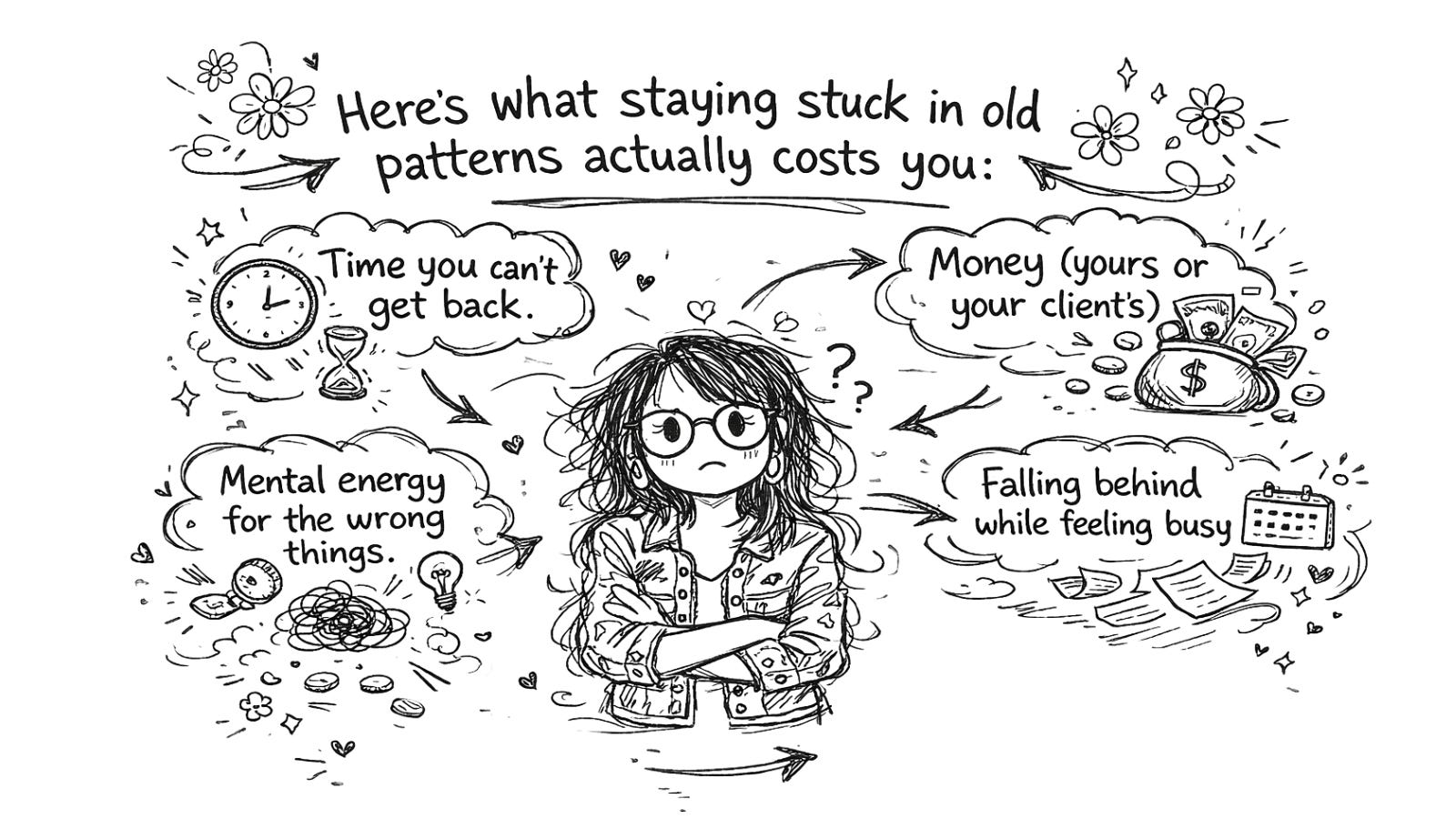
Here’s what staying stuck in old patterns actually costs you.
Time you can’t get back. Every hour spent on the line-by-line approach when a smarter method exists is an hour you could have spent on work that actually requires your judgment.
Money (yours or your client’s). That course update I mentioned? The old approach would have cost my client significantly more. Not because I was padding hours. Because the process itself was inefficient.
Mental energy for the wrong things. The cognitive load of grinding through tasks the hard way leaves you depleted for the work that matters. The strategic thinking, the creative problem-solving, the relationship building.
Falling behind while feeling busy. This is the sneaky one. You’re working hard. Putting in the hours. But the people who’ve loosened their grip on old rules are moving faster with less effort. And the gap widens.
The friction you feel isn’t a sign that you’re behind or not getting it. It’s a sign that you’ve invested deeply in your craft.
The question isn’t whether you’ll feel resistance. It’s whether you’ll let that resistance make your decisions for you.
The weight of experience.
I want to say something that might sound obvious, but needs to be said anyway.
You’re allowed to find this hard.
If you’ve built a career doing things a certain way, and now the landscape is shifting, it’s completely reasonable to feel friction. That friction is evidence that you’ve invested deeply in your craft. That’s not a weakness. That’s the weight of experience.
The goal isn’t to become someone who never hesitates. It’s about becoming someone who can sit with the discomfort of not knowing, try a different approach, and honestly evaluate whether it worked.
I still catch myself spinning my wheels. I still default to old patterns more often than I’d like. But I’m getting better at noticing when it’s happening.
And that noticing? That’s the skill.
Sometimes you have to unlearn to relearn. That’s not failure. That’s growth with more layers.
I’m curious about your experience with this.
What’s one rule or process you learned years ago that you suspect might be holding you back now?
Not a general category. A specific thing. The way you research. How do you start projects? What do you think you need to know before you can begin?
One thing I’m working on:
I’ve been developing a Context Library Workshop. A structured exercise to help you build three cornerstone context pieces for your business. These are the documents that capture what makes your work valuable, how you approach problems, and what you’re actually trying to accomplish.
I’m looking for two people to work through this with me. Whether you’re just starting to explore AI tools or you see the opportunities and want to move more intentionally, getting this foundation in place changes how you work with AI.
If that sounds useful, mention it in your reply or send a DM. Tell me where you are in your AI journey, and I’ll follow up with details.