


For years I believed the template was the answer.
Use a structure. Follow the framework. Pick the writers you admire and reverse-engineer how they do it. The advice made sense — consistency, clarity, repeatability. So I built templates. Then I found better templates. Then I borrowed frameworks from writers whose work I admired and mapped my ideas onto their shapes.
And the information wasn’t bad. It was boring and incomplete.

I love to paint but a trained painter I am not. And for years I would use those paint by numbers kits. You know the ones — printed canvas, numbered sections, every color pre-assigned. They even give you brushes. Generic ones, but brushes.
At first it’s frustrating. Staying inside all those tiny little spaces. Then it gets efficient. Then it gets robotic. You’re not being creative — you’re just the person following the numbers.
That’s what the template was doing to my writing process.
The real problem wasn’t that the ideas were bad or the content was weak. It was that my articles were missing the best parts — the lessons, the snafus, the messy parts.
Most writing advice lives at the endpoints. Here’s the problem. Here’s the output. A to D, clean and straight.
Nobody shows you B and C.
What Happened When I Handed AI the Blueprint
Every week I would sit down to “write” the article.
I’d hand AI the brain dump — the build log, the experiment notes, some random thoughts I’d captured through the week. And from that pile of raw material, it would outline and draft the article. Based on the template.
Here’s what I didn’t notice for a while: the information was getting pared down to fit the tidy little spaces. The riffs didn’t make it in. The creative insights got smoothed over. The “oops, here’s where it went sideways and here’s how I adjusted” moments — gone. And the real failures? The ones rooted in my own mindset? Those definitely didn’t survive the template.
It wasn’t robotic. It wasn’t sloppy. You couldn’t look at it and say “an AI wrote this.”
But it was missing the only thing that made it worth reading — the experiences that only someone going through it could articulate. The part where I second-guessed myself at step three. The detour that turned out to matter more than the destination. The small realization that only shows up when you’re in the middle of something messy and paying attention.
The template didn’t know those parts existed. So it left them out.
The Better Template That Still Didn’t Work
So I did what made sense. I went looking for a better template.
I pulled some of my favorite writers. The ones whose articles felt effortless to read, whose structure seemed to carry you forward without you noticing. I asked AI to help me analyze what they were doing and build something better. Maybe it was a flow problem. Maybe the gaps just needed different sections.
Same thing happened.
I’d finish a draft and find myself rewriting large chunks of it. Not because the words were wrong exactly — but because they weren’t landing on the things that actually happened. The real texture of the experiment. What I was actually feeling at step three when it wasn’t working the way I expected. The adjustment I made that wasn’t in any plan but turned out to matter.
The words were there. They just weren’t making the cut.
And that’s when I finally looked at the right problem.
It wasn’t the structure of the template. It wasn’t the writers I was borrowing from. Templates don’t work for the way my creative process works — and more importantly, they don’t have room for the things that happen between step one, step two, and step three. The pivot that only makes sense if you were there. The failure that wasn’t a failure, it was information. The moment where the whole direction shifted because of something small that a template would never think to ask for.
That’s not a gap you can restructure your way out of.
Structure Isn’t a Template — Here’s the Difference
So I ditched the templates.
And then I just sat there.
Because the templates weren’t just a writing problem — they were also my process. Without them I had a pile of raw material and no clear path through it. I still needed to get from the brain dump to a published article without spending three times as long rewriting everything. I still wanted AI in the mix. I just needed it to stop making decisions that weren’t its to make.
That’s when I realized I’d been confusing two things that aren’t the same.
Templates and structure. I’d been using them as interchangeable words for the same idea.
They’re not.
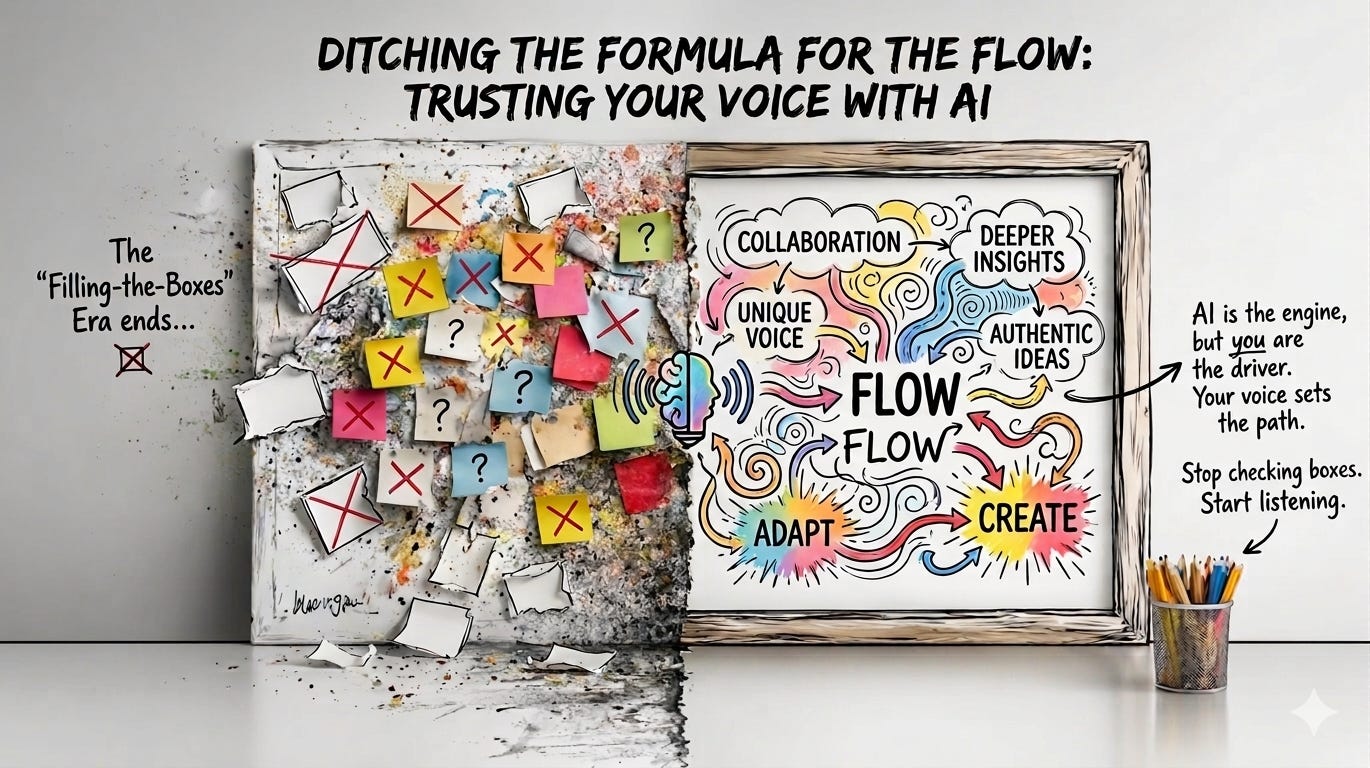
A template tells you what goes where. Section one is this. Section two is that. Hit these beats in this order at roughly this length. It’s a paint by numbers canvas — the decisions are already made before you sit down.
Structure is different. Structure is just a flow of information. A guide, not a cage. You still know where you’re going. You just get to find your own way there.
The messy middle — the detours, the pivots, the things that only make sense because you were in them — those fit inside structure. They never fit inside a template.
And if you’ve ever handed a process over to a framework and wondered why the result didn’t feel like you — you already know what I’m talking about.
You’re Not Doing It Wrong. You’re Using Someone Else’s Process.
For as long as most of us can remember, we’ve been taught to follow the blueprint.
Funnels. Frameworks. Content templates. Launch sequences. There’s a proven path for almost everything in business — and following it is how you get results. Do X, then Y, then Z. Hit these steps in this order. Success is a system.
And for a lot of people, it works. The map gets them where they’re going.
But what about the ones whose minds need to work through things differently? What about the off-roads — the detours that don’t show up on the map but turn out to matter? What about the person who learns by going sideways first, or needs to feel their way through the middle before the beginning makes sense?
The map still gets everyone to the same place, technically.
It just doesn’t account for how some of us actually travel.
And borrowed confidence — following someone else’s proven path — looks exactly like best practice right up until the moment you notice what it cost you to get there.
How to Know When a Template Is Working Against You
So how do you know when a template is working for you — and when it’s working against you?
Start here. These aren’t a framework. They’re just honest questions worth sitting with (and a few simple one-line prompts) to help you think it through.
Does finishing the draft feel like something you would say or do? If it’s not reflecting the whole story, you need to ask yourself why it feels off and if it helps or confuses the audience.
Prompt: Does this sound like my voice and me having a conversation or like a cleaned up version of me? [paste draft here]
Are you rewriting large sections after the draft is done? Not polishing. Rewriting. If you’re regularly putting back parts that got cut to fit the template, the template is editing your voice. And your audience will see that.
Prompt: Does this have a natural flow of information and are there any gaps that may confuse the audience? [paste draft here]
Does the output sound like you — or like a version of you that cleaned everything up? There’s a difference between clear and sanitized. If you read the draft out loud and it doesn’t feel like you, chances are it’s not.
Action: Paste your article into a text reader. Does this sound like your experience or how you would tell the story to a friend?
If any of those land, you’re not doing it wrong. You’re just working with a tool that was built for someone else’s process.
The next step isn’t finding a better template. It’s figuring out what structure actually fits how your mind works — and that looks different for everyone.
Yes, it takes time to get there with these systems. It feels to me, it will always continue to be AI Assisted area especially when quality is required. Your prompts are very helpful in dientifying it.