


My Monday morning starts the way most of my days begin: I open the Chief of Staff dashboard to prepare for what’s ahead.
But last Monday, I opened it and something still felt off. I couldn’t put my finger on it. Not broken-off. Not useless-off. Just off.
The more I sat with it, the more I realized — the last couple of weeks I’d been wrestling with a few friction points in my day-to-day operating system. Or, as I like to call it, the Chief of Staff. The rhythms. The weekly commitments. The reworking of the email triage journey, which you can read about in past articles. All of it feeding into the dashboard, helping me make the most of my energy, not just my time.
And I knew something had to give. What it was, I wasn’t quite sure yet.
Part of the process, and to me the best part, is finding the breaks to create the fixes. But these breaks were personal. Harder to see the forest through the trees.
Because the outcome wasn’t just about what would work or cause friction. It was about whether I was willing to show you the messiest parts of the process to get there. The parts that are sometimes the most difficult to put out in public, because you might look at them and say, “Isn’t this what she tells us not to do?”
Short answer: yes. That would be the very thing I’d tell you not to do.
But taking your own advice isn’t always the easiest pill to swallow.
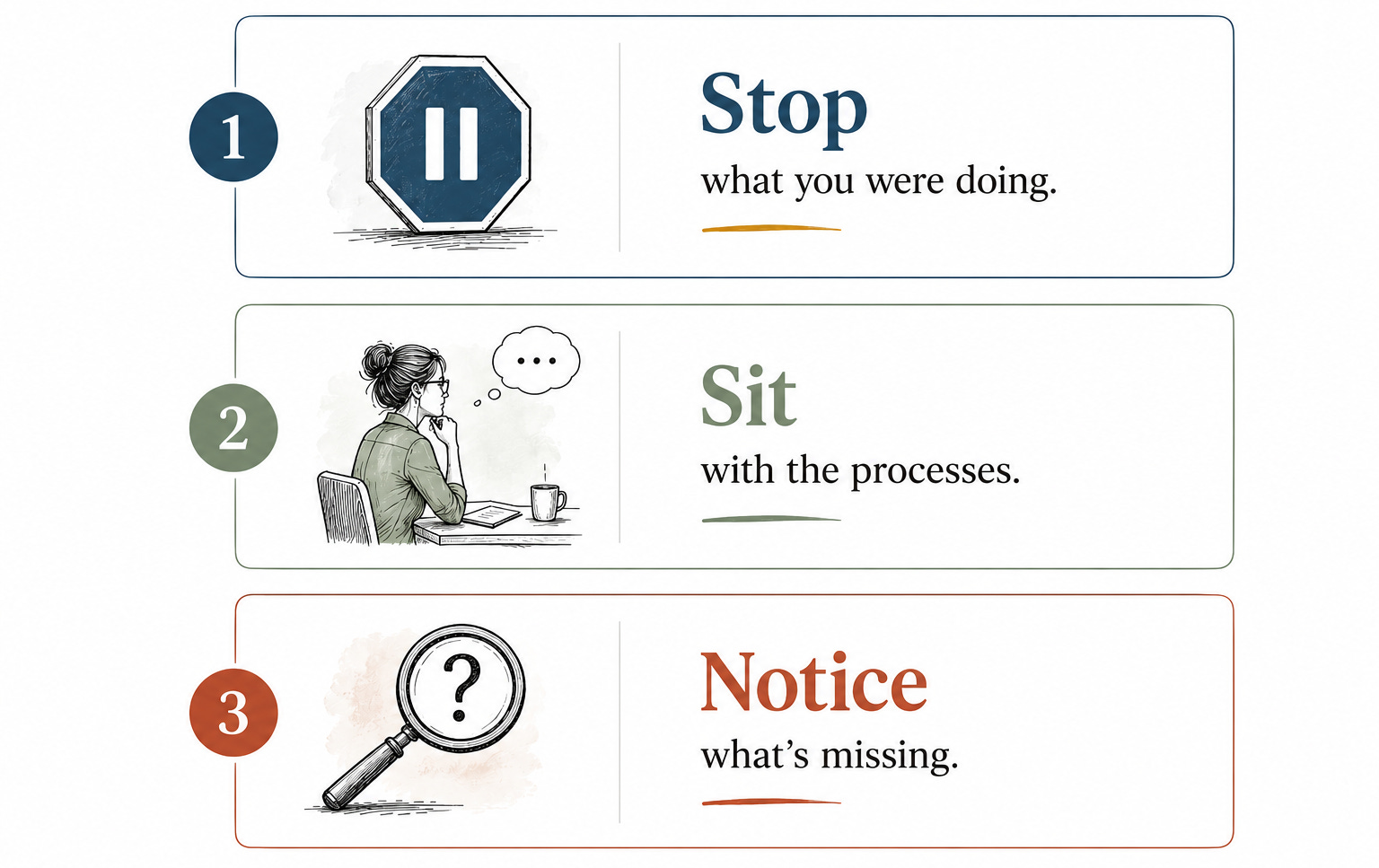
So this past week, I just took a step back. I stopped following all the things I’d been doing. I stopped running the daily rhythm. I didn’t do any weekly commitments because I just needed to clear my mind of where those friction points were. I didn’t stress about whether I needed to check my emails or not. I just lived in the moment and went through the processes.
And that’s when I realized I was still unconsciously following everyone else’s wins and game plan. The piece bringing it all together — the dashboard I’d built — was the piece I was building based on what I’d seen from everyone else.

Hi, I'm Lee. I help solo business owners get clear on AI and automation decisions before they commit — no hype, no hustle, no borrowed playbooks.
New here? Find the room that fits → No Foundation Yet → Lost In Translation → Built For Someone Else → The Last Mile
Nothing was broken
Nothing was broken. That’s the part that took me the longest to name.
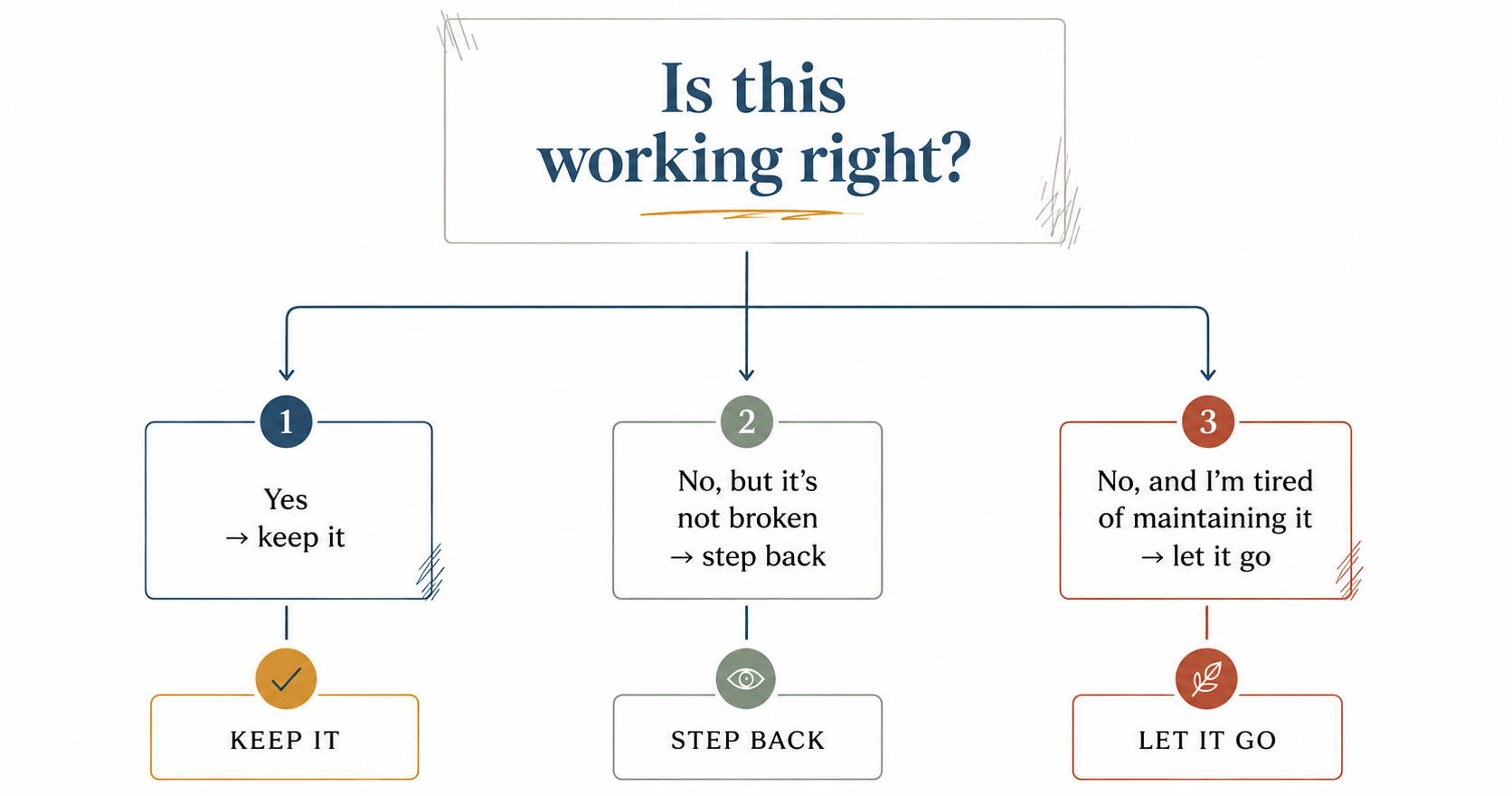
The daily rhythm worked. The weekly commitments worked. The email triage worked. They were all working. They just weren’t working right. Not 100%. Not for me.
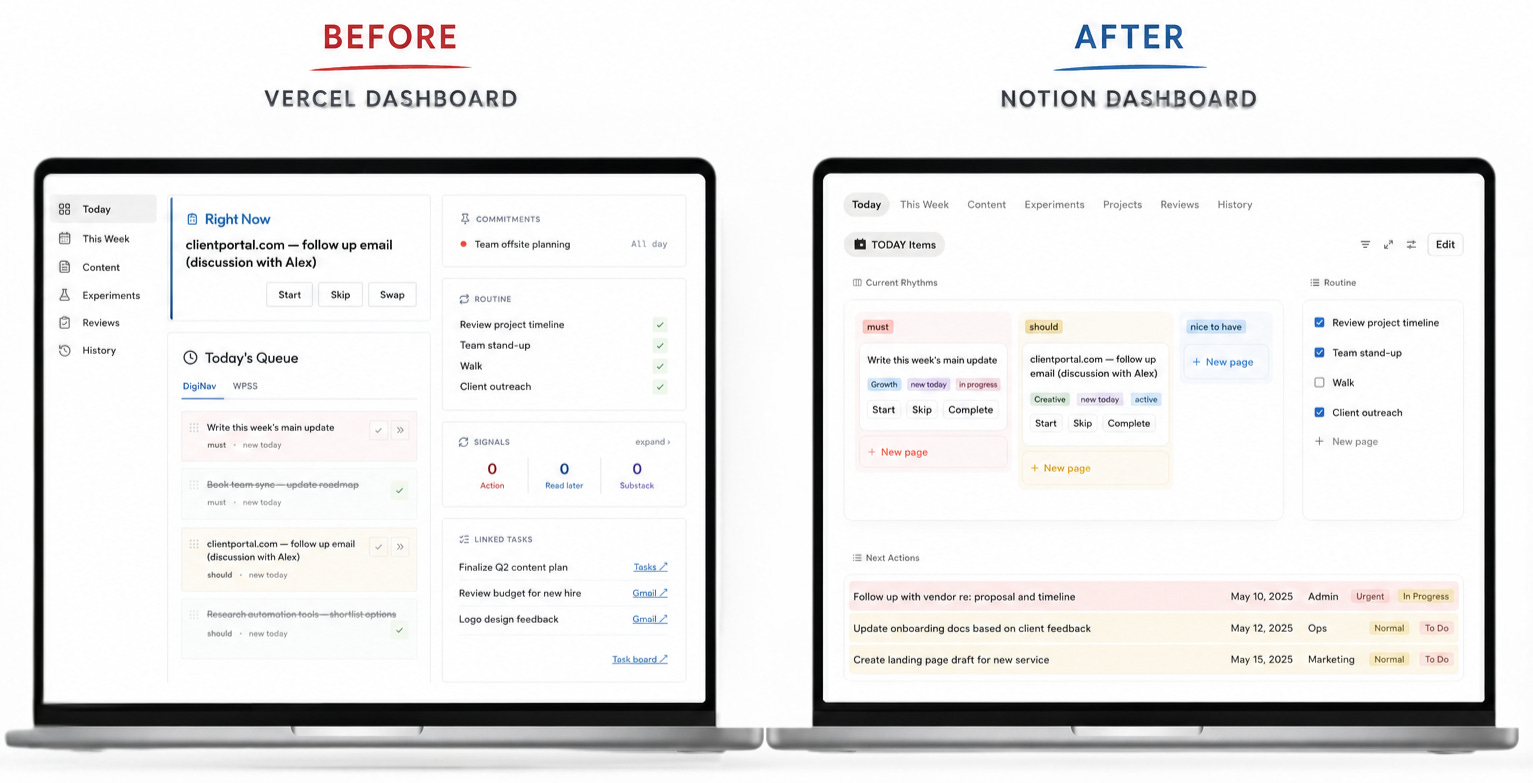
The daily rhythm and the weekly commitments are good processes. I rely on them. But I’d built a dashboard on top of them, beautiful, in Vercel, styled exactly how I wanted, to pull it all together in one place.
And every time I made a change to a Notion space to get the information that mattered most, the dashboard broke. Four version reiterations in. I was using AI to bridge the rhythm builder and the weekly commitments and the end-of-day pulse. Adding tools to fix a tool I’d built to look at the tools I already had.
The email triage I’d built with a Google script and Gemini still had friction. I’d written articles about it. I’d shown people how to set it up. But I was still triaging the triage. The labels weren’t applying right, and I knew CoWork (Anthropic’s desktop agent) could automate it further, but I’d been resisting adding another third-party option to the stack.
Two systems that worked. Two systems that weren’t working right.

Pretty or functional
The dashboard moment is where it cracked open.
I was looking at it, and the question landed: was it pretty, or functional?
It was pretty. It was fun to build. It was the thing everyone was building. But every time I made a change to a Notion database to get the information that mattered most, it broke. And I’d have to fix it. To look at it. In a browser. Signed into a Google account.
Or I could just open Notion.
Here’s the part I was overlooking the whole time: the answer was already in Notion. I just couldn’t see it because I was thinking about design aesthetic instead of usefulness. Notion isn’t as visually appealing as a dashboard I build myself in React and Vercel. I’ll give it that. But Notion has changed. It can do most of what I had the dashboard set up to do. Pull from the same sources, hold the same information, show me the same things.
The dashboard wasn’t solving friction. It was adding a layer on top of the thing that already had my information.
I was doing more work to maintain the watching than I was doing the work itself.
I told you to swap blinders for earphones
Friday I wrote about how to stop feeling like an outsider on AI. About swapping blinders for earphones. Vision wide, volume down. Stop letting the noise drive your decisions.
This week I caught myself with the earphones on and still building the wrong thing.
That’s the part I want to name. Because I think we tell ourselves that if we just fix our inputs, read different people, leave the bubble, stop comparing, we’ll naturally stop engineering for what we’re watching.
We won’t.
You can be in the right bubble, reading the right people, asking the right questions, and still build a dashboard because dashboards are what everyone’s building right now. You can have the earphones on and still hear enough through them to start engineering toward what you’re hearing instead of what you need.
Correcting the inputs isn’t the whole job. It’s the first job. There’s a second job underneath it: catching yourself when you’ve stopped walking your own talk.
When tired is telling you something
I want to be honest about how I got to the recognition, because the version where I just stepped back and saw the truth isn’t accurate.
I stepped back partly because the dashboard kept breaking and I was tired of fixing it. I stepped back partly because triaging the triage was wearing me down. I stepped back because I was tired.
The clarity didn’t come from wisdom. It came from fatigue.
And I think that’s important. Because the reader version of this article would be: Lee took a thoughtful pause and recognized her patterns. The real version is: Lee was tired of maintaining things that weren’t working right, and the tiredness made the question loud enough to hear.
The exhaustion is the signal. If you’re tired of maintaining something that isn’t actually broken, that’s data.
That’s not a personal failing. That’s the gap between what you built and what fits.
What I actually decided
The dashboard: I’m going back to Notion. Not because Notion is better. Because Notion is mine. I’ve been using it for years, I know how to work with it, and it doesn’t break when I change it. The Vercel dashboard was a beautiful experiment. It taught me what I needed to know. I’m not going to keep maintaining it just because I built it. The rhythm and the weekly commitments don’t need a layer on top of them. They just need to keep doing what they already do.
The email triage: I added the third-party tool I’d been resisting. CoWork is now running the triage based on what it knows about me, not on a generic Apple script with stringent rules I was working around. The biggest caveat was setting my MacBook to not sleep, which I solved too. It’s been running for a week. It’s working beautifully.
The pattern shows up in the small calls too. I’ve stuck with Midjourney because it nailed my style, even when everyone was touting Gemini, then ChatGPT, then back again. I use ChatGPT for what it does best, not because someone told me to. And I still second-guess every one of those calls. Was I ahead of the curve, or did I just get lucky by not following the latest craze?
I don’t know. I’m not going to know until later, if ever. The point isn’t being right. The point is making the call from inside my own work instead of from inside the watching.
What isn’t broken but isn’t working right
Here’s what I want to leave you with.
What in your work right now isn’t broken, but isn’t working right either?
Sit with that. Don’t fix it. Don’t optimize it. Just notice it. No big AI prompts or processes. Just you and your gut.
What are you maintaining because you built it, not because it fits?
And then: if you stopped using it for a week, really stopped, would you miss it? Or would you finally see what was actually working, and what you’d just been maintaining?
The first time you correct your inputs, you change what you’re listening to. That’s real work and it matters.
But the second time, and there’s always a second time, you catch yourself building toward what you’re listening to, even when what you’re listening to is good.
I don’t know what you’ll find when you sit with this. I’m not going to tell you what to do with it. The point isn’t to follow my call. It’s to make yours.
That’s the work I’m in right now. Out loud. With the earphones on. Still building the wrong thing sometimes. Still recovering in real time.
If this tension feels familiar, you may want to keep exploring from here.
Related Theme
Built For Someone Else: Building workflows that fit your actual business and energy instead of someone else’s blueprint.
Continue the conversation:
One thing to site with:
What are you maintaining because it fits your work — and what are you maintaining because you built it?
Thinking Through Something?
If you’re sitting with a decision, workflow, tool stack, or AI process that technically works but doesn’t feel quite right, I offer limited advisory sessions for solo business owners trying to sort through the noise without adding more complexity.
Thank you for sharing this, Lee! I think it’s great you’re showing how you don’t use AI, and it’s just as important as showing where you can.
So much about what we’re doing with AI right now is fluid, flexible. One day it perfectly solves the problem, the other day it doesn’t, and that’s because we’re always changing.
Very important points, Lee. AI isn’t always the answer to every problem, and neither is building everything from scratch ourselves.