

When I was sixteen, getting your drivers license was the rite of passage. Everybody’s milestone. And in my family, there was a rule: you couldn’t get your license until you had a job to pay for your own insurance and gas. The privilege came attached to the responsibility.
So I watched my friends get handed theirs. No caveats. They turned sixteen, took the permit test, practiced, got the license. That was the whole path.
Mine had an extra step bolted onto the front. And I was peeved. Genuinely angry about it. Why was the bar set higher for me than for everyone I knew? It took me longer. I was the passenger while my friends were the drivers. I got there eventually. Had the job, got the license. But for a good while I was sure the rule was unfair, and I second-guessed it the whole time. Is this even worth it?
Then I turned twenty-six. I remember the moment. Holy crap, I’m in the next phase, first twenty-five behind me. And I looked back to take stock of what I was grateful for.
The rule was on the list.
The extra step wasn’t a disadvantage. It was the thing that built my relationship with money, with responsibility, with earning what I had.
The harder path hadn’t gotten me to the same place by a slower route. It built something the easy path didn’t build.
I’ve been thinking about that rule a lot lately, because I’m standing in the same spot again. Except this time, nobody set the bar for me. I set it for myself.
This isn’t the first time I’ve caught myself following frameworks built for someone else instead of trusting the path that actually fits.

Three tools, one job
I sat down a short bit ago to settle a question I’d been carrying: I’m paying for three different AIs that can create images (one only creates the images). Do I actually need all three?
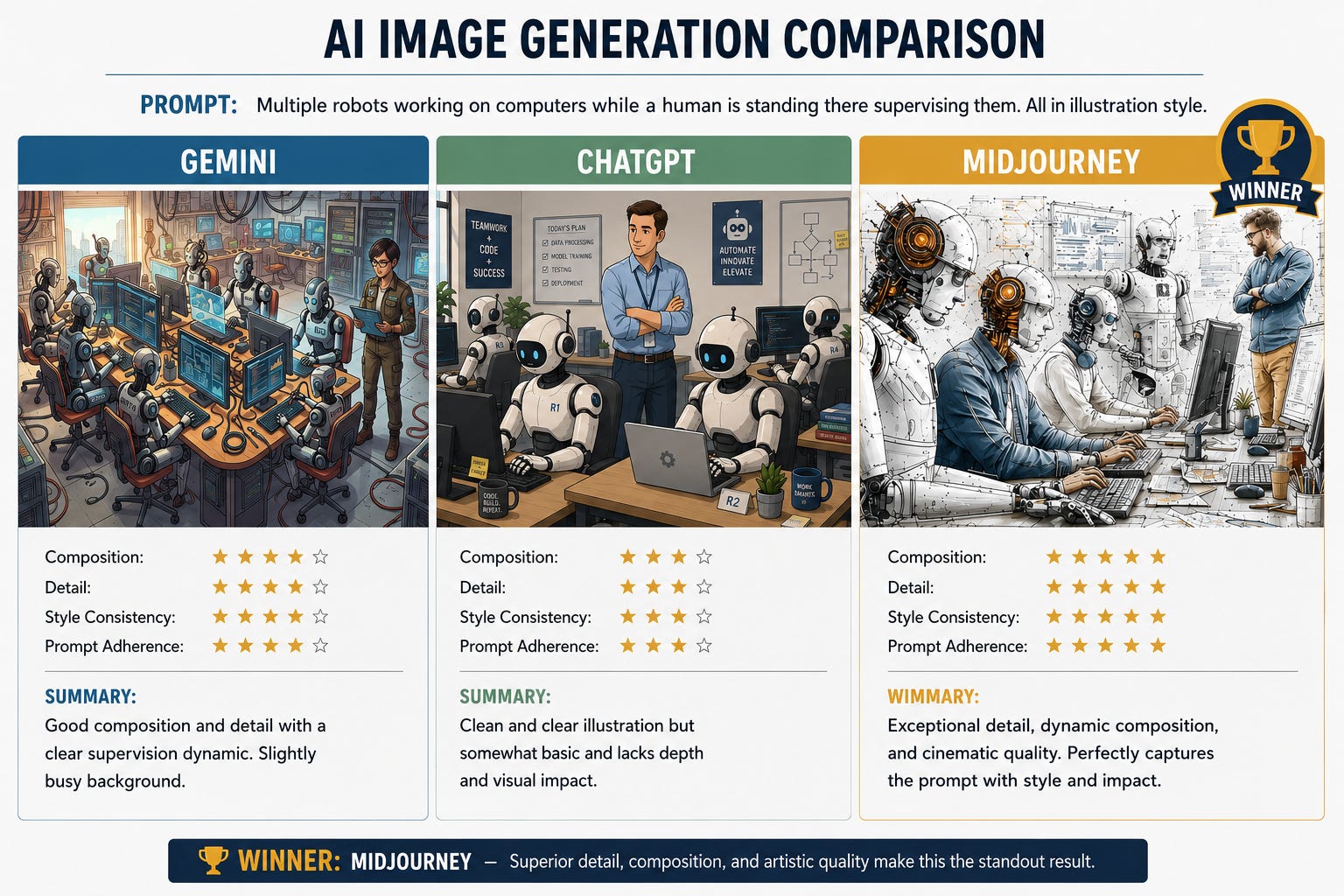
So I ran a test. I pulled up a featured image I needed to make, fed each tool a few examples of my own work and my style guide, and wrote a prompt for the scene I wanted. Then I gave the same setup to Nano Banana, to ChatGPT, and to Midjourney. Three tools, same job, head to head.
Midjourney landed it (it being my style). Every time.
The other two missed. Every time. I adjusted the prompt. I changed the references. I tried the tips and tricks everyone swears by, the exact phrasing, the magic words, the structure that’s supposed to produce the perfect image. Nothing got me the look I was after.
And here’s the part I want to be honest about. I didn’t walk away thinking those tools work differently. I walked away thinking what am I doing wrong.
The doubt that wasn’t really about me
That question sent me looking. Not at the tools. At myself.
I took it to Gemini. I took it to ChatGPT. I even took it to Claude. I described what I was doing and asked, more or less, what’s off here? What am I missing? I was sure there was a setting I’d skipped, a technique I hadn’t learned, some obvious thing everyone else knew that I didn’t.
This wasn’t new, by the way. I’ve been with Midjourney since it lived on Discord. And Discord and my brain did not get along. Not the image-making, the finding. Every image I made disappeared into a chat thread, and I’d lose it. I almost left over that. Then they moved to a browser, and that was the change that kept me. So I’d already been through one round of is it me, or is it the tool and stayed.
Then there’s the prompting itself. Midjourney V7 and V8 are, functionally, two different engines. The way I asked V7 for an image is not the way V8 wants to be asked. I had to relearn it. And the relearning cut against everything I’d been taught about prompting, because Midjourney doesn’t want instructions. It wants you to set a scene. You don’t tell it to do X, Y, Z. You give it creative input and let it interpret.
That’s a hard hump to get over when every other tool has trained you to be precise and literal.
If you read DigiNav Compass Signal, you’ll stop second-guessing your AI and automation decisions because you’ll have a way to tell what actually fits your business from what’s just noise.
The expertise is already yours. You just needed a framework to trust it again.
It was never me
Here’s what the rabbit hole finally turned up.
It’s not me. Midjourney isn’t a worse version of ChatGPT or Nano Banana. It’s a different kind of tool. It works in layers. It’s built for artistic interpretation, not instruction-following. So no matter how perfectly I copied the prompting that worked for everyone else, I was never going to get the same result. I was using a different kind of engine to do a different kind of thing.
The doubt was the wrong question. “What am I doing wrong” assumes there’s a right way I’d failed to find. There wasn’t. There was just a tool that asks for something different than the popular ones do, and a result, on the other side of that difference, that I couldn’t get anywhere else.
The bar I set for myself
This is where the license rule came back to me.
At sixteen, the higher bar was handed to me. My parents set it; I just had to clear it. What I’m doing with Midjourney is the same shape, an extra step everyone around me skips, except now I’m the one holding the bar. Nobody’s making me take the harder path. I’m choosing it.
And I could have not chosen it. I could have settled. I could have taken the popular tool, accepted images that were fine, and told myself the difference didn’t matter. That would have been easier. It would have cost me less time and less relearning.
But I’d be making everyone else’s process. I’d be taking something that works for me, something people recognize, something they see and know is mine, and trading it for a result I don’t actually want, just because the path to it is smoother.
The license rule taught me what that trade costs. The easy version gets you the license. It doesn’t build the thing the harder version builds. My images are distinctive because I stayed on the harder path long enough for them to become mine. That’s not stubbornness. That’s the higher bar doing exactly what a higher bar does.
You don’t have to pick just one tool
Staying with Midjourney does not mean I’ve sworn off the other tools. That’s the part I don’t want misread.
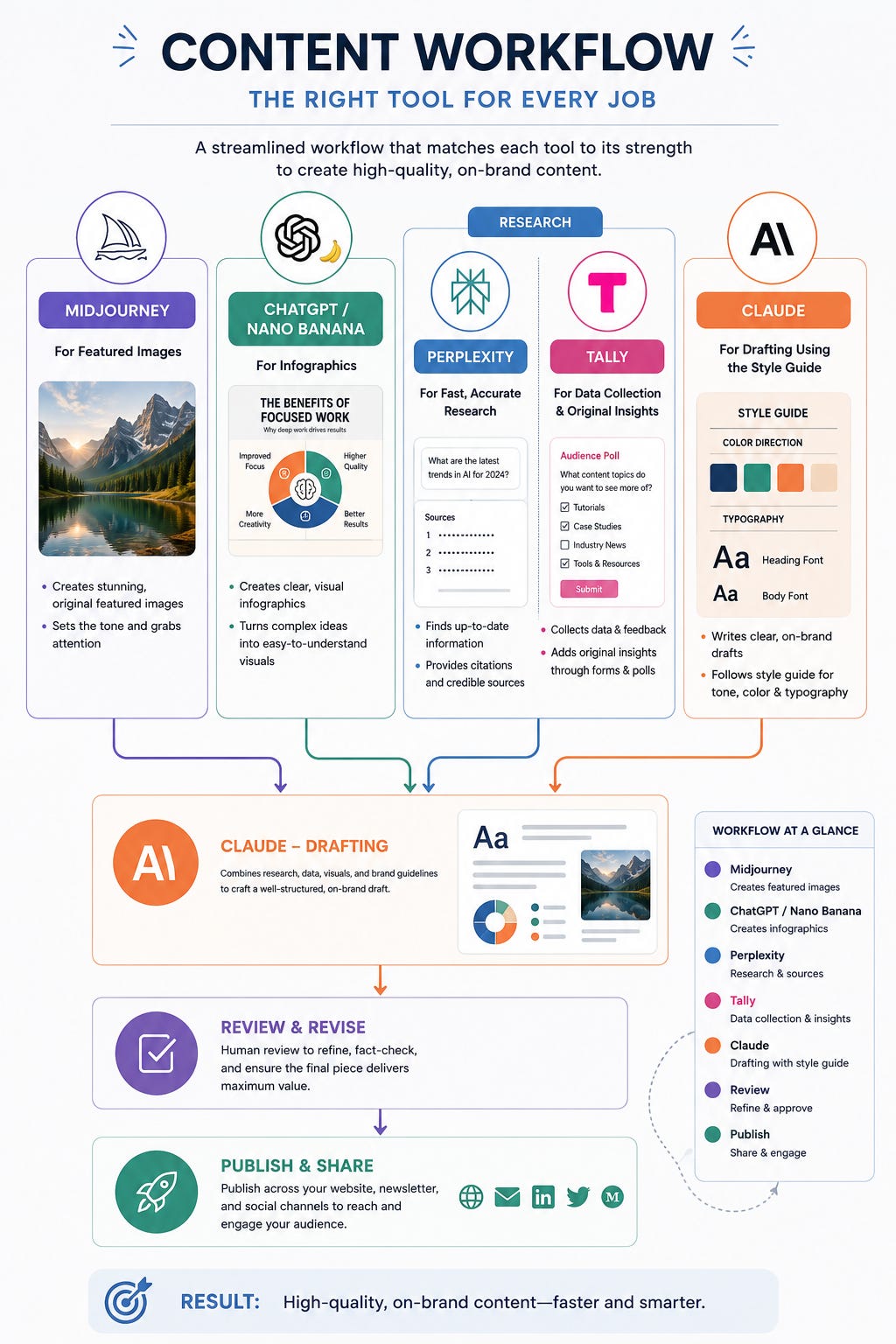
Look at any of my articles. The featured image is Midjourney. But the infographics, the step-by-step visuals, those aren’t, because right now Midjourney can’t handle heavy text the way ChatGPT and Nano Banana can. I use Perplexity and Tally for research. I use Claude to think and draft. I use Midjourney for one kind of image and Chat for another. It’s the same instinct behind coming back to the tool that actually worked after testing the alternatives.
Holding a higher bar doesn’t mean forcing one tool to do everything. It means knowing which result you’re protecting, and being honest about where another tool genuinely does the job better.
The bar isn’t loyalty to a tool. It’s loyalty to the result.
Before you switch
Every time a new tool drops, the comparison articles start, and the question underneath them is always the same: should you switch? It’s easy to let that question turn into doubt about every choice you’ve already made.
So here’s a better one to sit with.
What does your current tool produce that you’d genuinely miss if you switched, and is that thing the result you actually want, or just the result you’re used to?
If the honest answer is nothing, I’d be fine, then switch. The new tool might be the better fit, and there’s no higher bar worth holding for its own sake.
But if there’s something real there, a result that’s yours, that you’d lose, that you worked to build, then the doubt isn’t telling you anything true. It’s just noise from watching everyone else take the smoother path. You already cleared the harder one. That was the point.
If this tension feels familiar, you may want to keep exploring from here.
Related Theme
Built for Someone Else: Building workflows that fit your actual business and energy instead of someone else's blueprint.
Continue the conversation:
You’re Not Falling Behind on AI. You’re in the Wrong Bubble.
Permission to Explore Isn’t Inefficiency — It’s Strategic Curiosity
One thing to sit with:
What are you maintaining because it fits your work, and what are you maintaining because you built it?
Thinking Through Something?
If you're sitting with a decision, workflow, tool stack, or AI process that technically works but doesn't feel quite right, I offer limited advisory sessions for solo business owners trying to sort through the noise without adding more complexity.
A topic after my own heart! I resonate with so much in here and have had the same experience using Midjourney vs. ChatGPT vs. Nano Banana. I use them all at different points in my process (and sometimes wish I could just stick to one). Midjourney is usually in the brainstorming phase for me because I love its unexpected results sometimes :) But you’re so right about being loyal to the result, not the tool.
PS – I love the style you landed on with Midjourney for your substack. I remember that discord phase and it hurt my brain too! So glad they offer the browser version now