


This year’s winter jaunt was laid-back St. Augustine, Florida. Getting there and back meant two days in the car — the perfect stretch for catching up on work, reading, and whatever sparks come from hours of uninterrupted road time.
After my turn to drive, I decided to get an article or two into the pipeline. Except the work couldn’t be tackled on my iPad. Pulling out the laptop isn’t usually a big deal, but the computer bag was wedged in the back of the car and getting to it required some gymnastics I wasn’t in the mood for.
That’s where the rubber hit the road on my fancy Cursor content creation process.
The rubber being Cursor. The road being this: every conversation felt like starting from scratch. I was re-explaining myself every time. The context that makes working with Claude feel like working with someone who actually knows me — the memories, the context docs, the way I’ve built up how I operate over dozens of sessions — none of that was there. So while the AI agent was doing its job — technically — I was starting from scratch. Again.
That’s when it hit me: your AI workflow is only as good as what your AI actually knows about you.

Moving from Cursor back to ClaudeAI
The decision to move the full content pipeline out of Cursor had already been made — that part was clear. But mid-migration, something stopped me. The experiment docs were being glossed over and they’re the foundation of every article I write. Get that wrong and everything downstream is shakier than it needs to be.
So before anything else, I dealt with that first.
I had nine experiment files sitting in Cursor as markdown docs. I uploaded them all to Claude, and we assessed the existing Notion database together — what to keep, what to cut, what was missing entirely.
Claude fixed the schema.
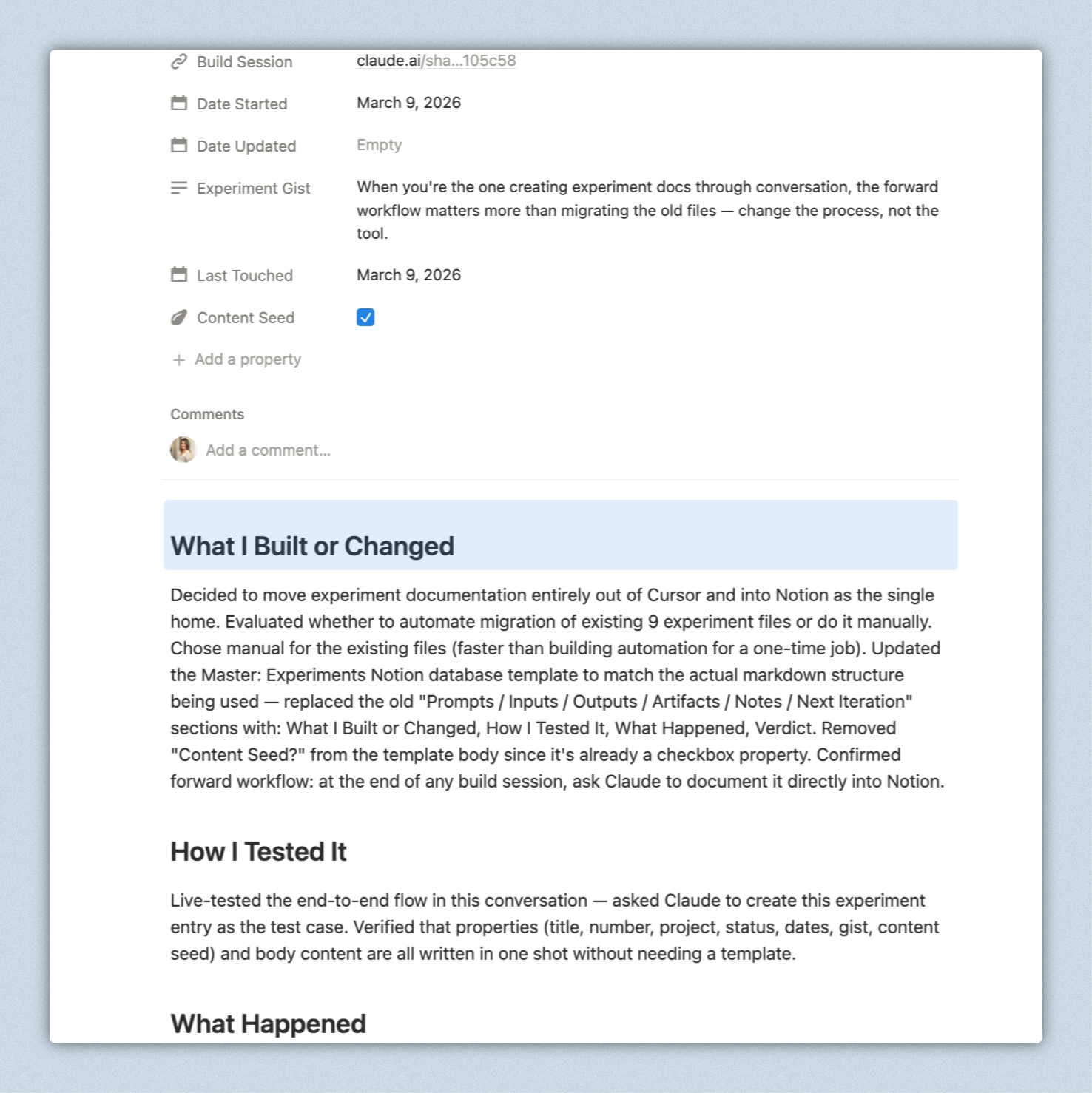
The old template sections — Prompts, Inputs, Outputs, Artifacts, Notes, Next Iteration — got replaced with the structure that actually matched how I work: What I Built or Changed, How I Tested It, What Happened, Verdict.
Then the MCP applied all the existing records into the updated database. That’s where it got interesting. The first test run overwrote records instead of updating them. We fixed it and retested. Four rounds before it landed cleanly.
Once the existing data was solid, I added the forward workflow: at the end of any build session, ask Claude to document it directly into Notion. I live-tested this in the same conversation — one API call, all properties and body content written correctly in one shot.
The improvement I didn’t see coming: documenting the build directly through the conversation removes more friction than any tool switch ever could.
The breaking points, or not.
Nothing broke in the technical sense. Which is almost the point.
The friction in Cursor wasn’t loud. It didn’t throw errors or fail visibly. It just quietly required more from me than I realized — more re-explanation, more re-context, more process around the edges. The kind of thing you stop noticing because you’ve adapted around it.
What I didn’t expect was how much I relied on the build notes — the Experiment doc — as the actual foundation of each article. It adds the context, the actual conversation threads from AI and sometimes screenshots.
It was a structural piece that wasn’t getting its due. Cursor’s AI agent didn’t have access to the relationship Claude has built or the conversation memory. That’s not a Cursor problem — it’s just a fundamentally different thing.
Because sometimes broken isn’t when things don’t work, it’s when things are overlooked.
And if I’m honest, I’d been chasing a shinier setup instead of trusting the process I’d already built. The tools that had context — Claude, Notion — were right there. I just had a layer in the middle that didn’t.
If I had to do it again.
Trust the process you already built. Notion had been functioning as my persistent memory all along — storing context, tracking experiments, holding the thread between sessions. Claude had been the thinking partner. Those weren’t gaps to fill with a new tool. They were the foundation worth building deeper into.
I’d stacked a layer on top instead of doubling down on what was working. The switch didn’t require a complicated migration plan. It required recognizing that the combination I was working around was already solving the problem I needed solved.
New and shiny has a cost that’s easy to miss: it starts with zero context. And zero context means starting from scratch. Every time.
Decision one in the bag.
Kill Cursor for content creation. The decision wasn’t about features or capability — it was about context. Notion for persistent memory. Claude for thinking partner and automation. That’s the combination that already knew how I worked.
Cursor wasn’t a bad tool. It was the right tool for a moment that’s passed. The smarter move wasn’t finding something newer. It was recognizing what was already working and doubling down on it.
Notion remembers. Claude thinks and connects. That’s the pairing worth building on.
One more thing worth naming: things move fast in the AI space. What feels like a gap today may not be the stumbling block tomorrow. That’s not a reason to wait — it’s a reason to make decisions based on what’s working now, not what you’re hoping a new tool will eventually solve.
This is Part 1 of a short series on rebuilding the content workflow from the ground up. Getting the experiment documentation right — the soul of every article — was the foundation.
Next up: how the Article CEO workflow sits on top of it, and how the full pipeline runs from first spark to published piece.
One Thing You Can Try Today
Take five minutes and run this prompt against your current workflow:
“I use [tool/s] to do [specific job]. Given what I know about [the other tools I use daily], is this still the right fit — or am I working around it without realizing it?”
You’re not looking for a reason to switch anything. You’re just looking with fresh eyes. The answer might be: this still fits perfectly. That’s a useful thing to confirm too.
You do a better job of me documenting what you do! I think because I am experimenting a lot, but my Claude Projects are pretty cool. I've built a couple apps on Google AI Studio as well. Most of those are in the dev section, I actually launched one of them. We are living in an OS world now, what is your operating system? Good conversation Lee!