

Growing up, we were taught to respect our elders and listen to people in authority. I had my favorites. One of them was the flamboyant neighbor a few houses down — the one usually doing something that made the other adults roll their eyes.
It’s not that I wanted to pick up her habits or her quirks. At the time I definitely didn’t want to raise five boys and three dogs. Okay, maybe the dogs. And the smoking and being put together 24/7 didn’t fit with the tomboy me.
But her confidence was something. And the way she handled the side-eye and the criticism — that was inspiring. I learned a lot from her.
Most likely it was due to the filters I had unknowingly developed. You know that gut reaction that tells you when something is off or not quite the right fit.
✳︎ ✳︎ ✳︎
You already know how to do this
Even all these years later, we still do this. Every day, with people and ideas and advice, we’re sorting what fits from what doesn’t.
But somewhere along the way it got harder to hear. The internet filled up with people who sound certain. The feeds, the newsletters, the courses, the YouTubers — everyone with a framework, everyone with a recommendation, everyone two steps ahead of where you are.
And it started to feel like a tool problem. Or an AI problem. Or a problem with not knowing enough yet.
It’s none of those. It’s a filtering problem.
Hi, I'm Lee. I help solo business owners get clear on AI and automation decisions before they commit — no hype, no hustle, no borrowed playbooks.
New here? Find the room that fits → No Foundation Yet → Lost In Translation → Built For Someone Else → The Last Mile
✳︎ ✳︎ ✳︎
Why it’s so hard right now
Part of what makes this moment tricky is that almost no one is actually an expert yet.
AI is new enough that real expertise is rare. But you wouldn’t know it from the feeds. Everyone has positioned themselves as the person who figured it out. And when everyone sounds like an authority, the usual signals you’d use to sort them — credentials, confidence, follower counts — stop telling you much.
Then there’s the advice that’s just old. Techniques that made sense a year ago and don’t anymore. “Start every prompt by telling it to act as your role.” “Begin with the perfect prompt.” Some of it was never necessary, and as the tools evolve, more of it falls away. But it keeps getting repeated, because it once worked, and repetition sounds like authority too.
And the hardest one: plenty of brilliant people are sharing genuinely good work that still has nothing to do with your business. They’re not wrong. They’re just not building what you’re building.
That’s the part that catches you. Not the bad advice — you can spot that. It’s the good advice meant for someone else.
✳︎ ✳︎ ✳︎
Valuable is not the same as useful
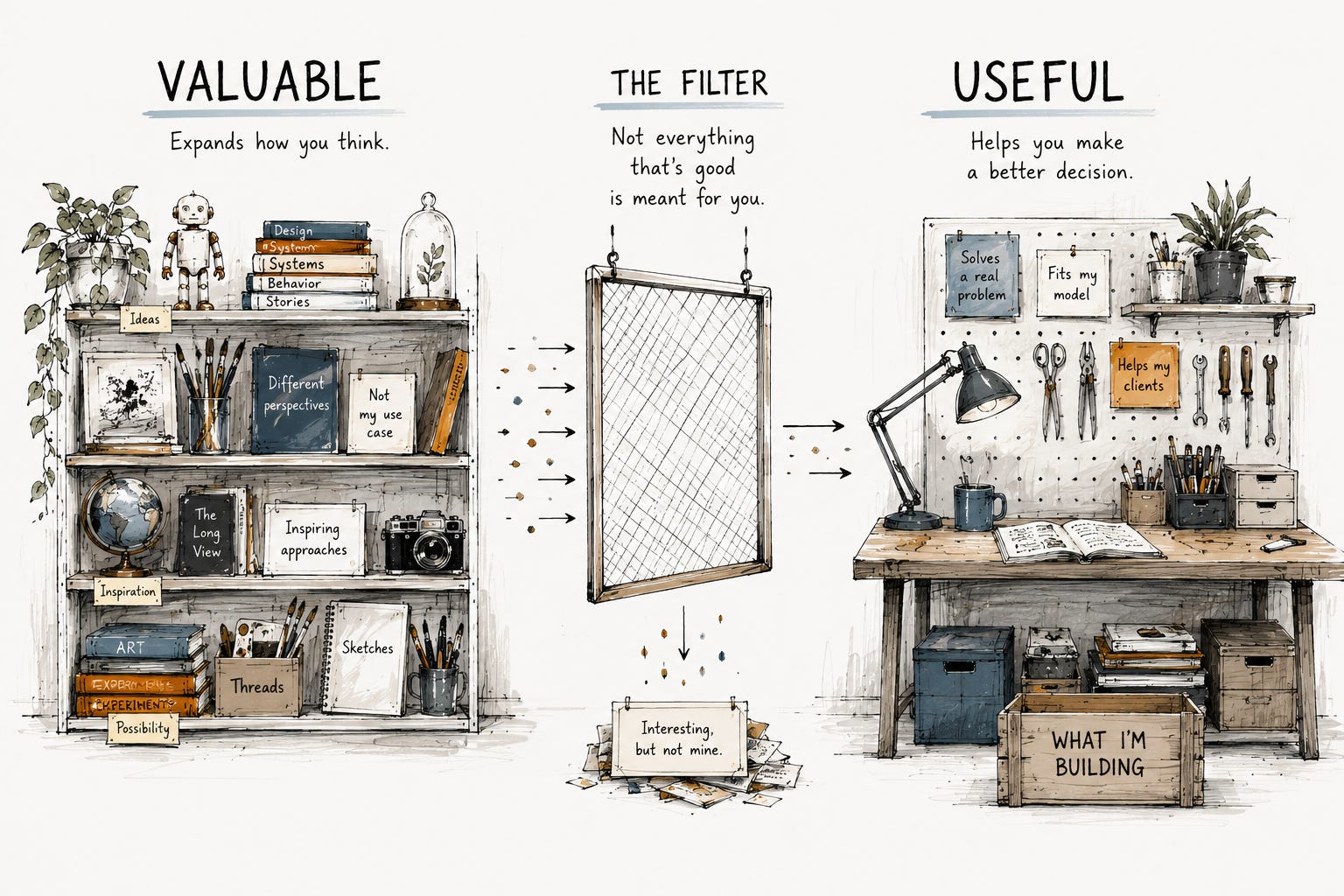
So how do you sort the good advice meant for someone else from the good advice meant for you?
Not by deciding who’s worth following. By noticing the difference between valuable and useful.
Someone can be valuable. They expand how you think. They show you something you hadn’t considered. Alyssa Fu Ward, PhD is this for me — much of what she shares isn’t built for my business, but the way she works changes how I see a situation.
Take her Open Door project, where a group each builds a piece of one collective space. Or the way she distills insights from others using AI and art. None of it is my use case. All of it shifts how I think about what’s possible.
That’s valuable. Valuable isn’t the same as useful.
Useful is when someone’s work consistently helps you make a better decision. This is also why the template habit can quietly work against you — borrowed structure that fit someone else’s process, not yours. Mia at ROBOTS ATE MY HOMEWORK is useful to me because she shares the thinking and the process, not just the finished build. I can take how she works through something and adapt it to my own business.
The value is in the method, not the output.
And then there’s the source you keep, even knowing most of it isn’t for you. Stu Jordan has been my AI go-to for years. He pushes the limits, further than I have any reason to go, because I’m not building what he’s building. I didn’t stop following him. I built a filter for him, a sense of what to actually act on and what to admire from a distance.
That filter is the whole thing. Not picking the right people. Knowing what to do with the ones you’ve got.
A few questions that do the work
Once you start filtering on purpose, a few questions do most of the work.
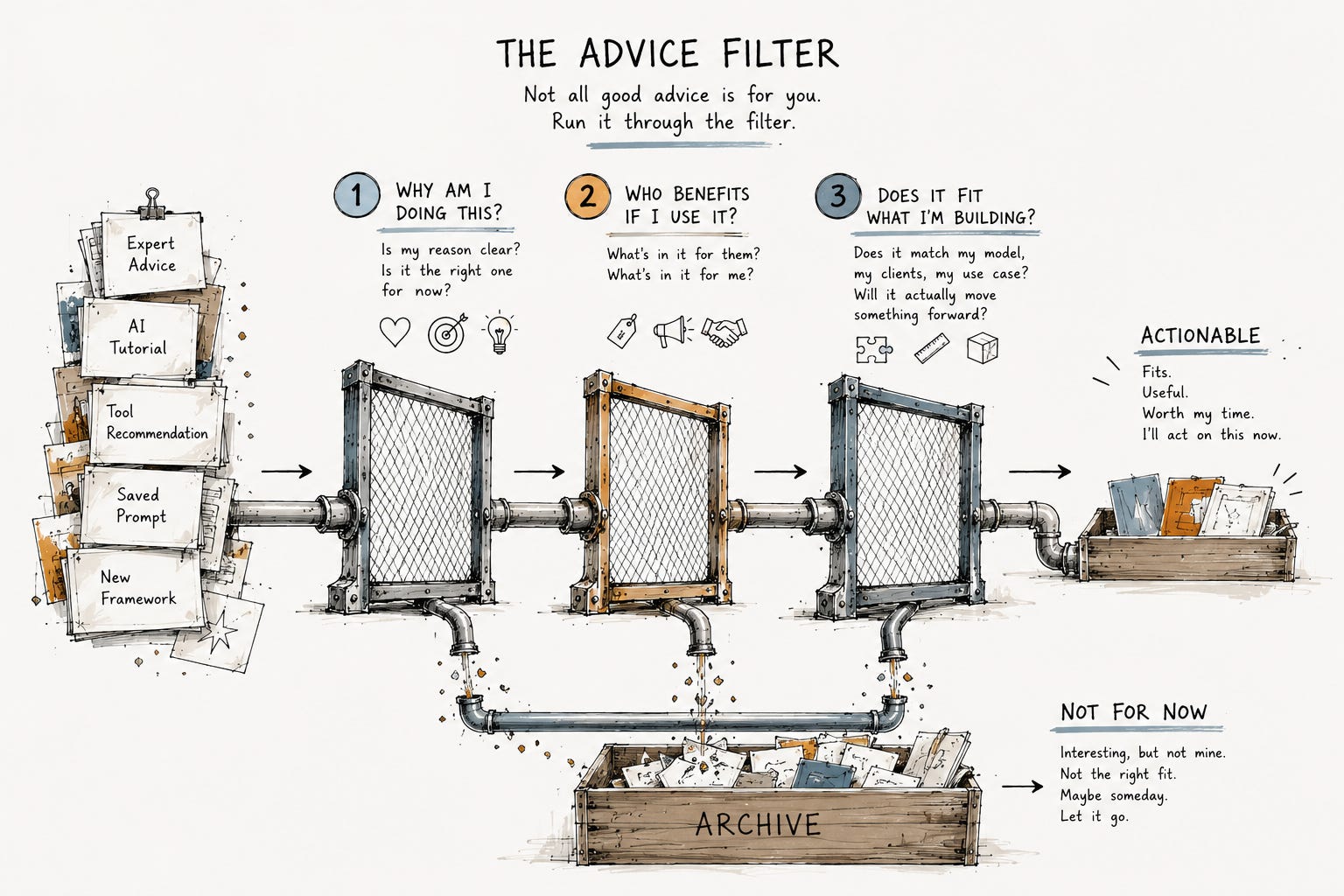
The first one I ask before building anything: why am I building this? Is it because it’s cool and I want to play with it? Because it actually moves something forward? Or because I want to learn the technique? All three are fine answers. The trouble is when you don’t know which one you’re in — that’s how “cool” quietly costs you a week.
The second is about who’s doing the recommending. When someone tells you a tool is the latest and greatest, it’s worth asking what’s in it for them. A lot of the time there’s an affiliate commission attached, or they’re building an offer around it. That doesn’t make them dishonest. It means the recommendation has a second job, and you should know that before you adopt it.
And the third is the one that stings a little. If you’re saving something for someday — a tool, a thread, a technique — but you’re not doing anything with it, is the save even worth it? By the time you come back, it may be outdated. The pile isn’t progress. It just feels like it. (I’ve written before about how saving outpaces doing — the gap between learning and acting.)
None of this means stop following people who are nothing like you. I do it constantly. It means take what they’re doing and bend it to your situation — your model, your clients, your use case. The signal that you’ve crossed a line: when their work makes you doubt yourself, or change course for no reason you can name. That’s not learning anymore. That’s drift.
✳︎ ✳︎ ✳︎
The prompt graveyard
I have a folder full of prompts I’ll probably never use. It’s the new version of the swipe file graveyard — collecting that feels like progress and isn’t.
I collected them the way everyone did. Prompt engineering was the thing, and we all became collectors — saving, screenshotting, copying every clever prompt we came across, sure that somewhere in the pile was the magic one that would unlock it all. I have prompts in there I never once tried. Others I saved are for a version of these tools that doesn’t really exist anymore. Old asks for an old moment.
That folder is what no filter looks like.
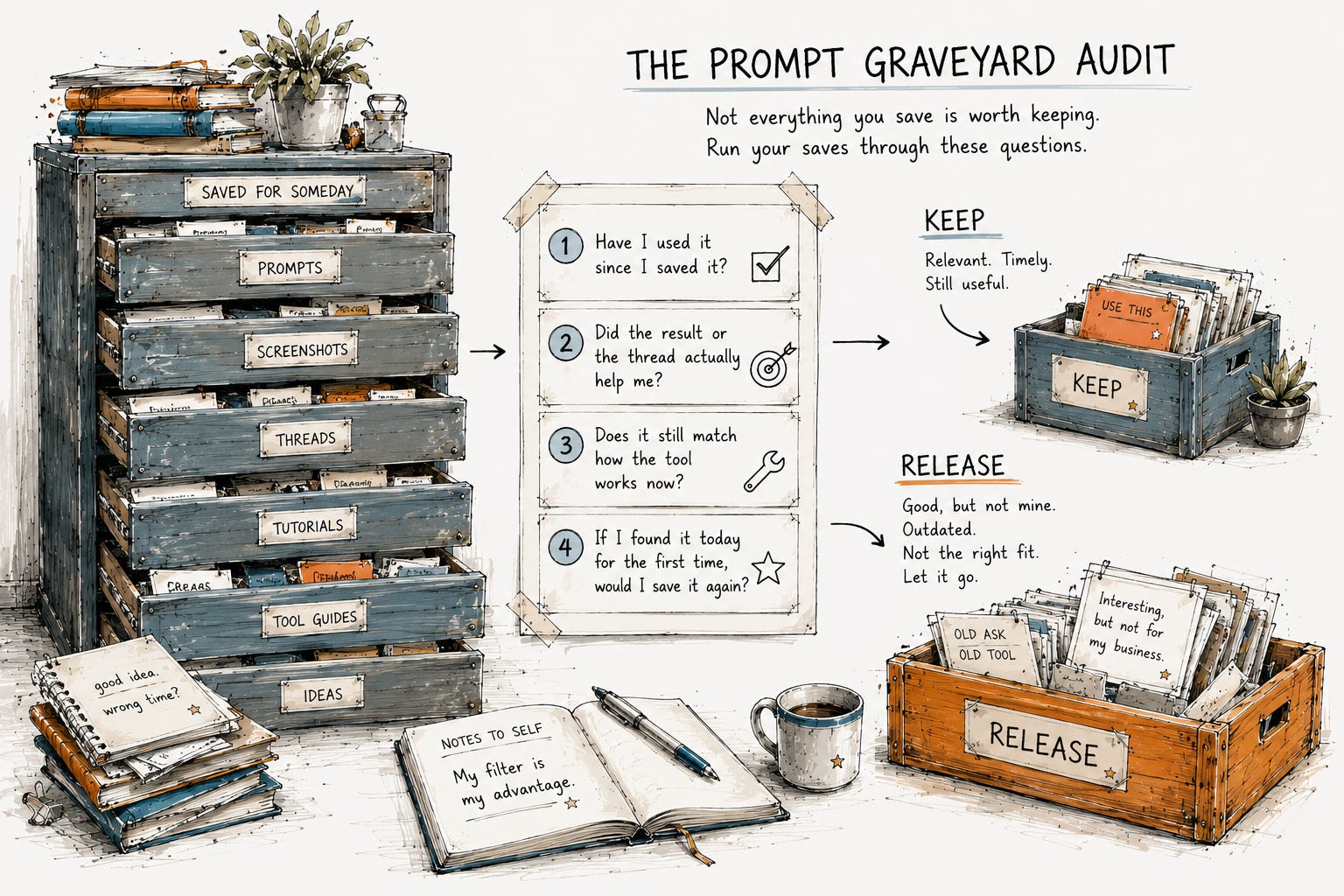
Not a character flaw — just what happens when you let everything in because it might be useful someday, and never run it through the gut check of is this mine.
So that’s the decision, and it’s a quieter one than it sounds. Keep following Alyssa, Mia, Stu, and the people who make you think. Keep learning from people who build nothing like you. But put it through the filter on the way in, not into a folder for later. Decide what’s yours and act on it now. Then put the rest aside — not because it isn’t good, but because good was never the question.
If you want to see your own filter at work, go look at the prompts you’ve saved:
Have you moved on them since you saved them?
Did you note whether the result or the thread was actually useful?
Does it still match how the tool works now, or is it an old ask for a moment that’s passed?
If you found it today for the first time, would you save it again?
✳︎ ✳︎ ✳︎
Back to the neighbor
I think about that neighbor sometimes. She never asked anyone’s permission to be exactly who she was, and she never tried to be anyone else either.
You have a version of her too. Someone you watched, somewhere, and knew without deciding it: that part is mine, that part isn’t. You didn’t study them. You didn’t save them to a folder. You just took what fit, and moved on from the rest.
That instinct is still in there. It’s the same one you’re trying to use on every expert, every tool, every thread you’ve saved for someday. You’re not missing a skill. You’re trying to remember one you’ve had since you were a kid, watching someone three houses down be entirely themselves.
✳︎ ✳︎ ✳︎
Thinking Through Something?
If you’re sitting with a decision, workflow, tool stack, or AI process that technically works but doesn’t feel quite right, I offer limited advisory sessions for solo business owners trying to sort through the noise without adding more complexity.
I love this, Lee! And thank you for shoutout! The AI space is so noisy that the best signal to pay attention to is the one inside you. It’s not about whether the content is useful or valuable in general, it’s about whether it’s useful or valuable to you, who you are in this moment, what is important to you.
This is such a good reminder to let the noise be the noise and focus on (filter to!) what matters most to you.
"Valuable isn't the same as useful" is going to live in my head rent-free.
This is the exact thing I keep bumping into... I follow people building nothing like what I'm building, and the trap is never the bad advice; it's the genuinely good advice that just isn't mine. The "good advice meant for someone else" line nailed it.
The prompt graveyard hit a little too close, too. 😉
I've got the folder. We all do. What clicked for me reading this is that the filter is the whole skill ... not picking the right people, but knowing what to actually do with the ones you've got. Saving the rest for later was never the same as deciding it's yours.
Great piece, my friend!