

I’ve been trying to track my work for almost two decades.
Paper. Pencil. Spreadsheets. Atomic Habits. Notion databases that took me a full weekend to build. Productivity systems borrowed from people whose businesses looked nothing like mine. Every few years a new tool, a new framework, a new promise that this would be the one that finally stuck.
None of them did.
When AI showed up, I thought maybe this was different. I started building what everybody else was building, a chief of staff dashboard modeled on someone else’s flow. I was a few hours in when I caught myself telling Claude, for the third or fourth time, this is not a productivity system.
Claude called me out.
I was piecemealing every impressive build I’d seen on Substack and YouTube and stitching them into exactly the thing I said I didn’t want. A productivity system. A nicer-looking version of every system that hadn’t worked for me before.
So I stopped.
I closed the tabs. I stepped away from the dashboard. And I sat with the question I’d been avoiding for eighteen years: why has none of this ever worked for me?
I wasn’t failing the systems. The systems were built for someone who wasn’t me.

The list wasn’t built for me
The list I’d been chasing wasn’t built for me.
Time blocking. Theme days. Morning routines optimized down to the fifteen-minute increment. Frameworks designed for people who ship the same kind of work every day, content creators, vibe coders, anyone whose output looks roughly the same on Tuesday as it does on Friday.
My work doesn’t look like that. It never has.
Some days I disappear into an experiment for six hours. Some days are quick. Answering clients, clearing the inbox, moving small things forward. Some days my brain wants to think and refuses to do anything else. Some days I need to be outside before I can sit down at all.
But every productivity system I tried assumed I’d show up the same way every morning. So I kept trying to become that person. I’d follow the routine for two weeks, and then something would shift, a rough night, a heavy stretch of client work, a week where I needed to think more than do, and the system would collapse.
Then I’d blame myself. Start over. Try again.
The piece I missed for years: I wasn’t failing the systems. The systems were built for someone who wasn’t me.
The AI version of this is louder. Automate this. Schedule that. Hand off the things that waste your time. The list got longer and the assumption stayed the same. Your day is a stack of repeatable tasks waiting to be optimized. What you need is more output, faster.
I kept trying to map myself onto it anyway. Because that’s what trying every system teaches you to do. You assume the next one will work if you just follow it correctly.
Why productivity systems don’t work for me (and maybe you)
I went back to the question I’d been avoiding: why has none of this ever worked for me?
The answer wasn’t you haven’t found the right system.
The answer was you’ve been asking the wrong question every time you sit down.
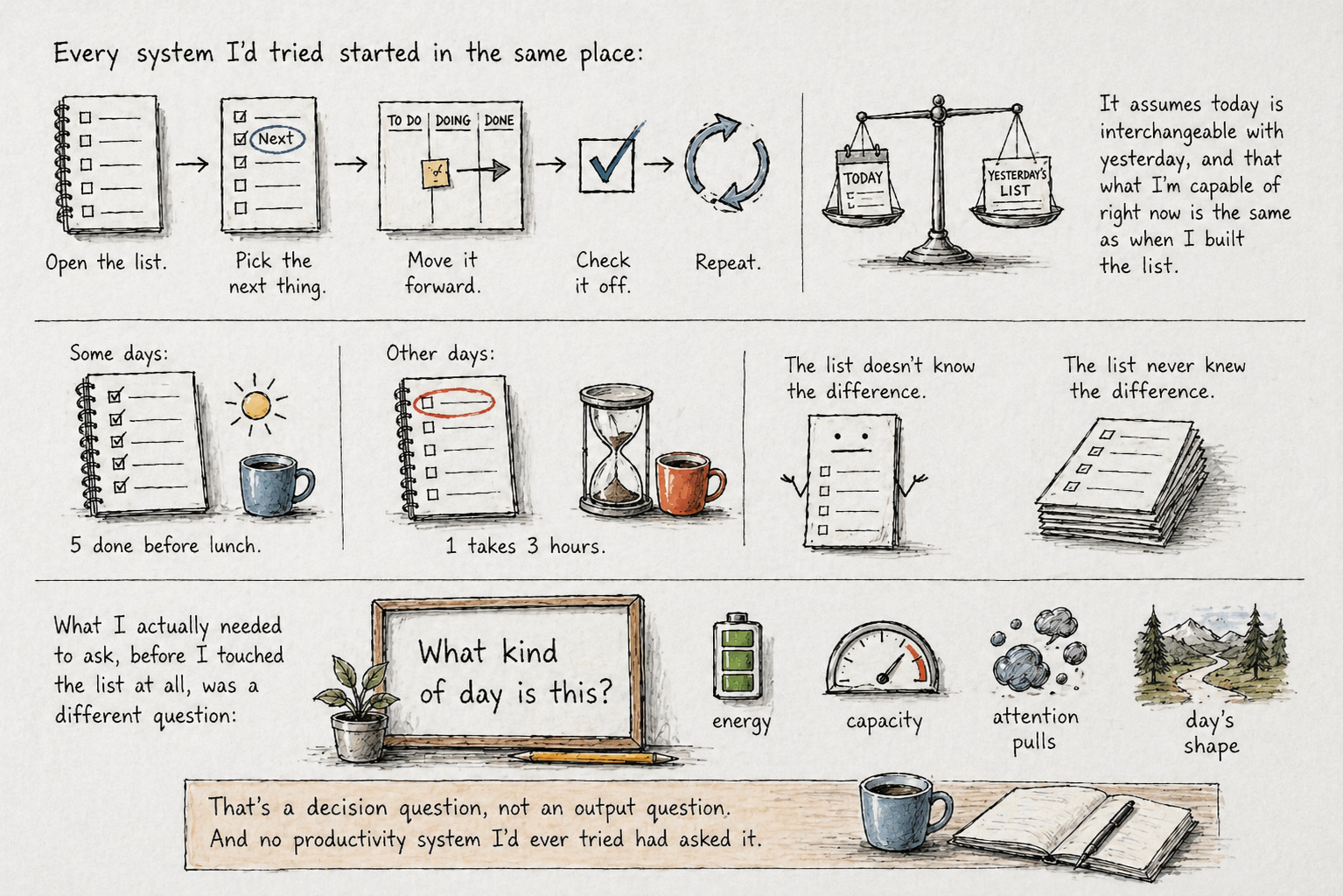
Every system I’d tried started in the same place: what do I need to get done today? Open the list. Pick the next thing. Move it forward. Check it off. Repeat.
The question sounds productive. It feels productive. But it assumes something that isn’t true. That today is interchangeable with yesterday, and that what I’m capable of right now is the same as what I was capable of when I built the list.
Some days I sit down with a list of seven things and I’m clearheaded enough to move through five of them before lunch. Other days I sit down with the same list and the first item takes me three hours because my brain is somewhere else and I won’t admit it.
The list doesn’t know the difference. The list never knew the difference.
What I actually needed to ask, before I touched the list at all, was a different question:
What kind of day is this?
Not what’s on the calendar. Not what’s overdue. What’s the shape of the day in front of me. What’s my energy, what’s my capacity, what’s pulling at my attention before I’ve even started.
That’s a decision question, not an output question. And no productivity system I’d ever tried had asked it.
Building a decision system instead of a productivity system
So I started building something different.
Not a productivity system. A decision system. Something that started with the question I’d been skipping, what kind of day is this, before it asked me anything about what to do.
I called it the Daily Pulse.
The first thing it asks isn’t what’s on the list. It’s an inner check. How am I feeling. What’s my energy. Did I sleep. What’s already pulling at my attention before I’ve sat down. Then it asks what’s on the calendar. What commitments are non-negotiable today, what’s flexible, what could move if the day calls for it.
Only then does it look at the work.
The order matters. Because if you ask the work first, the work always wins. Every list I’d ever built worked that way. Open the list. Pick the next thing. Don’t think about whether you have it in you to do that thing, just do it. By the end of the day, half the items would be checked off and I’d feel like I’d been hit by a truck and not be able to tell you why.
The Daily Pulse reads the day before it touches the work.
That’s the part AI can’t do for me. Claude can build the dashboard. Claude can pull from my calendar, my notes, my Notion databases. Claude can do almost every part of this faster than I can. But Claude cannot tell me what kind of day I’m having. Only I can answer that. And until that question is answered, every other question downstream of it is the wrong question.
That was the reframe.
Use AI for the work you can outsource. Don’t outsource the read.
Five flags, not a grid
The Daily Pulse needed a way to know what was getting starved.
Not a productivity grid. Not a list of tasks sorted by priority. A way to see, across a week, where I was pouring everything in and where I’d gone quiet. Because I already knew what happened when I didn’t watch for that. I’d disappear into a stretch of heavy client work and come up three weeks later having not read a book, not gone outside, not talked to anyone outside of a deliverable thread.
So I gave it five categories.
Build, Think, Learn, Grow, Live.
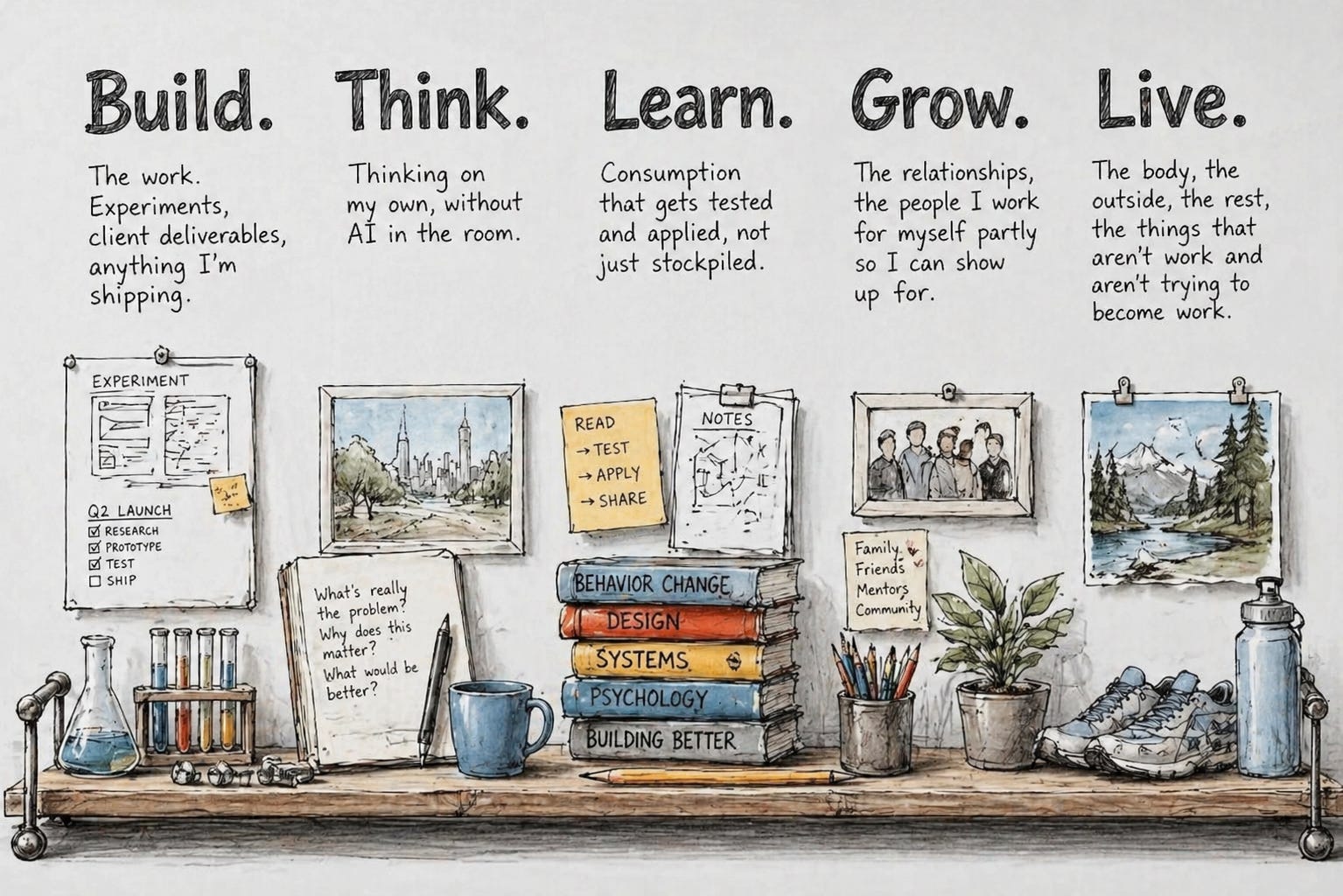
Build is the work. Experiments, client deliverables, anything I’m shipping. Think is thinking on my own, without AI in the room. Learn is consumption that gets tested and applied, not just stockpiled. Grow is the relationships, the people I work for myself partly so I can show up for. Live is the body, the outside, the rest, the things that aren’t work and aren’t trying to become work.
The categories aren’t a schedule. They’re flags.
If a week is heavy in Build and Learn and Grow has gone untouched, the system says so. Not here’s what to do about it. Just, hey, you haven’t touched this in five days, are you good with that? Sometimes the answer is yes. Sometimes the answer is no, that’s why I feel like garbage and don’t know why.
That distinction was the whole point. I didn’t want a system that picked my work for me. I wanted a system that called me out when I was about to repeat a pattern I already know costs me.
That’s the part most productivity systems get backwards. They optimize for what you do. The Daily Pulse optimizes for what you’d otherwise miss.
If you want to test what this feels like before you build anything, here’s a prompt you can paste into Claude or ChatGPT to try it once:
I want you to help me read my day before I plan it. Ask me four questions, one at a time, waiting for my answer before moving on:
1. How am I feeling today, physically, mentally, emotionally?
2. What's already on my calendar that I can't move?
3. What's pulling at my attention before I've even started?
4. Looking at the work I could do today, which of it actually matches the day I just described?
Don't suggest a schedule. Don't optimize anything. Just help me see the day clearly before I decide what to do with it.
Run it once. See if the answer to question four surprises you.
If it does, you’ve already learned the thing the Daily Pulse took me weeks to figure out: the read comes before the plan, every time.
Just because you can build it
I spent eighteen years trying to find the system that would finally work for me.
What I needed wasn’t a better system. It was a better question.
The Daily Pulse isn’t the point of this article. It works for me because it was built around the way I read a day, the categories that keep my week balanced, the inner check that matches my energy patterns. If you copied it move for move, it would feel like wearing somebody else’s shoes.
But the question I had to ask before I could build it, that one’s worth borrowing.
Every list you’re staring at right now, the AI playbook, the productivity stack, the chief of staff dashboard, the framework that promises to finally get you organized, every one of those was built by someone else for the way they work. That’s not a flaw. That’s just what it is.
The question isn’t whether you can build it. You probably can. AI has made it easier than ever to clone someone else’s system in an afternoon.
The question is the one I should have asked a long time ago:
Just because you can build it, does it apply to you?
Sit with that for five minutes before you build the next thing. Before you automate the next task. Before you copy the next dashboard from a tutorial.
If the answer is no, you’ve just saved yourself another two weeks of trying to fit into someone else’s shape.
If the answer is yes, build it. But build it from your own questions, not theirs.
If you’re stuck between I should be doing more with AI and I don’t know what’s mine to build, that’s the gap I help close. Book a call and we’ll get clear on what’s worth building for you specifically, and what’s just somebody else’s good idea.
Ooooh fun animations!
I love this Lee. I've recently built a task management system in Claude for myself and it's the first one that's actually working for me. It doesn't do what yours does and it is a little bit more traditional but because I actually am in Claude every day that I'm working on code like a girl, it works for me. All the other times I tried different to-do systems, I'd have to go to that specific to-do system and it didn't work for me so email became the place that I stored stuff. And in my head and for me, getting some of it out of my head and setting a reminder that Claude will remind me while I'm in the place that I'm already working has worked well. but the nice thing about AI and Claude is that you can tailor it exactly how you need without a lot of effort and that's what I've been doing. I see that's what you're doing and that's really cool.