

Right now, every corner of the internet is telling you to add AI agents to your business. Automate this. Delegate that. Build a system that runs while you sleep. And if you’re a solo business owner trying to figure out what AI automation actually means for you — not for a team with engineers, for you — the noise is deafening.
Chances are you’ve already tried at least one tool that promised to make your life easier — and quietly abandoned it three weeks later. You’re not alone. Over half of small business owners are experimenting with AI but never committing. And 82% of the smallest businesses say AI simply “isn’t applicable” to them.
That’s not a technology problem. That’s a translation problem. And that’s what this is about.

I went to Vo-Tech in high school mostly because I wanted a hands-on learning experience. Cooking was where everything clicked — not just the process of making food, but the chemistry behind it. The measuring. The way combining the right ingredients in the right order creates something that didn’t exist five minutes ago. Sometimes it was really tasty. Sometimes it bombed epically. Either way, I understood what happened and why.
The plan was culinary institute after graduation. James Beard. The full professional kitchen. I wasn’t just dreaming — I was training.
Then came the blind taste test. Mandatory for admission, no way around it — and they couldn’t guarantee there’d be no seafood in it. With my allergy, that took me completely out of the game. Not a maybe. Not a workaround. Just like that, the award-winning culinary path was off the table.

But that path closing didn’t mean it was the end of my love for cooking.
This was the recalibration moment. A moment of — okay, this door is shut, so where do I go now? The Culinary Institute was the plan. James Beard and the awards were the destination. And neither of those was happening now.
It stings when you’ve been working toward something specific.
But what I knew I wasn’t going to do was decide that cooking was broken for me — or that I’d wasted my time training for something that didn’t pan out. Those skills were still there. The love of it was still there. I just had to figure out what cooking actually looked like without a classically trained chef in a restaurant at the end of the road.
Long story short, I never stopped cooking.
The classically trained path closed, but cooking stayed open. I still cook for friends, family, my husband, different events. Sometimes small meals, sometimes big ones. Sometimes I just open the fridge, look at what’s in there, and make something cohesive out of it.
And nobody has ever looked at a meal I made and said, “Whoa, I can’t believe you never went to culinary school.”
Because the goal was never about the restaurant or the awards. When I create a meal, it allows me to be part of the experience. That was always the point.
So I just had to figure out which version of cooking actually fit into my life.
AI automation works the same way.
Right now, every piece of content out there is pointing you toward the restaurant — full automation, removing yourself from the process. It’s all about building agents and sub-agents, AI-scheduled tasks, letting AI run while you sleep. Let AI do the work so you can scale, grow, and be everywhere at once.
But that’s not what you actually need for your business. Because as a creative and as a solo entrepreneur, you need to be part of the process — not completely removed from it or paralyzed by it.
This is the part that’s real, and one of the things nobody is talking about.
There are different levels of AI involvement, and the level that fits your business should come from your actual needs, your processes, and honestly, how much of yourself you want to keep in the work. Not from whatever framework someone built to showcase their expertise or sell you a tool.
Some people will want to run the restaurant with a full staff. Others just want to cook a cohesive dinner with what they have in their refrigerator. Those are different goals, and neither one is wrong.
So let’s break it down into the simplest terms first.
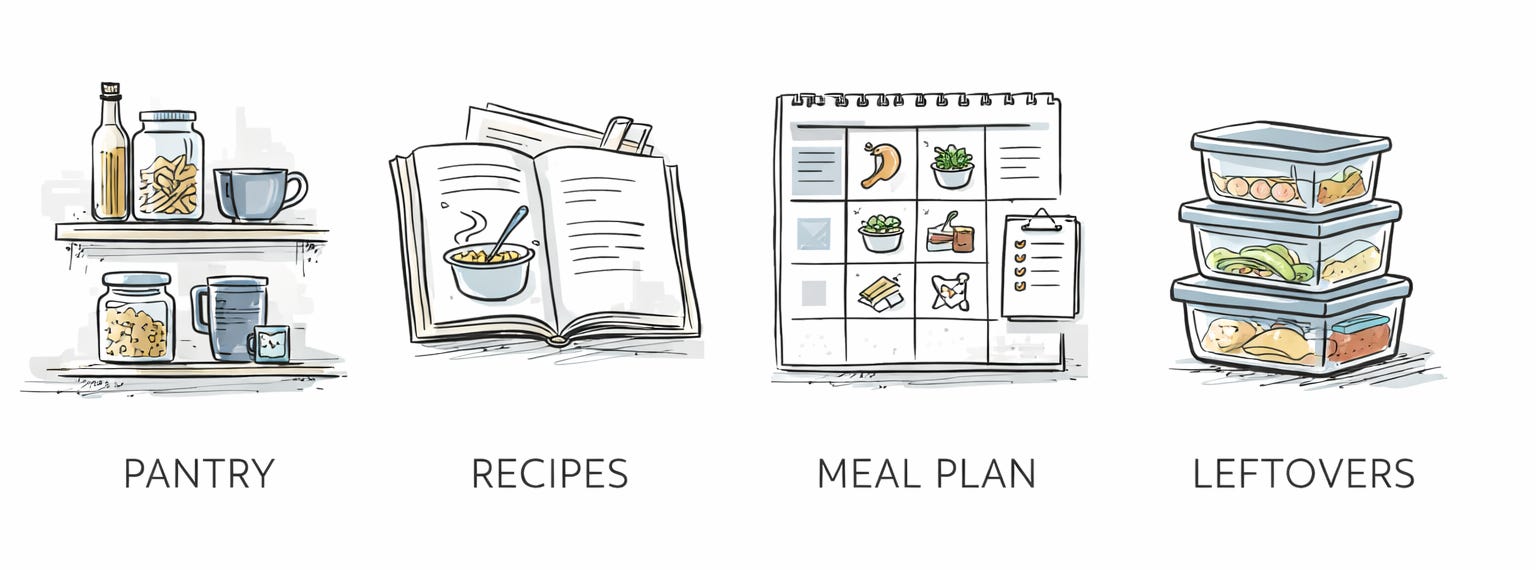
The Pantry — What’s Already on Your Shelf
Step one of AI automation for solo business owners: know what you have before you buy anything else.
In the AI world, this is your stack. The tools you’re already paying for or using for free — ChatGPT, Claude, Gemini, Perplexity, Canva, whatever’s already open in your browser on any given day. The subscriptions you signed up for with good intentions. The free tiers you’re dabbling in.
This is what the industry calls your AI tooling or your model layer — the raw ingredients sitting on the shelf. And just like a real pantry, most people have more in there than they realize. The problem isn’t that the pantry is empty. It’s that nobody’s taken inventory.
Before you can cook anything, you need to know what you have. That’s it. That’s the whole pantry step.
The question at this level: What AI tools am I actually using right now — and what am I paying for that I haven’t touched in three weeks?
The Recipes — The Things You Already Do Well
Where AI assistance (not full automation) fits into your existing business processes.
Recipes are your repeatable processes. The tasks you do regularly, in roughly the same order, that produce a reliable result. Writing a newsletter. Responding to client inquiries. Putting together a proposal. Onboarding a new client. These are your recipes.
Here’s the thing about recipes you’ve been making for years: some of them are so ingrained that you move through them on autopilot. You don’t notice what’s in them anymore — which means you also can’t see what could be improved or where AI could genuinely help. You’ve always done it that way. It works. End of story.
But other recipes are ripe for a shortcut. And this is where AI assistance — not automation, assistance — actually fits. Think of it like buying a rotisserie chicken from the grocery store instead of roasting your own. The meal still gets made. You’re still cooking. You just didn’t spend two hours on the part that didn’t need two hours.
In practice, this looks like using AI to draft a first pass, generate an outline, summarize a long document, or repurpose something you already created. You’re still in the kitchen. You’re still making the meal. You’re just not doing every single step from scratch.
The industry calls this: AI-assisted workflows, co-pilot tools, or prompt-based automation. It sounds complicated. It’s just a smarter grocery run.
The Meal Plan — Coordinating Across the Week
This is what most AI agent advice is actually talking about — and where solo owners need to decide how far to go.
A meal plan is sequencing. It’s not one dish — it’s how the dishes connect across a stretch of time. Monday’s roast chicken becomes Tuesday’s soup. The prep you do on Sunday makes Wednesday easier. Things flow into each other with intention.
In your business, this is where scheduling and coordination come in. What runs when, in what order, triggered by what. Some meal plans are simple — a sticky note on the fridge that says what you’re cooking each day of the week. Others are full meal delivery services: planned, packaged, and dropped at your doorstep on a schedule.
This is the level most AI agent content is talking about — automated workflows, scheduled tasks, multi-step sequences that run with minimal input from you. Tools like Zapier, Make, n8n, or CoWork live here. So do the AI agents and sub-agents everyone is building in public right now.
And here’s where the all-or-nothing trap springs: most of the content skips straight to “build the full meal delivery service” without asking whether you actually need it.
“A sticky note on the fridge is a meal plan too. It doesn’t need to be a subscription box.”
The question at this level: Which sequences in my business actually benefit from running on their own — and which ones need me in the loop?
The Leftovers — What Actually Survived
The most important step in any AI workflow: testing what works, ditching what doesn’t, and letting your results guide the next decision.
This is the most underrated part of the whole framework, and the one nobody talks about.
After every meal, you find out what actually worked. What got eaten. What got pushed to the side of the plate. What you’d make again and what you’d quietly retire. That feedback doesn’t stay in the kitchen — it goes back into the pantry, informs the next recipe, shapes the next meal plan. This is how the whole thing gets better over time.
In your business, this is your testing and iteration layer. It applies whether the process is automated or manual, yours or borrowed. What did the automation actually save you? What did it break? What did you think would be easier that turned out to be more complicated? What small thing ran quietly in the background and genuinely freed up your week?
The industry calls this: Retrospectives, feedback loops, iteration cycles. Which — fair. But leftovers is more honest. Some things survive the week and get better. Some things go in the trash. Both are useful information.
I’m in the middle of this right now. And I can tell you exactly where I drew the line — and why.
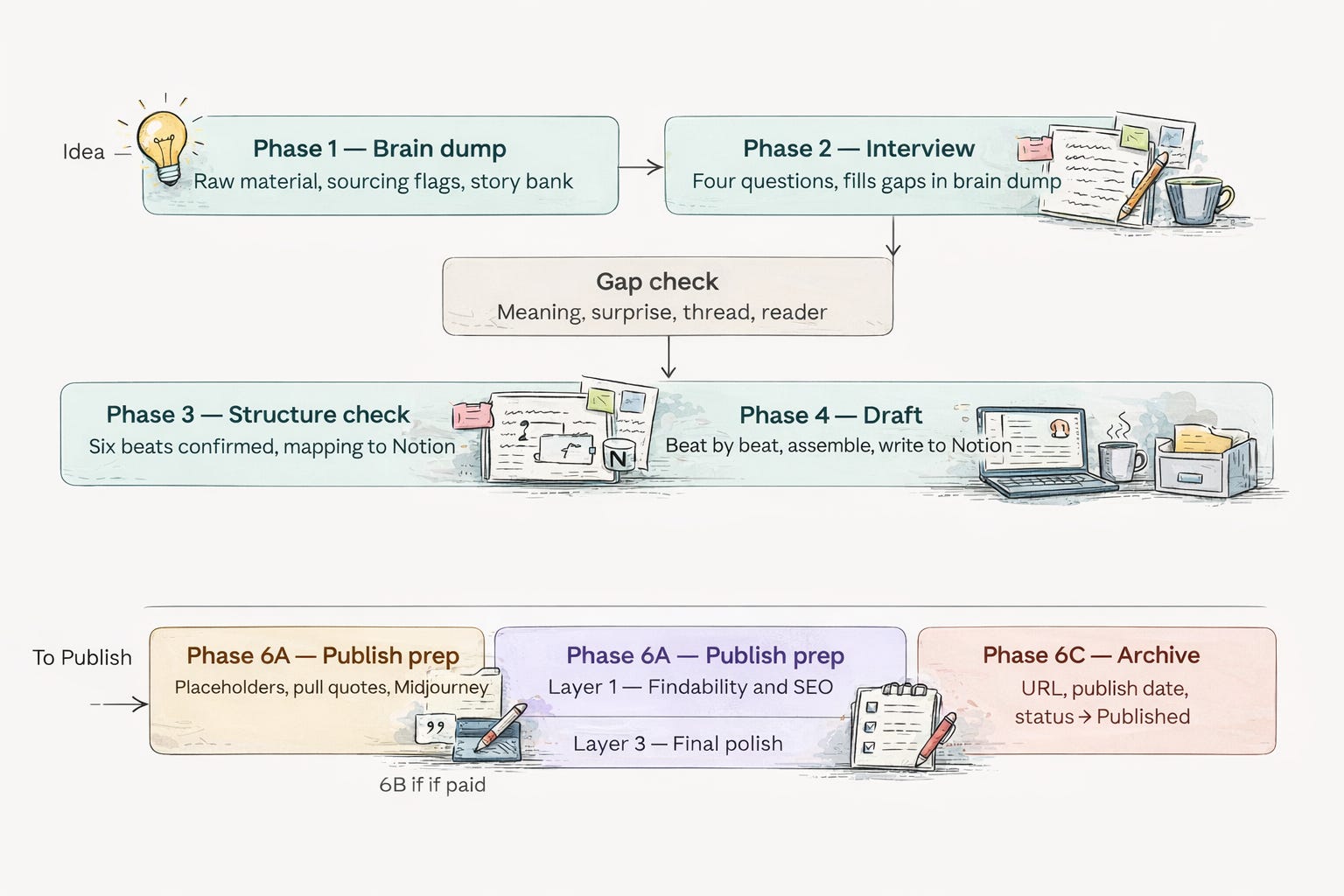
My Content Lab pipeline — the process I use to research and write every article — sits firmly in the Recipes layer. The creativity is the work. My experiences, my take, the hands-on-ness of it. That’s not something I can hand off to AI, or to anyone else, and still have it be the same thing. The moment I remove myself from that process, I’ve handed off the thing that makes it worth reading.
“If I outsource the recipe, I’m just serving someone else’s food.”
Same goes for my chief of staff dashboard. That lives at the Meal Plan level — it’s how I sequence and coordinate my week. But if I hand that completely over to a process, it becomes about productivity. And managing my energy, not my task list, is the whole point. I’m not willing to trade that.
But here’s where the Leftovers come in. My CoWork automations — subscription tracker, daily news recap — those run on a schedule and do their thing without me. I kicked them off, I tested them, and I know what they do. They free up bandwidth without removing me from anything that matters. They survived. I’d repeat them. That’s how I know they belong in the kitchen.
That’s my line. Not a framework someone handed me — mine. Built from figuring out what I actually needed to stay in the work, and what I was fine letting go.
So here’s the question I want you to sit with.
What’s actually in your pantry right now?
Not what you think you should have. Not what someone else’s stack looks like. What do you actually have on the shelf — the tools you’re using, the processes you’ve already built, the tasks you do on repeat every single week?
And from that — is there one dish worth making? One recipe that could use a shortcut, one part of your meal plan that could run on its own without you losing anything that matters?
You don’t have to build the restaurant. You just have to know what you’re cooking and why.
If you’re feeling stuck between “I should be doing more with AI” and “I don’t even know where to start,” that’s exactly the conversation DigiNav is built for.
If you’re a paid subscriber, the next section is for you.
I put together a practical framework for actually running a project once you know what’s in your kitchen — without losing the thread, without starting over every session, and without burning the kitchen down. It’s the how behind everything we just talked about. You’ll find it below.