

TL;DR: A respected expert can still be the wrong AI advisor for your business. Start with the job you need help with, then check the person's documented work, business fit, blind spots, and whether the perspective adds something useful before giving it a seat.
I chose the people before I named the jobs
Last week, I shared why I built an AI Board of Advisors and why it needed boundaries. I work solo, and I missed the mentors and mastermind groups I once turned to when I got stuck inside my own thinking. The Board was my way of bringing those outside perspectives back into the room.

Hi, I’m Lee. Welcome to DigiNav Compass Signal. Around here, I share what happens when AI and technology meet a real business—the useful parts, the messy parts, and what you can take into your own work.
Today, I’ll be showing you what I got wrong when I chose my first advisors and the five questions I now use to decide whether an AI advisor fits the business it is supposed to help.
The first version of my AI Board of Advisors started with people whose work I respected. Some I knew and learned from over the years. Others were before my time, but they were just as strong and knowledgeable.
But when I put the panel in front of real business decisions, the gaps became obvious. No one covered my biggest weakness: sales. And I quickly found out that the growth and monetization advice leaned on high-volume creator models and bigger teams that did not fit the small, relationship-led business I was building.
The problem was not that these people had nothing useful to teach me. The problem was that I had started with the people. I needed to start with the jobs.
Someone can be a respected expert and still be the wrong advisor for the work in front of you. Their method can be sound and still depend on a business model, pace, team, audience, or definition of growth that does not fit yours. They may belong in your research without earning a seat at your table.
That changed the question from, “Whose ideas do I admire?” to, “What job needs to be done, and whose documented method fits a business shaped like mine?”
Five questions before an advisor earns a seat
When I rebuilt the board, I stopped treating advisor selection as a search for the smartest person in the room. I started testing each possible advisor against the job I needed done and the business the advice had to serve.
You can use the same test with one person. You do not need to build a full board first.
Name the job. Start with one recurring decision, tension, or part of the business where another perspective could help. Be specific. Positioning, sales, audience growth, and monetization are connected, but they are not the same job. I could not fix a sales gap by adding another general business thinker.
Check the evidence. Look for documented work that directly covers that job: books, articles, talks, interviews, or other public sources that show how the person thinks and works. A large following, a few good quotes, or an AI summary does not prove that the method fits the role. That documented work becomes the source for the advisor profile the AI uses.
Check the business fit. Good advice can still be wrong for your business. Look at what the method assumes about team size, time, money, audience, pace, delivery, and growth. If the advice depends on publishing every day or handing the work to a bigger team, it may not fit a business built around limited capacity and trusted relationships.
Record the blind spots. Every method has limits. Ask where it could stretch beyond its real expertise, import a business model you do not want, or create work you cannot support. Those limits belong in the advisor profile too. They tell the AI when that perspective should stay out of the decision.
Make the advisor earn the seat. The person should add something you do not already have. More agreement is not always more useful. Sometimes you need a different view. Sometimes you need better evidence. And sometimes the honest answer is that this person belongs in your research, but not on your advisory board.
At the end of the tests, the result is not based on a simple yes or no. The advisor may be okay for a small test or remain as a research source. They could need more evidence, or they could just not fit at all. Leaving an empty seat is better than filling it with someone whose advice was never built for the business you're building.
Start with one advisor, not a full board
The first thought is to build a complete and full board. But before you do that, pick one part of the business where another perspective would be the most helpful. That's the first advisor to start with.
Once you know where you need help, think about who has already helped you understand that part of your business. It could be someone you know, someone whose work you have followed, or someone new you need to research. The name is only a starting point. Their work still has to pass the five tests.
Those five questions help you decide whether that person could be useful in the role. You aren't looking for a perfect advisor. You're checking whether their actual work matches the area where you need help and whether their way of working makes sense for your business. If you can't find enough of their own work to answer those questions, don't let AI fill in the blanks. Keep them as someone you learn from and keep looking.
If they do fit, test the advisor on one real scenario you're already working through. The test isn't only about the answer you get. It shows the perspective that advisor brings to the situation. It also shows whether that perspective factors in the way your business actually works and helps give more direction to a decision you've been waffling on.
I learned this the long way by building the full Board, putting it into real work, and then fixing the places where the advice did not fit. I turned that process into Build Your Own Advisor and Council.
Instead of trying to build the whole thing at once, it walks you through choosing one advisor, researching their work, testing the fit, and deciding whether they earn a place. Then it helps you build a small Council when a decision needs more than one perspective. It includes four guided AI prompts, three simple templates, and a completed example that you can use with the AI you already use.
You don't need a full board to find out whether this can help. Start with the part of your business where another perspective would be useful, and build one advisor from there.
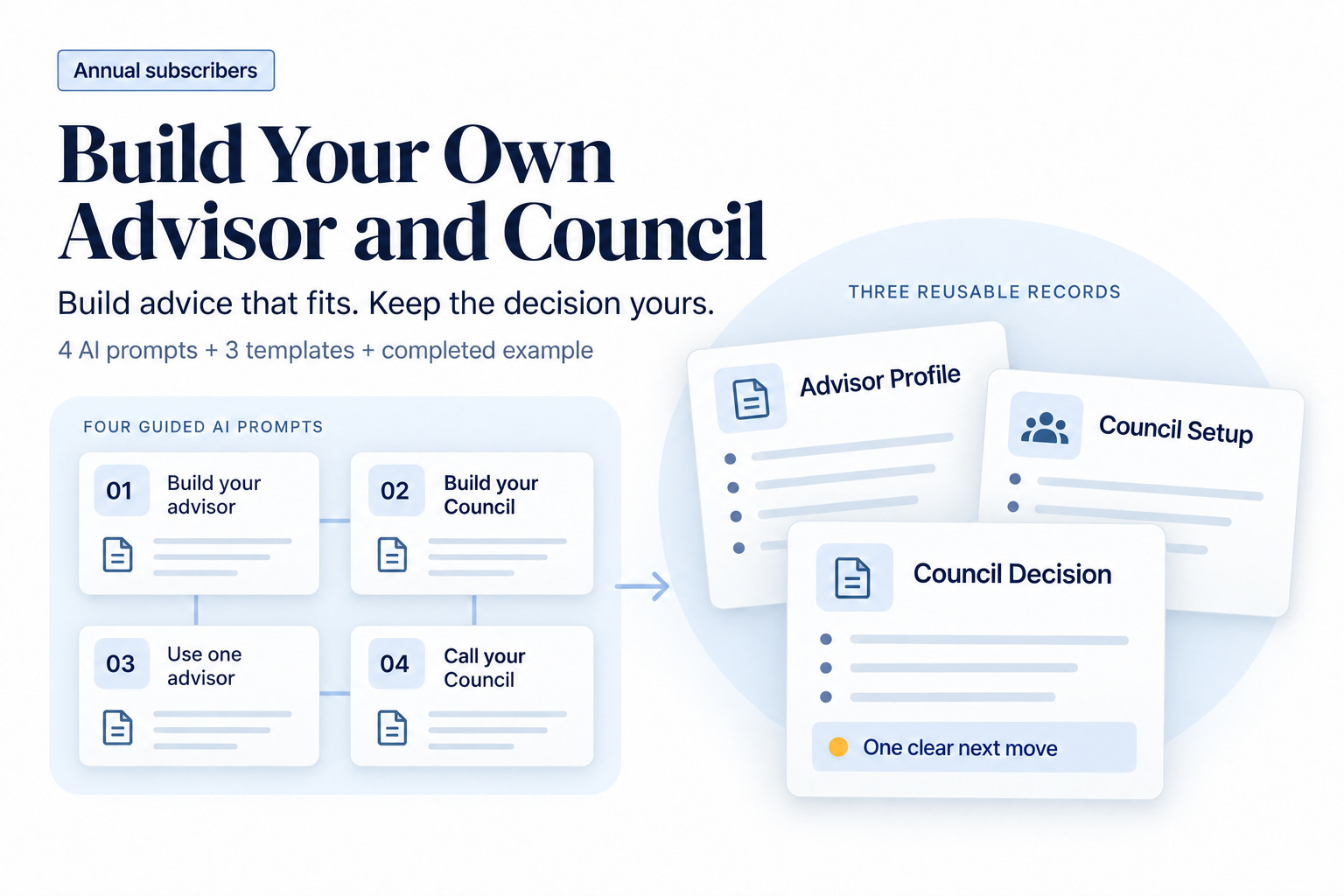
If you want the full process I used, Build Your Own Advisor and Council is available when you become a paid annual subscriber to DigiNav Compass Signal.
Become a paid annual subscriber and get Build Your Own Advisor and Council.
The part about starting with the people instead of the jobs is the one that totally resonated with me, Lee.
I went the long way around on this too, just from a different direction. I built a bunch of agents (most are used on an 'as needed' basis, and eventually whittled it down to a handful of core ones. What survived were the mentors attached to an actual job... critique, or a framework, or guidance on a decision I keep circling. The ones I kept because the thinking was impressive got cut.
I think about the amount of time and energy I've put into all of it, and it's a little mind-boggling, lol. However, I've learned SO much with all of it.
Also, "leaving an empty seat is better than filling it" is going in my notes.
This is a great post. The balance between advisor job title first vs People first approach is interesting with AI, because in practice I have seen people first approach work more and some of the exercises you mentioned included business fit, and value. The balance matters for AI and I like how you broke down what to do. I need to try this with AI