

TL;DR: Working solo with AI made it easy to move fast while staying stuck inside my own thinking. I built a virtual Board of Advisors to replace the mentors and mastermind groups I once relied on. It evolved into an Advisor for moments when I truly do not know what I think, a Council for high-impact decisions, and one important rule: most everyday work needs neither.
The voice I still reach for
All through life, you rely on other people to guide the way. In school it's teachers, counselors, and coaches. At work it's bosses, coworkers, and colleagues.
And then there was my Grams.
She was the person you went to for all the sage advice you needed while navigating this thing called life. Her opinions were trusted, and that trust came from lived experience: raising her own humans, and then their humans. Her circle from church and card club and the community trusted her and her advice too.
No matter what you told her, she listened patiently, asked the right questions, and never judged. She was the safe space. Sometimes she had all the answers. Other times she had just enough to keep you moving (and alive).
There's a saying: you don't know what you don't know. Grams was all about that. If she didn't know, she told you so, but she gave you something to think about. That's what caused the aha moments. The ones that make you think, shoot, why didn't I think of that?
I still find myself asking, what would Grams do?
So when I started building DigiNav and working with AI, I knew I needed more voices, insights, and opinions.
Hi, I’m Lee. Welcome to DigiNav Compass Signal. Around here, I share what happens when AI and technology meet a real business—the useful parts, the messy parts, and what you can take into your own work.
Today, I’ll be showing you how my AI Board of Advisors went from a list of thinkers I admired to two kinds of help I actually use, and the mistakes it took to get there.
When the sounding board disappeared
For the longest time, I was part of mastermind groups, and I had mentors I could go to when I was stuck. That was my sounding board. Someone outside my own head who would listen, push back, and ask the question I hadn't thought to ask myself.
But when you work solo without a team or employees, usually with the help of AI, you seem to be on the island alone.
When working alone or even with AI, it's easy to get stuck in your own thinking. There's no mastermind call on the calendar and no mentor to catch you when an idea has been going in circles for a week. You can move fast and still be stuck.
So I thought, why not build a Board of Advisors to help move me along? I'd seen other people creating their own sounding boards of virtual experts, and I wanted more voices, insights, and perspectives in the room.
But I didn't want to collect impressive names or simulate famous people. I wanted bounded, evidence-based perspectives that fit my real business, my capacity, my goals, and the decisions actually in front of me.
✳︎ ✳︎ ✳︎
A list of experts was not yet a working board
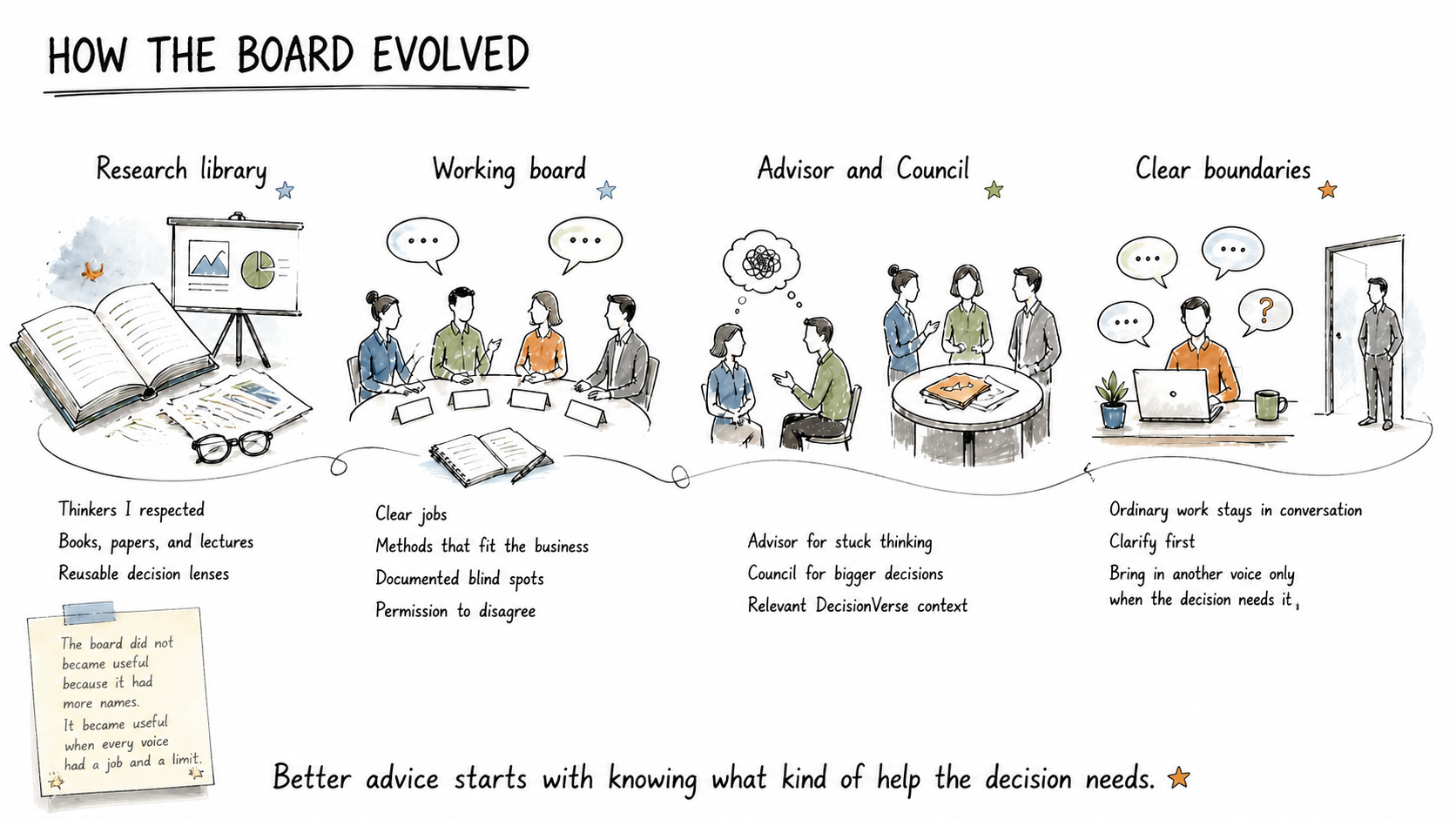
The first version wasn't a board at all. It was a research plan built around people whose work I respected. Herbert Simon. Kahneman and Tversky. Gary Klein. I wanted to pull useful ideas from their books, papers, and lectures and turn them into decision lenses I could use.
That's a good library. It's still not a board.
The difference became clear when I put the first working panel in front of real business decisions. It was strong at checking decisions and keeping me honest. But the business coverage was uneven. No one covered the complete sales job, and the advice on monetization and audience growth leaned too heavily on a high-volume creator model that didn't fit a small, relationship-led advisory business.
So the question changed. It was no longer, “Whose ideas do I admire?” It became, “What job needs to be done, and whose documented method fits a business shaped like mine?”
You don't need to build a full board to use that shift. A few questions worth borrowing are:
What kind of decision or work do I need help with?
What perspective is missing from the voices I already trust?
Does this person's method fit the way I actually work and live?
A respected name was not enough to earn a seat. The person needed a clear area of expertise, work I could verify, and experience that fit a solo, owner-led business with real limits on time, capacity, and budget. I also wanted their blind spots recorded. If everyone agreed or pushed in the same direction, the board would only give me a more convincing version of my own thinking.
Who sat on the board mattered too. When I said I wanted diversity, I wasn't asking for a demographic checklist. I wanted different kinds of lived perspective: women and men, people who understood building around children, caregiving, limited capacity, and other demands that shape how work gets done. The advice had to fit a real life, not only a business model.
The rebuilt board became seven women and four men, with different jobs and different reasons for entering a decision. They were not AI impersonations of famous people. Each profile had to stay bounded by documented work and methods, and each advisor needed to be able to disagree with me and with the others.
That gave me a working board on paper. It still didn't tell me whether I had built the right way to use it.
Then I turned it on.
✳︎ ✳︎ ✳︎
When a good-looking answer exposed the wrong design
At first the board sat inside my weekly review system, the same automated process that reviewed my daily notes, gathered the week's insights, planned the next week, and was supposed to clean up.
And the advisors, as one big panel, horned in on the results of the week. Whether I had a decision worth their time or not.
That was mistake number one. Well, two, if you count the board assembly.
I wrote about that weekly system before, so I won't repeat it here. The short version: a missing cleanup step showed me that capture, cleanup, planning, and advice were all tangled together, and the advisors needed to be their own process.
Two kinds of help, not one
Then I came across a system from another creator that split the roles of the advisors. The best way I can describe it is having a mastermind group and a board of directors.
The mastermind helped with stuck decisions, to help me get out of my own way. They knew the one thing that was niggling in the back of my mind and pushed on it.
The board of directors (now the Council) looked at the big picture. They could use the relevant DecisionVerse context, which is my second-brain type of setup, and they focused on growth and movement, not just what's the issue today.
So I rebuilt the Advisor and Council as two separate skills.
One of the tests: the reach plan
I had a 12-week reach plan built around a real problem: I'm having trouble promoting my articles. The goal for this quarter is to expand reach beyond Substack, so I want to start using other social media to drive traffic.
When I took the plan to the Council, ChatGPT brought in the Advisors instead. I said no. This is a bigger decision, and it needs the Council.
That was the first sign that the roles were not as clear as I thought. I corrected the route, and the Council did the big-picture work the plan needed.
Part of the plan was to take an article and expand it with YouTube videos that pointed back to the article, the perks, or whatever the promotion was. The kind of thing you could totally get on board with.
Where the problem became impossible to miss
Later, as I worked through the YouTube part of the plan, the Advisor kept showing up. It was being invoked on almost every question I asked, including ordinary questions that should have stayed inside the conversation.
It wasn't waiting until I was genuinely stuck. It was turning routine project work into a reason to bring another voice into the room.
That was a terrible way to work through a problem. The first mix-up showed me that the Council and Advisor roles needed to be separate. The repeated interruptions showed me that separation was not enough. The Advisor needed stronger guardrails for when to stay out of ordinary work.
✳︎ ✳︎ ✳︎
Not every decision needs another voice in the room
The guardrails sorted out Council versus Advisors. They didn't sort out Advisors versus everything else.
Working in projects, I kept seeing the same thing. "Let me ask the advisors. Let me pull in the advisors. Let me talk to the advisors." On ordinary questions. On routine project decisions. Once, inside a Council thread, where I'd already picked the kind of help I wanted, and I had to tell them to stop.
It's kind of like they've become a busybody of ChatGPT threads.
The advisors shouldn't be pulled in on every question and decision. But nothing in their instructions said so. Their job was written as "give direct decision support," which is broad enough to cover almost anything I do with AI. There were rules for what the Advisor couldn't execute. There was no rule for when it should stay out of the room.
Two kinds of "I don't know"
The real fix came from a thing I'd been saying without hearing it.
A lot of times I'll be working through something, get asked a question, and say I don't know. Sometimes we just get clear on it, because I didn't understand how the question was worded. But other times I really don't know how to answer it. Not because the question wasn't clear, but because I'm not clear in my mind.
Only the second one is an Advisor moment. The first one is just a conversation.
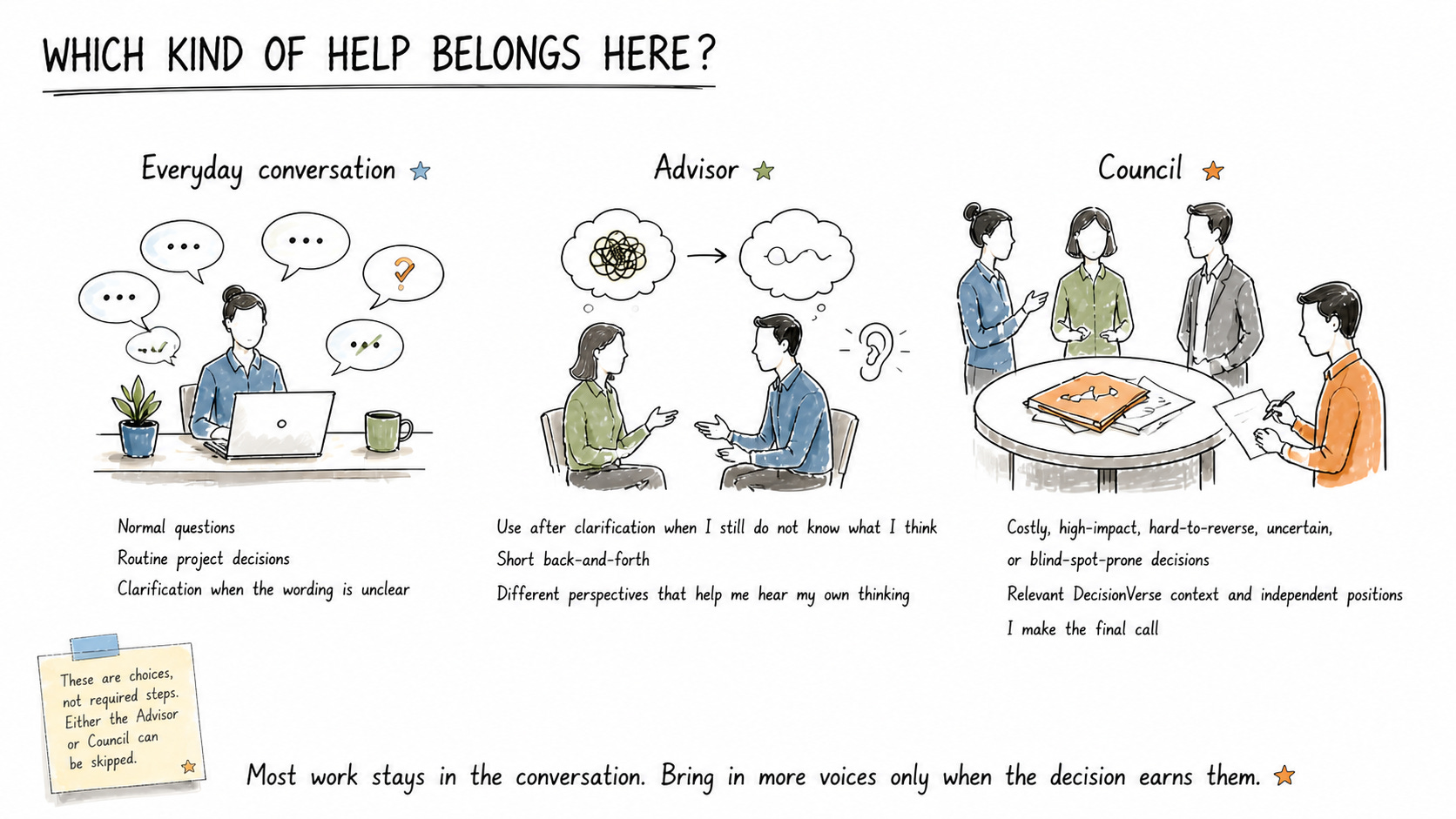
So the Advisor got an invocation boundary. Ordinary questions, routine project decisions, and normal back-and-forth stay in the current conversation. "I don't know" is not an automatic trigger. Clarify the question first. Offer the Advisor only when I still don't know what I think.
Three levels, not one
Getting there meant naming what each kind of help is for.
Everyday work stays in the conversation. Most decisions don't need another voice in the room.
The Advisors are for when I'm genuinely stuck. Short back-and-forth, different perspectives, help hearing my own thinking. A mastermind, not a committee.
The Council is for the big ones. Costly, hard to reverse, uncertain, or prone to my blind spots. Two to four named advisors, positions formed independently, disagreement kept visible, and I make the call.
Either one can be skipped. Nothing has to pass through all three.
A simple version of the boundary is something you can borrow too:
Keep ordinary questions and routine project decisions in the current conversation. If I say I don’t know, clarify the question first. Bring in the Advisor only if I still don’t know what I think. Use the Council for the bigger decisions that are costly, hard to reverse, or likely to expose a blind spot. Where it stands
The new boundary is in place. What I can't tell you yet is whether the busybody is gone for good. That takes more ordinary conversations than I've had since the change.
I still ask what Grams would do. She listened, asked the right questions, and gave me enough to keep moving, even when that wasn't a complete answer. Turns out that was the design all along.
A board that is not just you is the useful cut. The piece that still breaks is the handoff when the council answers and nobody owns the decision.
I'll give you the answer I give everyone in 2026. You need advertising. Call us when you are ready. Paid search and social is the way. All the best, MG