

The Chaos Continues (And So Does the Progress)
Sometimes you have to step back from big projects and just work on the little things.
Right now, I’m in the middle of buying and selling a house, surviving a move, and managing the holidays. I don’t have bandwidth for major initiatives. Honestly? I don’t want to start anything big at the end of the year anyway.
But here’s what I’ve learned about momentum: it doesn’t require massive action. It requires forward movement. Any forward movement.
So this week, instead of building grand systems or launching new offers, I focused on three small experiments. None of them is a game-changer on its own. But stacked together during a low-bandwidth season? They’re exactly what kept me from stalling out completely.
Maybe one of these will spark something for you. Or maybe it’ll just show you that you’re not in this chaos alone.
Small Wins Aren’t Consolation Prizes
Most people think progress requires significant blocks of time. The big project. The complete system overhaul. The perfect conditions.
But here’s what I discovered while juggling moving boxes and family obligations: waiting for perfect conditions is how momentum dies.
The real issue isn’t that you lack time for big projects. It’s that you’ve convinced yourself that small projects don’t count.
They do.
When I looked at what actually moved my business forward this week, it wasn’t some grand strategy session. It was three simple experiments that took maybe an hour each. And now I have:
A daily inbox triage that saves me 20 minutes of decision fatigue every morning
Actual feedback on my prompting habits from the AIs I use most
A reflection process that’s helping me think clearly about 2026 without the usual productivity planning pressure
If I’d waited for “real time” to work on “real projects,” none of this would exist.
Here’s the cost of waiting: You lose the compound effect of small wins. One tiny improvement doesn’t feel significant. But three small wins this week, plus three next week, plus three the week after? That’s how you end a chaotic season ahead instead of behind.
How Three Simple Experiments Became Actual Systems
I’ve been running experiments all year. Taking existing processes and adding AI or automation to them. Figuring out where the human hand matters and where it doesn’t.
But here’s what kept happening: I’d run an experiment in Claude, then another in ChatGPT, and I was all over the board trying to find what I needed later.
So I created a simple Notion page with toggle dropdowns. For each experiment, I capture three things:
The initial prompt or brainstorming session (linked to the conversation)
The output (what actually got built)
A brief explanation of what worked or didn’t
That’s it. Nothing fancy. But now, when I look back, I can see what I’ve already figured out. No more recreating the wheel.
Here’s what emerged from this week’s experiments.
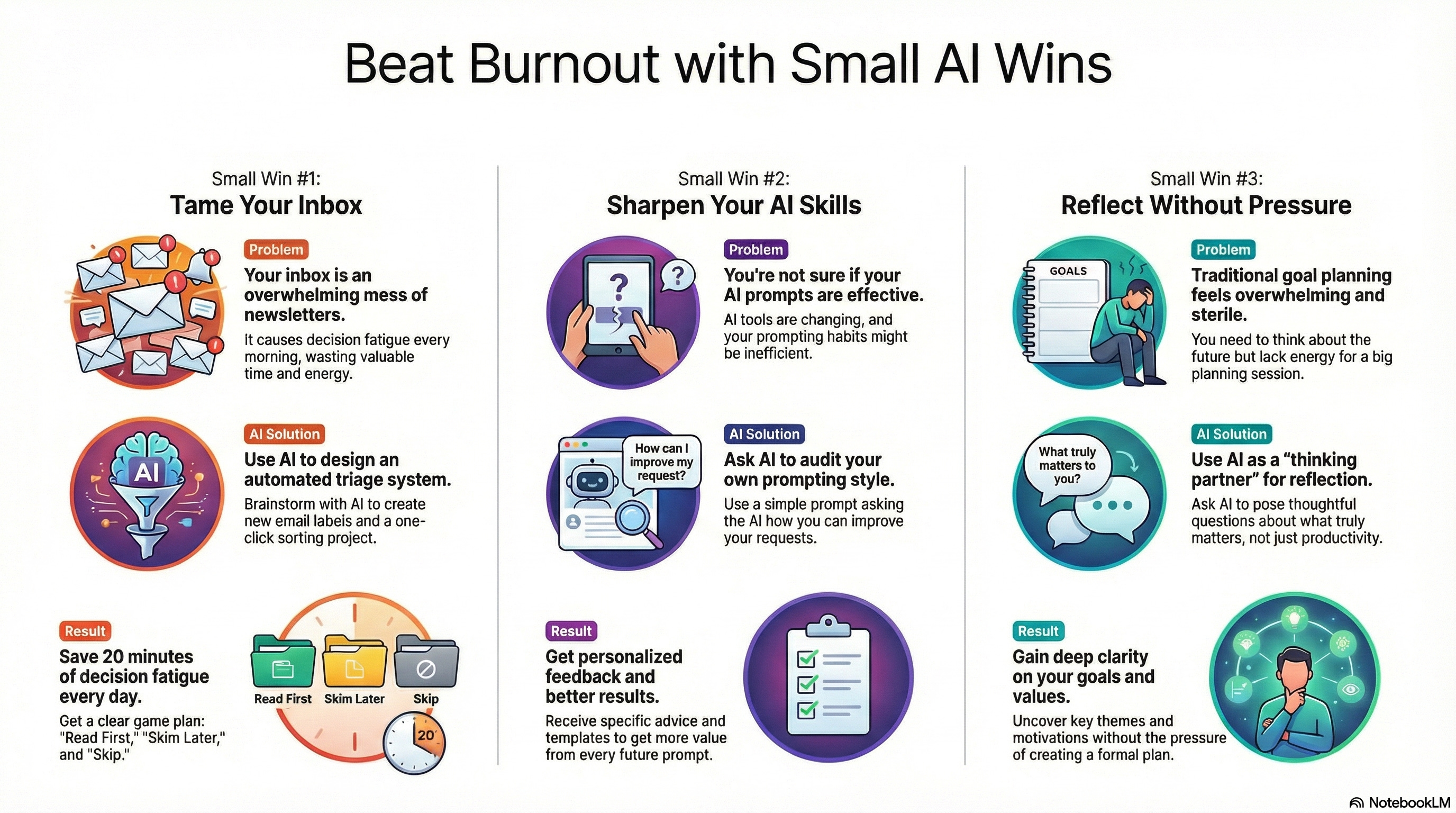
Experiment 1: Newsletter Triage (The Daily Inbox Problem)
I subscribe to a lot of Substack newsletters. You all sharing information is amazing. But it becomes overwhelming when you see how many unread posts are waiting.
I wanted something simple.
Look at what’s in my inbox > Triage it > These are the ones to read first. These can wait. These you can skip entirely.
So I started a brainstorming conversation with Claude. And one of the first things it said was: “This is gonna take some time because you have everything in one bucket, and there are things that aren’t important in the immediate.”
Fair point.
We came up with a new label structure in Gmail. I now have three labels under my main Substack catch-all:
Politics (separate because it’s not business-relevant daily)
System notifications (subscriber alerts, follows, etc.)
Triage (the actual newsletters I need to sort through)
Then I built a Claude project. All I have to do is click “Triage please,” and it looks at what’s in my inbox and breaks it into:
Read first and respond (time-sensitive or directly relevant)
Skim later (might be useful, not urgent)
Skip (not relevant today)
That’s it. I click a button. I get a game plan. I’m not staring at 47 newsletters trying to decide where to start.
Time invested: About 45 minutes for the Gmail restructure and Claude project setup.
Time saved: 15-20 minutes of decision fatigue every single morning.
Experiment 2: Evaluate My Prompting (The Self-Audit)
AI has changed exponentially lately. I wanted to ensure the context I provided, and the way I prompted, were making the best use of the tools.
So I ran a simple experiment. Same prompt in both ChatGPT and Claude:
“After looking at how I prompt for results, please tell me how I’m doing, how can I improve, and what I’m missing. Format the output with clear headings and organization.”
What ChatGPT said: You’re a highly specific user with a strong system mindset. Here’s what you’re doing well, where you’re struggling, what you’re missing, and how to improve. Then it offered to create a cheat sheet and template for more consistent prompting.
It also noted that I randomly jump from thought to thought. (ADHD kicking in. Guilty.)
What Claude did differently: It didn’t just immediately respond. It said, “I’ll be happy to do this, but I need some context here.” I had to point it to projects we’d already worked on and recent conversation threads. Then it went back, reviewed everything, and gave me feedback based on my actual patterns.
Both approaches were useful. But they confirmed something important: the same prompt in different AIs gets different results. And if you’re using multiple tools, it’s worth understanding how each one processes your requests.
The output: I now have clearer templates for both platforms. And a list of habits to break (like assuming the AI remembers context it doesn’t have).
Time invested: About 30 minutes total.
Ongoing value: Better responses from every future prompt.
Experiment 3: The 2026 Reflection (Not a Productivity Plan)
Since I have some downtime during this chaos, I wanted to reflect on 2025 and think about what I actually want for 2026.
But here’s the thing: I didn’t want the same old “map out the year” productivity planning that everyone does in January. I wanted to gut-check and vibe-check everything.
So I started with a prompt:
“You are my favorite thinking partner. Today we’re going to just talk about planning for 2026. I don’t want the same old planning everyone else does. I want to be asked questions that make me think about what really matters to me in the upcoming year.”
Then I added backstory. What’s happening in my life right now. Some things I’m planning to tackle. Random context that felt relevant.
I used Whisper Flow to speak it instead of typing. That way I didn’t self-edit. It came out in my actual words.
What happened in ChatGPT: It reframed what I said to confirm it understood. Then it started asking me questions about what was important. When I told it this wasn’t about productivity or actual planning, just thinking about what matters, it adjusted. At one point it asked: “Who are you becoming right now?”
That question hit different.
What happened in Claude: Similar start, but Claude kept trying to pull me back toward implementation planning. I had to keep redirecting it. When I said I just wanted to experiment and not worry about outcomes, it started swearing at me. (Overcorrected when I asked it to be less sterile. Had to tell it to dial back the cuss words.)
The ChatGPT conversation stayed more even-keeled for this particular use case.
Where I landed: I’m still working through this one. But I’ve already surfaced some important themes:
Replace some agency income so I can decide what to do with that business
Learn by doing, not consuming (I noticed I was taking in too much content without applying it)
Get back to the version of me who experimented without worrying about outcomes
Time invested: About an hour across two sessions.
Ongoing value: Clarity I wouldn’t have gotten staring at a blank planning doc.
The Real Lesson: Using AI Doesn’t Have to Be Complicated
These three experiments have something in common.
None of them required building massive automations. None of them required technical expertise. None of them required waiting for the perfect project.
They’re just simple applications of AI that saved time, improved my process, or helped me think more clearly.
Triaging newsletters so I have a game plan instead of a full inbox
Evaluating my prompting so I get better responses from the tools I already use
Reflecting on the year with a thinking partner instead of a blank page
Everything doesn’t have to be about creating these big vibe-coded automations or game-changing systems. Sometimes it’s just about making better decisions and thinking about things differently.
What This Looks Like in Practice
When I talk to people about AI integration, they usually think the problem is not knowing which tools to use. Or not having enough technical skills. Or not having time for “real” implementation.
But here’s what the conversation usually reveals: they’re waiting for conditions that don’t exist.
The moment things shift is when they realize small experiments count. That you can make meaningful progress in an hour. That “low bandwidth season” doesn’t mean “zero progress season.”
One person told me, “I keep thinking I need a whole day to work on my systems.” And I asked, “What could you figure out in 45 minutes?”
She built a client intake triage that same afternoon. Nothing fancy. Just a Claude conversation that helps her prioritize incoming requests. Took her less than an hour.
That’s the principle: Progress doesn’t require perfect conditions. It requires permission to start small.
The Small Wins Framework (For Your Own Chaos Season)
Here’s exactly how I approached this:
Step 1: Identify one friction point you deal with repeatedly (5 minutes) What’s something that annoys you every day or every week? For me, it was the newsletter inbox. For you, it might be deciding what to work on first, or processing client requests, or planning your content.
Step 2: Ask an AI to help you think through it (15-30 minutes) Don’t start with “build me a system.” Start with “help me think through this problem.” Let the conversation surface what’s actually causing the friction.
Here’s a prompt you can steal:
“I have a recurring friction point in my work: [describe it]. I don’t need a complete solution yet. I need to understand why this keeps being annoying and what a simpler approach might look like. Ask me clarifying questions before suggesting anything.”
Step 3: Build something small you can test immediately (15-30 minutes) Not a complete system. Just one piece you can try tomorrow. The newsletter triage wasn’t a complete email management overhaul. It was three labels and a Claude project. That’s it.
Step 4: Capture what you learned (5 minutes) Add it to a simple tracking system. The prompt, the output, what worked. Future you will thank present you.
Time invested: About an hour per experiment.
Compound effect: Three small wins this week means you end December ahead instead of behind.
Your December (And Beyond)
You can see that none of these experiments are revolutionary on their own.
But stacking small wins during the low-bandwidth season? That’s how you keep momentum without burning out. You don’t have to wait for the perfect project or perfect conditions to make progress.
The real question isn’t “What big thing should I build?” It’s “What small thing could I figure out this week?”
So here’s what I want to know: What’s one small friction point in your work that you’ve been ignoring because you’re waiting for time to “really fix it”?
Reply and tell me. I want to hear about your small win.
VIDEO: Want to see these three experiments in action? Watch me walk through the Notion setup, the newsletter triage, and the 2026 reflection process: Three Small Wins for Momentum.
This is Week 3 of the “Planning Without Burning Out” series. Missed the earlier pieces?
Next week: How these small experiments connect to the bigger picture of getting your context right before building plans. (Hint: It’s related to the SHIFT Your Context Workshop launching in January.)
This is SO good, Lee!
I have to save the video for later, but I am absolutely going to implement your email triage!
Love the graphic, too!