

I’m in a RED week right now.
If you read last week’s piece on hierarchy planning, you know what that means: survival mode. 3-5 hours of business time. Non-negotiables only. Everything else waits.
Closing is happening. Furniture will arrive soon. Appliance delivery scheduled. Boxes are everywhere. The business hasn’t crashed, which means the system is working.
But here’s the thing I didn’t expect.
Survival mode doesn’t mean doing nothing. It means doing things differently. And those few hours I do have? I’m not spending them on strategic planning or big decisions. I’m spending them on something that sounds almost irresponsible: playing.
The Two Traps
When you’re in a chaotic season, there are two obvious moves. Both are wrong.
Trap one: Push through anyway. Force the strategic planning. Build the January roadmap. Stay up late mapping goals when your brain is already running on fumes. I’ve done this. It produces fantasy documents that feel productive but fall apart by week two of execution.
Trap two: Disconnect completely. Step away from everything. Tell yourself you’ll pick it back up when life calms down. Sounds healthy. But if you’re building something you actually care about, total disconnection doesn’t feel restful. It feels anxious. You worry about losing momentum.
Neither option works because they both assume the same thing: that your only choices are full capacity or zero capacity.
There’s a third option. I’m calling it input mode.
Input Mode
Input mode is what happens when you don’t have the capacity for strategic output, but you’re not willing to lose momentum entirely.
Instead of producing, you gather. Instead of deciding, you explore. Instead of building the plan, you collect the raw material that makes planning faster later.
It looks like:
Seeing what others in your space are doing (not to copy, but to spark ideas)
Running small experiments with tools you’ve been curious about
Organizing what exists instead of creating what’s new
Playing with no deliverables required
None of these demands strategic thinking. All of it feeds January.
What I’ve Actually Been Doing
Here’s what input mode has looked like for me this month.

Playing with AI image tools
I made cartoon panels and infographics in ImageFX. Built character sheets in Midjourney. Tested a few other AI image generators to see if they could match what I was getting elsewhere.
Mostly, I was pushing for brand consistency. Could I get a cohesive look across different tools? Could I create assets I’d actually use?
But also... it was just fun. Creative play with no deadline. No client waiting. No pressure to ship.
What I learned: Yes, I can get consistent brand visuals from AI. It takes iteration. Midjourney handles character work better than the others. ImageFX is surprisingly good for quick infographics. This matters for January content planning.
Testing presentation tools
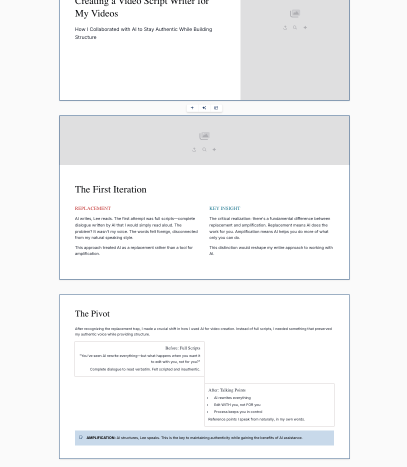
I wanted to find a tool that could help create slide decks for my videos. Tried Gamma. Tried Canva AI. Tried GenSpark.
Verdict: they were all okay. Nothing was a total hit for what I needed.
So I made a decision: it would be easier to create my own template and add information myself than to fight with tools that almost, but not quite, do what I want.
What I learned: Not a failure. Just clarity. I know the answer now instead of wondering. And I’m not going to waste January testing tools I’ve already tested.
Building the Content Repurposer
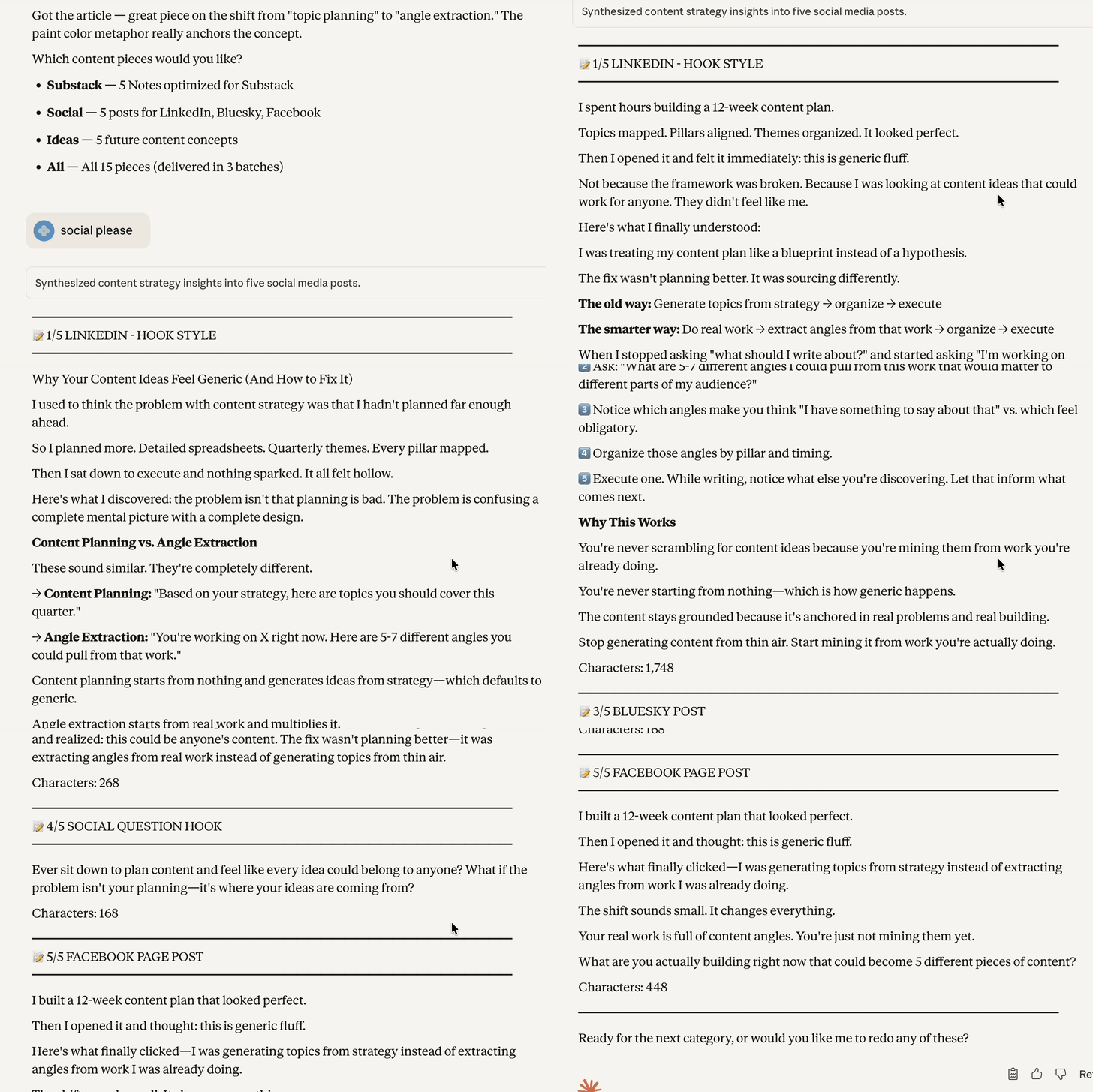
This one started as a Claude artifact. I wanted something that could take a piece of content and break it into shareable pieces for social.
The artifact worked well enough that I turned it into a full Claude project. Now I have a system that gives me purposeful items to share without having to start from scratch every time.
What I learned: This is a keeper. It’s already saved time this month, even in survival mode. It’ll be a core part of my content workflow in January.
Why This Isn’t Procrastination
It would be easy to look at this list and think: That’s just messing around. That’s avoiding the real work.
Here’s why it’s not.
Every experiment answered a question I’d been carrying:
Can I get consistent visuals from AI? (Yes)
Is there a presentation tool that fits my needs? (No, build your own template)
Can I systematize content repurposing without losing my voice? (Yes, and it’s already working)
When January hits, and I have actual capacity for strategic planning, I’m not starting from zero. I know what works. I know what doesn’t. I’ve already built some of the pieces.
The experiments didn’t demand strategic thinking. They fed it.
A Note on Not Overdoing It
There’s a temptation here to turn “fun experiments” into another productivity system. To schedule them. To measure them. To optimize the play.
Don’t.
The whole point of input mode is that it’s low pressure. The moment you start treating it like output, you’re back in the same trap.
Same goes for AI.
These experiments used AI tools, but I wasn’t trying to automate myself out of the process. The character sheets in Midjourney still needed my eye for what looked right. The Content Repurposer still needs my judgment about what’s worth sharing. The tools amplify. They don’t replace.
If you’re running experiments that completely remove you from the equation, you’re not building something sustainable. You’re building something generic.
What’s Next
I’ve got another RED week coming up (holidays), then two YELLOW weeks to close out the year. The Survival Protocol is still running. I’m still inside it.
But when January hits, I won’t be scrambling to figure out what tools to use or what systems to build. I already know. The experiments told me.
That’s the real gift of input mode. It doesn’t feel productive in the moment. It feels like playing. But it’s feeding the plan you’ll build when you actually have the capacity to build it.
So here’s my question for you: if strategic planning was officially off the table for the rest of December, what would you play with? What’s the experiment you’ve been curious about but haven’t had “time” for?.
This framing of “input mode” is so refreshing — it gives structure and language to a season most of us just try to muscle through or mentally check out from. The way you contrast the two traps (forcing fantasy plans vs. disconnecting completely) with this third path of low-pressure experiments and playful testing made me feel a lot less guilty about the small, curious things I gravitate toward when life is heavy.
Really loved the specificity of your examples — from AI visuals to presentation tools to the Content Repurposer — and how each one answered a concrete question you’d been carrying instead of becoming another productivity performance. It’s such a kind reminder that “survival mode” can still quietly feed future strategy, and that play can be preparation, not procrastination.