

Cooking is one of my passions. At the end of a day, it’s the thing that lets me point at something and say I made that — whether it turned out as dry meatloaf or as the good meatballs.
But some weeks an elaborate meal isn’t in the cards. It takes time and energy I don’t have.
A week or so ago I was at Costco and bought a bag of lemons. I had a picture in my head: a fresh lemon dessert, because doesn’t that sound like summer? Except who has time for that? Not me, not this week, not next.
So I had two options. Prep the lemons. Freeze the rind, freeze the juice, and have them ready for later. Or let them go soft in the bowl and do nothing with them at all.
Freezing it was.
And now every morning, before I head out to work out, I drop one lemon cube into my water. Lemon water. No extra work.
The dessert never happened. The thing I actually use every single day did.
✳︎ ✳︎ ✳︎
Hi, I'm Lee. I help solo business owners get clear on AI and automation decisions before they commit — no hype, no hustle, no borrowed playbooks.
New here? Find the room that fits → No Foundation Yet → Lost In Translation → Built For Someone Else → The Last Mile
✳︎ ✳︎ ✳︎
The Noise
The same thing happens in business, and it’s costing people more than a bowl of lemons.
Everywhere you look right now, someone is telling you to build this or ship that. And here’s what most of us picture when we hear it: an app. A full automation. A system with seventeen moving parts. Something big, something technical, something that prints money while you sleep.
So you take that picture and you hold it up against your own week. And your week, the real one, doesn’t match. You ran maintenance for a client. You answered emails. You finally rewrote that one paragraph that had been bugging you. None of it looks like the picture.
And the quiet question starts: am I even up to this?
Here’s where it goes wrong. Somewhere along the way we started hearing “shipped” and translating it to “made money” or “went big.” We collapsed success into size. But those aren’t the same thing, and treating them like they are is how a perfectly good week starts to feel like a failure.
You’re two steps ahead of someone and two steps behind someone else. That’s true of everyone, all the time. The noise just makes it feel like you’re the only one standing still.
✳︎ ✳︎ ✳︎
What Shipping Actually Looks Like
So let me tell you what shipping actually looks like. Not the picture. The real thing.
Last week I ran maintenance on an Agency site. Updates, checks, the unglamorous keep-it-running work. That shipped.
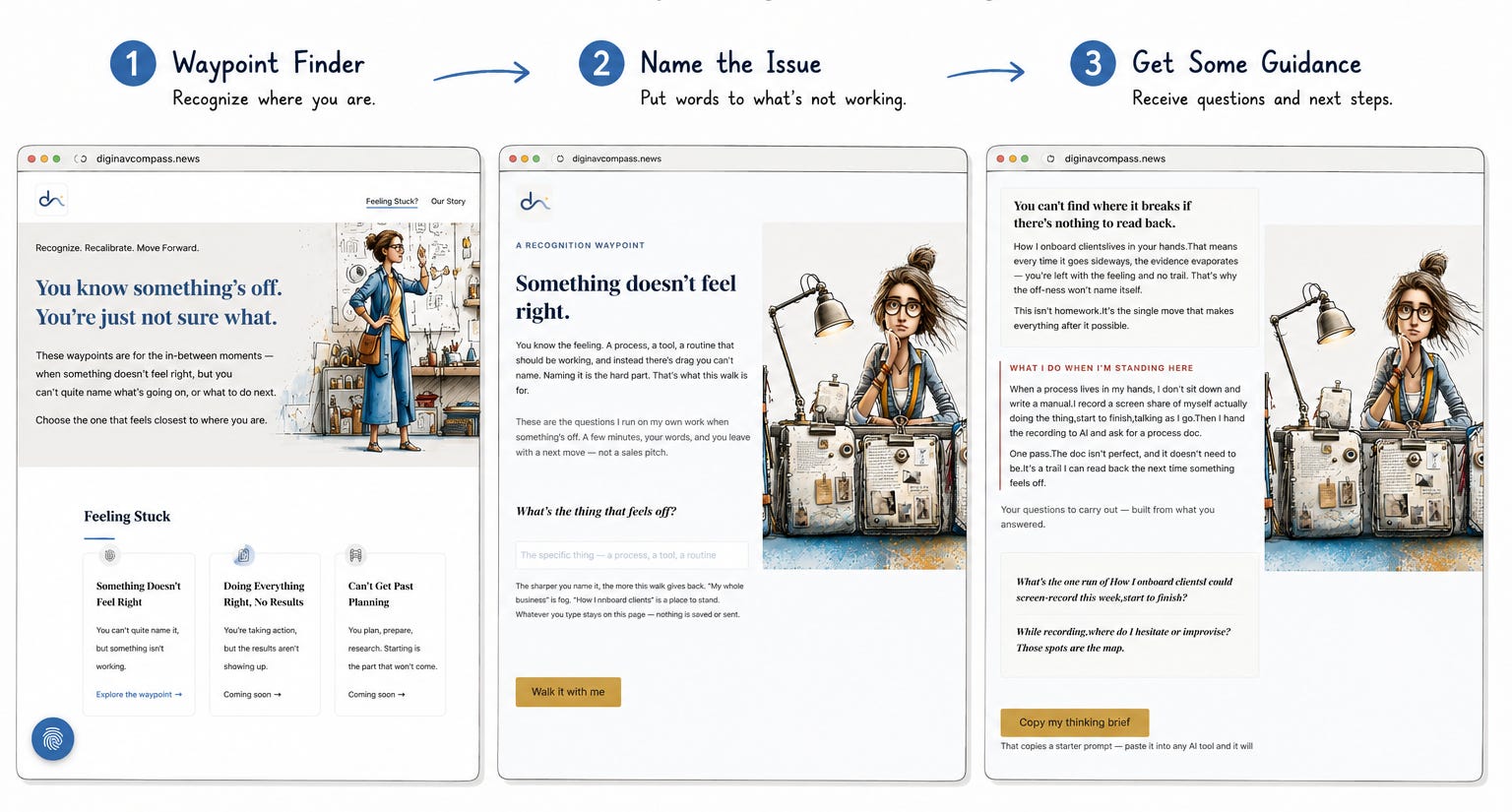
I wrote and coded a waypoint for my own website, a small interactive process a reader can actually walk through. That shipped.
A proposal went out to a new client. Shipped.
I rewrote a web page, not because the old one was broken, but because a conversation with Claude got me clear on what I was actually trying to say. The new version went live. Shipped.
And this blog post — the one you’re reading — is a build-and-ship item. It started as a tangle of half-formed thoughts and it’s becoming a finished thing you can read. That counts too.
None of those made money the day they happened. Not one of them looks like an app or an automation. And every single one of them is a thing I built and put into the world.
That’s the part the noise erases. Shipped doesn’t mean big. It doesn’t mean monetized. It means finished enough to stand on its own, finished enough that someone could look at it. A maintenance run you can point to. A page that’s live. A post someone can read. The bar isn’t impressive. The bar is done and reviewable.
✳︎ ✳︎ ✳︎
Where AI Comes In
This is where AI actually earns its place, and it’s smaller than the hype wants it to be.
Most of the noise sells AI as the thing that builds the app, runs the automation, replaces the whole job. That’s the version that makes you feel behind, because it’s asking you to manage a new system on top of the business you’re already running alone.
That’s not how it’s been useful to me.
What it actually does is take something vague and heavy, the thing you’ve been circling for a week, and help you turn it into one small thing you can finish and look at. Not the blank page. Not “learn a whole new skillset before you’re allowed to start.” Just: here’s a rough draft to react to, here’s the page rewritten three ways, here’s the proposal you’ve been avoiding, now in front of you.
That rewritten web page I mentioned? I didn’t hand the writing to AI. I chatted with Claude to find where the ideas were thin or had gaps, and those responses let me rewrite the lines that were meh at best. Then I shipped the version that sounded like me.
The catch is real: this only works when the task is bounded and you know what good enough to ship looks like for you. AI will happily produce more of something generic, faster. It can’t decide what matters for your business or what sounds like you. That part is still yours. The win isn’t that AI did it for you. The win is that you no longer have to start from nothing to move one thing forward.
✳︎ ✳︎ ✳︎
The Tracker
Here’s what I did about all of this, because noticing it wasn’t enough.
I built myself a routine, a daily and weekly rhythm, to track what I ship. No matter how small. That was the whole rule: it counts, and it goes on the list.
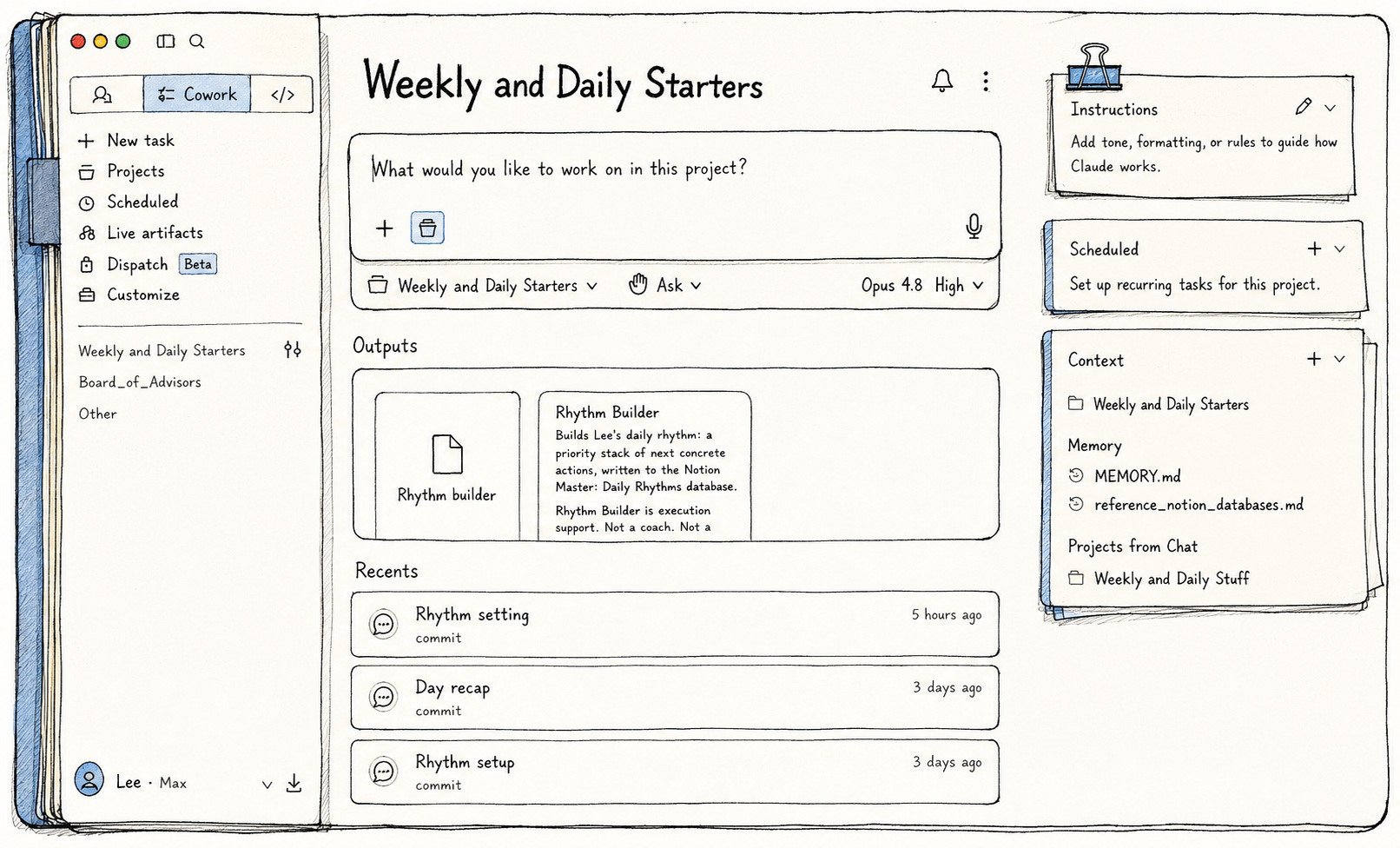
Some days the entry is “ran maintenance for the Agency.” Some days it’s “wrote and coded a waypoint.” Some days it’s a proposal, or a paragraph I finally fixed, or a post like this one. The size of the entry isn’t the point. The entry is the point.
What that did, quietly, was take the argument out of my own head. When the noise shows up, and it always shows up, I’m not standing there trying to remember whether I actually do anything. I’ve got the list, and the list settles it.
It also changed what I reach for on a low-capacity day. Instead of staring at the elaborate version and doing nothing, I look for the smallest finished thing I can put on the list. Maintenance, not a rebuild. One paragraph, not the whole page.
Tracking it turned shipping from a thing I felt anxious about into a thing I could see myself doing. That’s the difference between a slogan you nod at and a practice you actually run.
✳︎ ✳︎ ✳︎
A Small Example, Since I’ve Been Talking About Small Things
Where the idea came from. There are weeks when I hit the same wall of what to share, because sometimes there’s no “big” experiment or project driving the topic. And a vague topic is no use to you. It isn’t anything usable, it’s just noise. The problem is never a lack of things accomplished in a week, or a shortage of ideas. It’s turning the vague or the mundane into usable raw material without creating cognitive overload.
How I applied it. On June 2nd, I built a dedicated GPT: the DigiNav Content Explorer. It doesn’t write articles and it doesn’t replace my process. It does one bounded thing: takes a vague topic and hands back a small, reviewable set.
Question, Core Insight
Audience Tension
Potential Framework
Audience Language
Suggested Content Path.
The full research package is still there, but only if I ask. The default shifted from Question → Massive Research Package to Question → Insight → Decision → Optional Research.
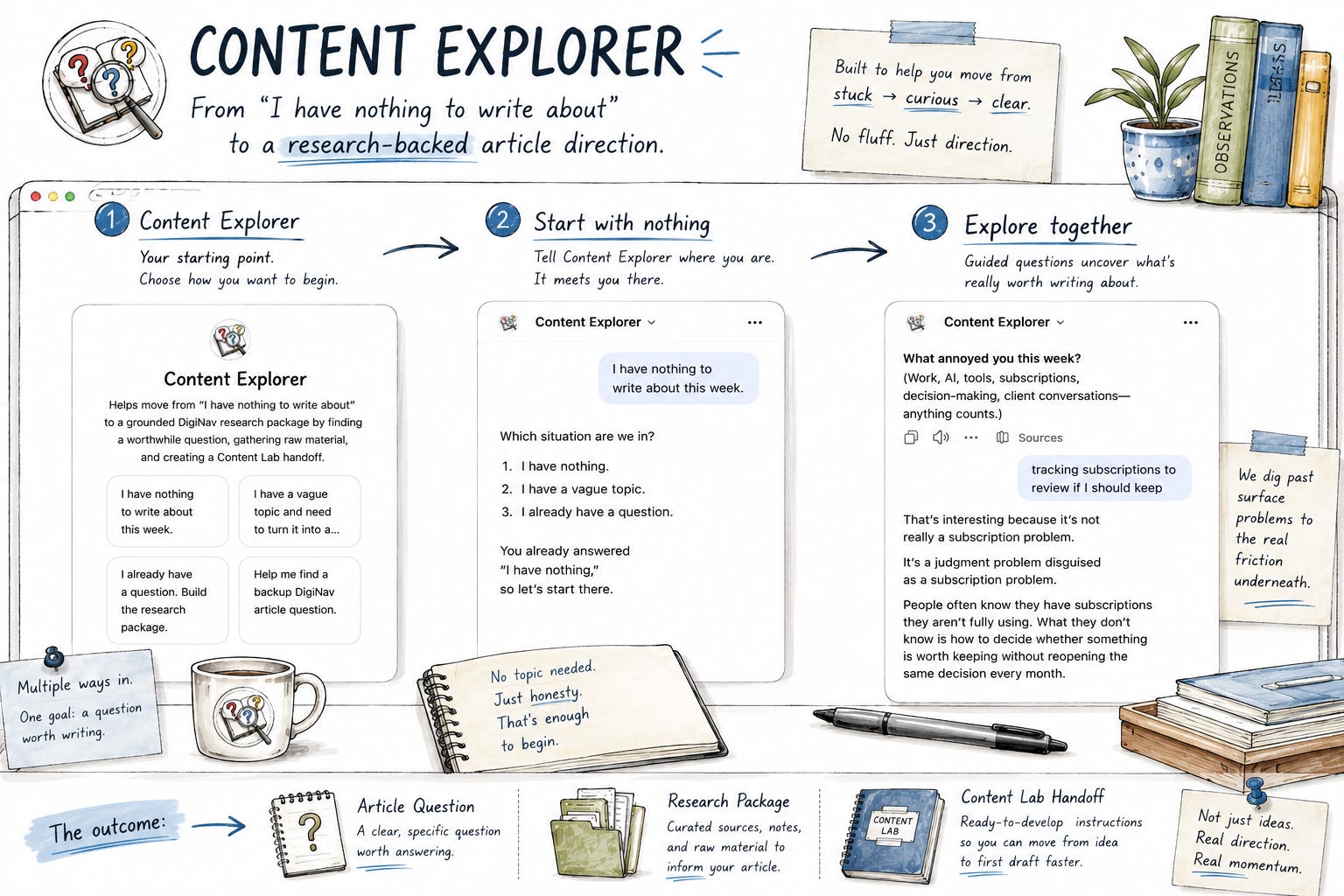
So that I’m never stuck for too long on what to produce. Instead, the GPT lets me dig into the experiences I’ve already documented, or the questions that bother a lot of you. Sometimes it’s a memory jogger; other times it points me toward what to test next. This small build gives me a well-researched topic to follow in minutes, instead of wracking my brain over what’s next.
The result. It does what I built it for. The shorter output is easier to react to. I can look at it and move, instead of drowning in a research dump. It’s handled the topics I already had, the half-formed ones, and the flat-out “I’ve got nothing this week” mornings. Not a dramatic win. A small tool that does one job and gets used.
The tie forward. If you’re sitting there staring at the screen, wondering what you could share that might help someone else — this is the size of thing I mean. It’s not writing the article or inventing the conclusions for you.
It’s doing the heavy lifting on the research, and that’s often what sparks your next step.
✳︎ ✳︎ ✳︎
Back to the Lemons
So back to the lemons.
The dessert I imagined never got made. It was the big version, the one that needed time and energy I didn’t have that week, or the next. If “making something” only counted when it looked like that dessert, I’d have ended the week with a bowl of soft lemons and nothing to show.
Instead I’ve got a cube in my water every morning. Small. Finished. Doing its job with no extra work from me.
That’s the whole thing. The maintenance run, the waypoint, the proposal, the rewritten page, the GPT that hands me a topic in minutes, this post. None of them are the dessert. They’re all the cube. Small, finished, real, and already out in the world.
You’re shipping more than you think. You’re just measuring it against a picture that was never the point.
So here’s what I’d leave you with: stop checking your week against the big version. Think about the tiniest thing you put out this week. That’s a build.
Got something you need to think through?
If you’re stuck on which small thing to finish, or the whole thing just feels off in a way you can’t name yet, I built a short walk for exactly that moment. A few minutes, your own words, and you leave with a next move, not a pitch.
Something doesn’t feel right →
✳︎ ✳︎ ✳︎
Thinking Through Something?
If you’re sitting with a decision, workflow, tool stack, or AI process that technically works but doesn’t feel quite right, I offer limited advisory sessions for solo business owners trying to sort through the noise without adding more complexity.
This is very relatable because I was having a similar conversation with my colleague the other day. I read this 70% and then quickly skimmed. Very well written!