


Every session started the same way.
Open a new conversation, load the three docs, explain what I was working on, explain how I worked, and explain what I would and wouldn’t do. AI would take it in, do something reasonable with it, and we’d move forward. Then I’d close the tab.
Next session: start over.
This was early, before AI tools had real memory, or right at the edge of it. All three foundation docs were in place by then. The Business Snapshot, the Audience Profile, the Voice DNA. Loaded together, they gave me better output than I’d gotten before. I thought that was the fix.
The problem showed up when I’d ask for help thinking through a decision. The answer would come back technically right, sensible on paper, but wrong in ways I couldn’t always name immediately. Suggestions that ignored a second business I was running. Directions that assumed a work style I don’t have. Boundaries none of the docs had any way of knowing existed. I’d add the missing context manually. The session would improve. I’d close the tab. Next session: start over.
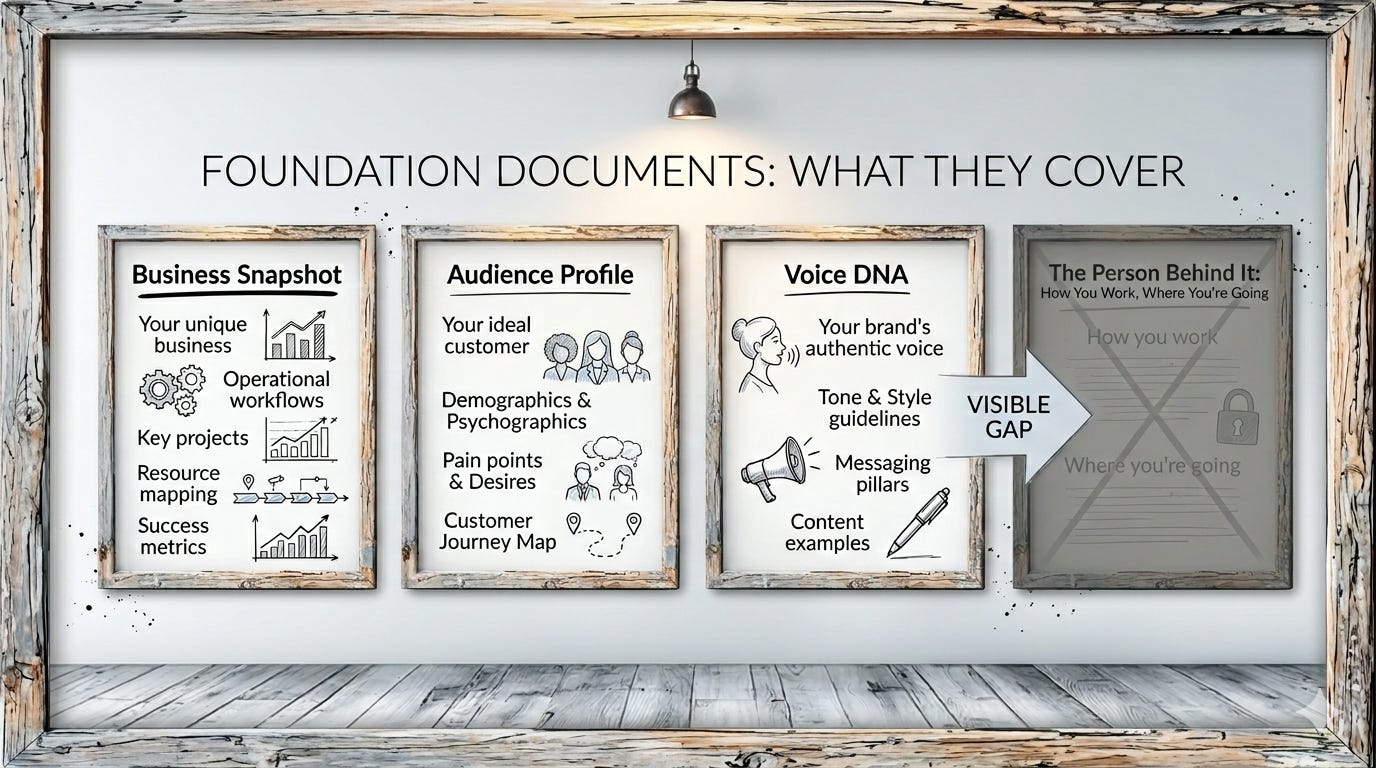
Business, audience, voice: the three docs tell AI about the operation. They say nothing about the person behind it.
Why This Is Harder Than It Looks
The standard advice is to build the three foundation docs and call it done. Business Snapshot. Audience Profile. Voice DNA. It makes sense. You’ve given AI the business context, the audience context, and the communication style. The logic is the same one we use when laying a building foundation: pour it once, get it right, then build on top of it.
The advice isn’t wrong. The three docs do what they’re supposed to do.
What they don’t do is tell AI how you work. Your decision-making style. What drains you. When you do your best thinking. What you’d never agree to, regardless of how sound it looks on paper. The reality of running a second business alongside the first. None of that is in a Business Snapshot. None of it belongs in a Voice DNA doc. It doesn’t have a home yet. The conventional wisdom skips the part nobody talks about: the person behind the operation.
A foundation without the framing that goes on top of it is still just concrete. It’s a starting point, not a finished structure.
What I Tried That Didn’t Work
So I tried the obvious thing first. I went back into the Business Snapshot and added a section. A few lines about how I work best: the hours I protect, the second business, the things I wouldn’t do regardless of what the numbers said. The logic was solid. The Business Snapshot was already the doc I loaded first. If I put the missing context there, it would be there.
It helped for about two sessions. Then the same drift came back. The Business Snapshot was built to describe the operation — the model, the audience, the positioning. When I added personal operating notes to the bottom of it, the doc did what docs do: it held everything without prioritizing any of it. AI would take in the full thing and give more weight to the business description than the three lines about how I work.
I’d patched a doc that wasn’t broken to solve a problem it was never built to solve. And I nearly convinced myself it was working. The sessions weren’t obviously broken. The output was still reasonable. But reasonable isn’t the same as right, and I was still adding the same context manually, session after session, the same way I had been before I touched the Business Snapshot at all.
Half-right output is harder to catch than wrong output. Wrong output is obvious. Half-right looks reasonable until you try to act on it and realize it was built for a version of you that doesn’t quite exist. I had documented the business, the audience and the voice. I hadn’t documented myself. And I’d spent time patching a doc instead of building the one that was actually missing.
What Actually Shifted
What finally changed wasn’t adding more to the three docs. It was realizing the three docs were never built to answer those questions.
Each one was doing its job. The Business Snapshot covered the business. The Audience Profile covered who I was talking to. The Voice DNA covered how I sound. Together they did what they were designed to do, and still left a gap I kept filling manually every single session.
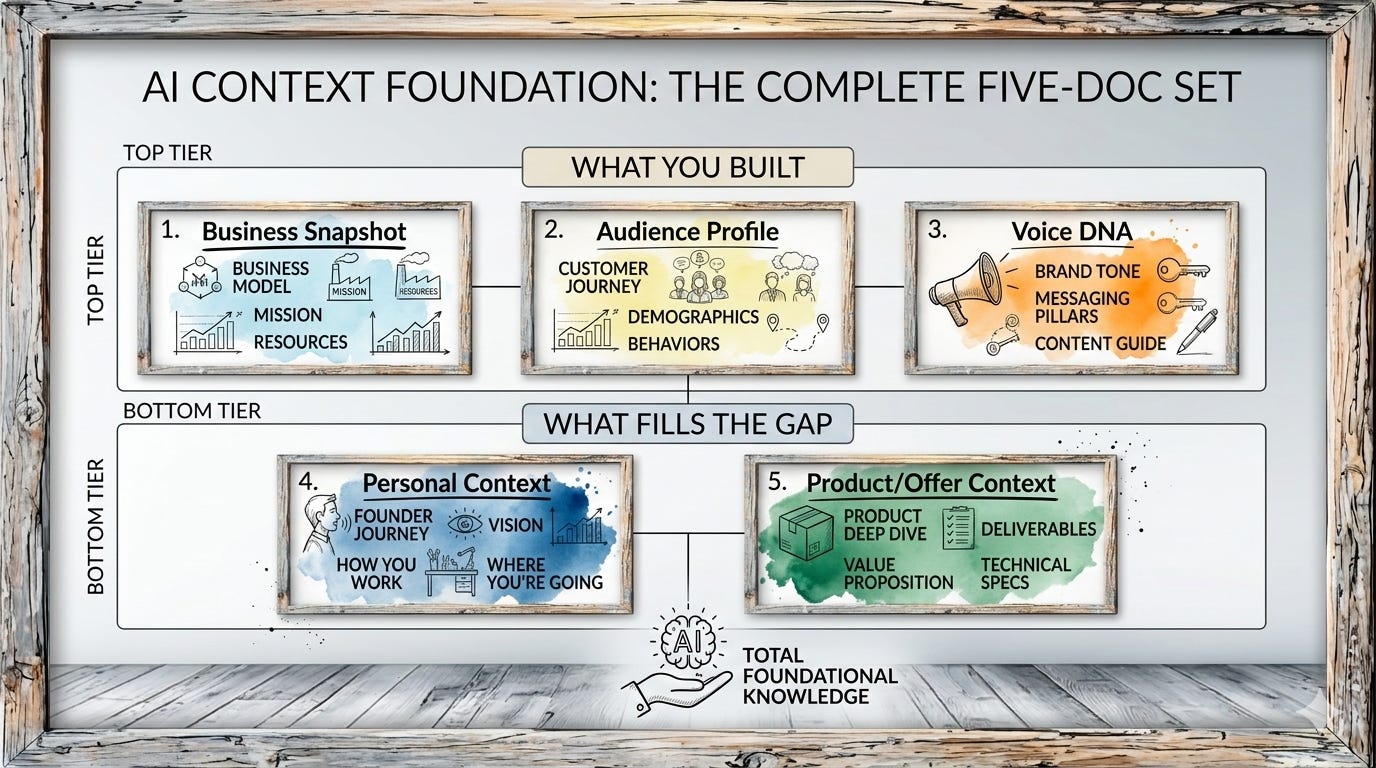
Two things were missing that had names once I looked at them directly. The first: Personal Context. Not communication style (that’s what Voice DNA covers). Operating style. When I do my best thinking. What drains me. My non-negotiables. The behind-the-scenes reality of running two businesses at once. How I actually make decisions, not how I’d describe my decision-making process if someone asked. The difference between those two things is larger than it sounds.
The second: Product/Offer Context. What I’m building toward, whether the offers are fully formed or not. What I’d never build, even if it made sense on paper. What success looks like in 12 months. Without it, every planning session defaulted to what had worked for everyone else before, solutions built on hustle-culture assumptions that had nothing to do with how I wanted to work or what I was actually building toward.
Once both existed, the sessions changed. AI stopped suggesting strategies that required energy I don’t have at the time of day I do most of my work. The rules I’d built around energy and recovery stopped being invisible constraints I had to re-explain every time. Planning had somewhere to land.
I had documented the business. I hadn’t documented myself. Those are two different documents.
The change from here doesn’t arrive all at once.
Build is where you are after the docs are in place. The foundation is real. That’s the table stakes.
Refine is the first few weeks of use. You notice something’s still off, open the doc, update a line. The next session is better. This is the system working, not failing.
The compound is harder to see from inside it. Sessions get easier. You stop re-explaining yourself. The output starts fitting in ways that accumulate quietly.
Operating differently isn’t a destination. It’s what’s already happening if you’ve made it to compound.
Here’s What This Looks Like in Practice
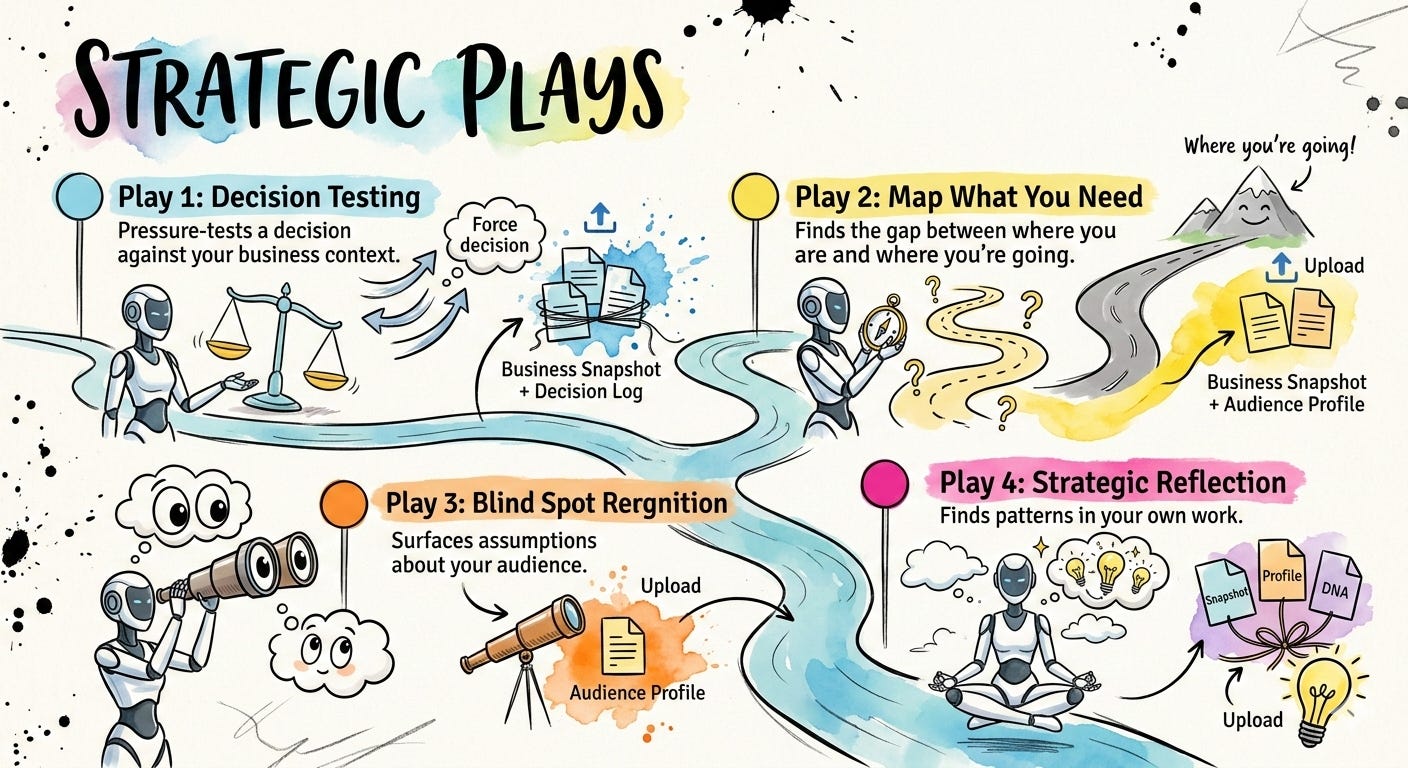
You now know what two docs are missing. While you’re building them, the foundation you already have can handle four plays. Each one pressures a different part of your context so you can see what’s holding and what’s missing. Run them with three docs. Run them again with five. The difference between those two sessions is where the remaining gap shows up.
Play 1: Decision Testing. Run it before committing to anything, new tool, new offer, new direction. It tests a decision against your actual business context instead of general reasoning. Why it matters: a decision that fits your business on paper might not fit how you work or what you’re building toward. Upload: Business Snapshot. Add Personal Context and Product/Offer Context when you have them.
Play 2: Map What You Actually Need. Use it when you know what you’re working toward but can’t see clearly what’s between you and it. It skips the 90-day roadmap and gets to the smallest useful next step. Why it matters: Personal Context shows whether the path forward actually fits how you work; Product/Offer Context gives the mapping somewhere real to land. Upload: Business Snapshot and Audience Profile. Add the two context docs when you have them.
Play 3: Blind Spot Recognition. Use it when the audience feels right on paper but the content isn’t landing the way you expect. It surfaces the gap between your interpretation of their problem and what they’re actually dealing with. Why it matters: knowing what you’re building toward changes which audience blind spots matter most. Upload: Audience Profile. Add Product/Offer Context when you have it.
Play 4: Strategic Reflection. Run it at the end of a month or a project cycle. It finds the patterns in your own work before you build more: what’s emerging, what’s stalling, what question you should actually be sitting with. Why it matters: this play does the most work with the full five docs loaded. Patterns that look like business problems often turn out to be operating problems, and that only surfaces when Personal Context is in the room. Upload: all three docs. Add Personal Context and Product/Offer Context when you have them.
When I run these, what surprises me is how quickly the misfit shows up. The plays don’t need the two extra docs to run. They need them to stop giving you answers that are half right. The companion piece walks through each play in practice: the prompts, the process, and what done looks like. Same format as the starter kit, with interview prompts, synthesis prompts, and what a finished doc actually looks like for Personal Context and Product/Offer Context.
What It Costs to Stay Stuck
Running without these two docs doesn’t stop the work. It just means some of your time and energy go toward compensating for what isn’t documented yet.
Bad output is easy to spot. You see it, you fix it, you move on. Misfit output is different. It looks reasonable. It fits the business. It passes the first read. The problem surfaces when you try to act on it and realize it was built for a version of you that doesn’t quite exist, someone with different hours, different constraints, a different sense of where this is heading. So you correct it manually. Add the context that’s missing. Get a better answer. Close the tab. Next session: same thing.
The energy drain isn’t the bad sessions. It’s what you’re doing in the good ones. Every time you re-explain your working hours, your boundaries, your direction, that’s a doc that doesn’t exist yet doing its work anyway, through you, one session at a time. The work gets done. It just takes more out of you than it should. Without Product/Offer Context, AI defaults to what’s worked before for someone else, in a different kind of business, with different values about how work should feel. The answers point in a direction that isn’t quite yours, and you spend energy steering back each time.
Noticing this friction isn’t a sign that something’s broken. It’s pointing directly at what’s missing.
Key Takeaways
If you take away only four things from this, make them these.
Business, audience, voice, and then you. The three foundation docs cover the operation. They say nothing about the person behind it. For a solo business owner, those aren’t the same thing.
Half-right output isn’t a prompting problem. It’s a missing-docs problem. If AI keeps coming back with answers that look reasonable but don’t quite fit, the gap is in what hasn’t been documented yet, not in how you’re asking.
Two docs fill what the first three can’t. Personal Context captures how you work, not just how you sound. Product/Offer Context gives AI a direction to orient around, rather than defaulting to someone else’s playbook. Both answer questions the foundation docs were never built to answer.
The plays work now. They’ll work better with five docs loaded. Run them with what you have. Pay attention to where the answers still feel slightly off. That friction is showing you exactly what to build next.
You’re Allowed to Find This Hard
Building the first three docs is hard in a specific way. You’re answering questions about the business: what it is, who it serves, how it sounds. Those questions have answers, even if they take work to surface.
Personal Context and Product/Offer Context are harder in a different way. They ask you to document how you actually work, not how you’d like to work. To articulate a direction that might not be fully formed yet. To be honest about constraints and non-negotiables that feel uncomfortable to put in writing because putting them in writing makes them real. That’s worth naming. I still catch myself skipping the personal docs when I’m in a hurry, loading three instead of five and then wondering halfway through the session why the output keeps needing correction.
A half-formed direction doc is more useful than no doc. You don’t need certainty to build either of them. You just need enough honesty to give AI something real to work with instead of letting it fill the gap with someone else’s assumptions about how a business like yours should run. Start with one line that’s true. Update it when something shifts. That’s the whole process.
The companion piece covers how to build them: same format as the starter kit, with interview prompts, synthesis prompts, and what a finished doc actually looks like.
What’s one thing you find yourself re-explaining to AI session after session? Not a business detail. Something about you: how you work, what you need, what you’d never do. Drop it in the comments.
Documenting the business but not the person behind it is the gap. In a solo business, the way the owner thinks, works, and makes decisions is part of the system. Leave that out and the advice can look right but still miss the reality of the work.