

Yesterday, I shared why I decided to move my subscription tracking from Notion to Google Sheets.
The decision was already made. What happened after that is the useful part.
This is a look at the prompts, decisions, corrections, and checkpoints that moved the work from an idea to a working system.
The decision was already made: subscription tracking was moving from Notion to Google Sheets.
What happened after that is the useful part.
This is not a tutorial for copying my setup. Your tools, data, and rules may be different. It is a look at how the work moved from an idea to a working system, including the prompts that moved it forward and the places where human judgment still mattered.
If you have information stuck in a tool that no longer does what you need, there may be something here worth borrowing.
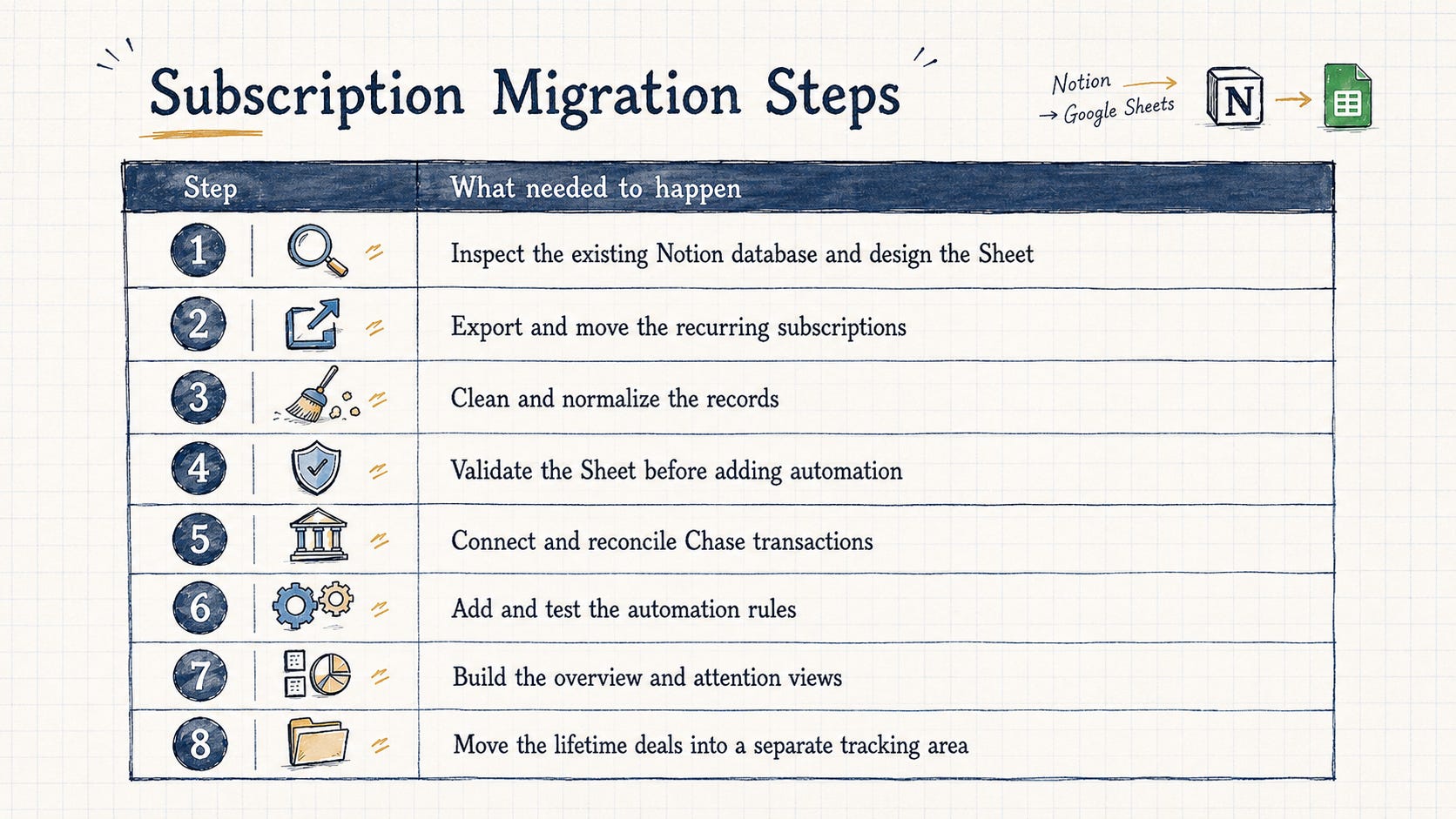
The working sequence
Before anything was moved, the project was divided into these steps of what needs to happen:
What does the finished system need to do?
What is actually in the current system?
Which rules require a human decision?
How does the plan move from Chat into Work?
Can the new system work correctly before automation?
How will actual transaction data reach the Sheet?
What can be automated safely, and what should stay visible?
Move the lifetime deals into a separate tracking area
The sequence kept “build the automation” from becoming one large, vague request.
✳︎ ✳︎ ✳︎
Step 1: Start with the job, not the replacement tool
The first prompt gave ChatGPT the destination and the reason for the move:
What I asked:
“Let’s come up with a five-step game plan to convert this from a Notion database to a Google Sheet with automation.”

A version you can adapt:
I want to move [current system] from [current tool] to [new tool] because [reason]. Before changing anything, create a phased plan that covers inspection, design, migration, validation, and automation. Show where you will need my judgment or access.
The end state was also clear. The Sheet should connect with Chase transactions, identify paid subscriptions, and show changes such as a price increase.
ChatGPT proposed this order:
Audit the Notion database.
Design the Sheet around expected versus actual charges.
Move and clean the data.
Build the Chase matching process.
Add the monitoring layer.
The useful part was not the number of steps. It was the order. The Sheet needed to “tell the truth manually” before Chase became an evidence source.
Food for thought: When a system is not working, it is easy to start with “move this into another tool.” A better first question may be: What should this system know, compare, or bring to my attention when it is finished?
✳︎ ✳︎ ✳︎
The plan was the easy part.
The real work started when ChatGPT inspected the existing database, found the contradictions, and brought the decisions back to me.
The rest of this article includes the prompts, corrections, checkpoints, and automation choices that moved the project from a plan to a working system.
