

My dad was a builder and tinkerer, always making us kids the coolest stuff. My favorite was a pair of walking stilts, the kind clowns use in the circus to make themselves ten feet tall.
It was easy to master walking on them, once you were up. And that was the problem.
The easiest way was to have someone help you. They held onto the stilts. You hoisted yourself up, and off you went, but there were times, more often than not, when nobody was around to help. That's where the Back Porch Steps came in. Sure, they were a little bit hard to navigate at first, and I can say not at all that safe, but they gave you the boost you needed to get started. And the same thing happened the other day when I found out ChatGPT could give you the same kind of boost.
Hi, I’m Lee. Welcome to DigiNav Compass Signal. Around here, I share what happens when AI and technology meet a real business—the useful parts, the messy parts, and what you can take into your own work.
Today, I’ll be showing you what happened when a handoff I’d always done by hand quietly stopped being my job, how it changed the way I split thinking from building, and what it might have you looking at in your own setup.
The handoff I always did myself
It all started in ChatGPT that day in a regular chat, and that was on purpose. I was thinking something through, and thinking is not something I want to spend my time and tokens on in Codex Work. Work is where the building happens, you know, the doing part. So I stay in chat while it's still a conversation, mapping and planning, and when it turns into something real, a punch list or a plan, I move the project over to Codex Work.
What I happened to be working out that day was my subscription tracking migration:
Get it out of Notion and into Google Sheets.
Link my Chase statements to the spreadsheet.
Let it record the payments and what was due when.
But it wasn't the subject that mattered. What mattered was that it started as a conversation in Chat and it needed to end up as an action plan in Codex.
So once it was all sorted out, I asked for what I always ask for:
Give me a recap, a punch list, and context of this conversation in Markdown files so that I can move it over to work.
And I already know what comes next. Download the files into the right folder, move it over, and start the conversation again with the proper assets and context. All of that just to move something already finished into another space without having to re-type or rehash the whole conversation.
✳︎ ✳︎ ✳︎
Continue to work?
Except that isn't what happened. I asked for the files, and instead of handing me the markdown files to go carry somewhere else, I got this:
Continue With Work?
You want me to create and move files into your local Obsidian vault, so Work mode is the right place to perform those file operations safely.
And then a button. Continue with Work.
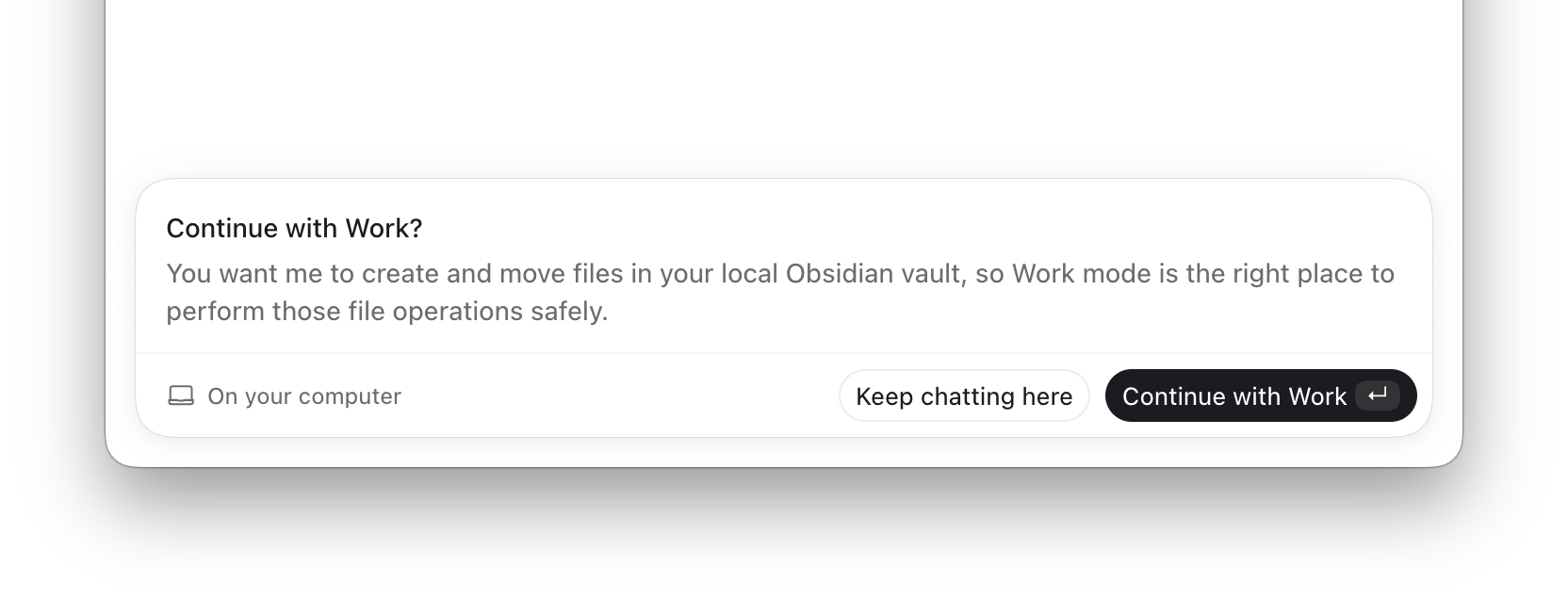
To be fair, I had told it where the files were going. That was in the ask. What I didn't expect was for it to treat that as the next step instead of the end of the conversation.
So of course I clicked Continue with Work. And it went and opened up work and continued the conversation there. It updated the project and added the three files I had asked it to create. It actually found the open folder in Obsidian and did the work from there.
No more download, move the files, reorient the conversation. The part that I always did manually was now happening for me. Automatically.
✳︎ ✳︎ ✳︎
Nothing had to be explained twice
My reaction to finding this new feature was a holy crap moment. Is this a game changer for using the thinking side and the doing side? The best part was the time and energy it saves. I mean, nobody minds skipping a few steps.
But here's what happens when one hand works with the other. I didn't have to retype any of the planning and clarification that I got as part of the setup, because chat knew that I wanted three files:
the recap of what we had worked out
the punch list of what still needed to happen
the context of why we made the decisions that we made
So while a lot of the heavy lifting was done with the regular AI chat, it carried over word for word, thought to thought, and clarification to clarification. The first thing that happened by moving from one model to the next wasn't a reorientation. It was picking up the punch list and starting to work on it, because at this point I knew the rest of the build could be done by ChatGPT work and not me manually making the changes.
It was ready to pull the subscriptions out of Notion and put them into Sheets, and here is how that went:
First it set up the Google Sheet based on the decisions that we had made on what to keep and what to dump.
Then we worked through connecting the Chase statement, because there wasn't a connection or an MCP available, but there was definitely a workaround.
That let me bring in the reconciliation and the daily automation so that things could stay current without me having to lift a finger to do it.
So in the end it wasn't about starting from square one. It was that nothing had to be explained twice, and we were automatically able to move from one phase to the next.
✳︎ ✳︎ ✳︎
I'm doing more
Here's the thing though. I wasn't always this careful about where the work happened. For a long time I didn't separate chat and work at all, because I pay for the higher level and figured it was all one big pool. Why would I care which side of the house I was standing in?
What changed wasn't the tools. I'm doing more.
Building and automating instead of just planning to.
Several projects moving at the same time.
Images and design work running through other tools.
Research and plan review that has to happen before any of it is worth building.
And when you're doing that much, one big pool stops being a pool. I found that out the day I hit the limit in work and had to burn one of my resets just to keep going. That's not the point of the story, but it's what made me actually look at where it was all going.
What I found was that I'd been spending build capacity on conversation. Thinking out loud in the place that was supposed to be doing the work, and then wondering why there wasn't enough left when it was time to build. The old way wasn't wrong when I started. It just got too blunt for the amount of work moving through it now.
It's about working smarter.
✳︎ ✳︎ ✳︎
Where I've landed, for now
So here's where I've landed, at least for now.
Chat gets the thinking. Planning, brainstorming, mapping something out, the general questions I need answered before I even know what I'm building.
Work gets the doing. Acting for me, saving the notes, scheduling the tasks, running the complex steps once the goal and the punch list are clear.
Everything else gets the parts it's better at. Research, plan review, the image and design work. Claude and the others are in that mix too.
The other thing that changed is how I open. Now I start every conversation with some version of this:
Today we're working on [whatever it is] and the goal is [whatever the goal is]. Let's make sure we're on the same page. Ask me clarifying questions until we both understand what needs to happen to get there. goes hereIt sounds like a small thing, but it front-loads the arguing. We sort out what I actually mean while it's still cheap to sort out, and by the time we're done I either have a punch list or I know I'm not ready for one.
What tells me it's time to move isn't a number of messages or how long I've been sitting in a conversation. It's clarity. When I can say what the goal is and what the steps are, it's ready to go get done. When I can't, I'm not finished thinking yet and it stays right where it is.
And I want to be careful here, because this is what works for me, right now, with the work I'm doing and the tools I'm paying for. Yours might split somewhere else entirely. The products keep changing, what they'll do for you keeps changing, and my own setup will change again too.
It's not about the ai but knowing the best practices for you.
✳︎ ✳︎ ✳︎
The part that's easy to miss
By the end of that day, the whole thing was finished. The subscription tracker was migrated from Notion to Sheets. We added in the automation layer that pulls the data in from Chase for the reconciliation, and now it's keeping current on its own.
I have different views set up so that I can see what's renewing without going and digging for it. I even have the entire Lifetime Deals inventory back added to the information, which I honestly was going to give up on because that was a big undertaking itself.
And this is the beauty of finding the quiet parts.
Just like me walking on those stilts, there isn't one clear way to make something happen, but you need to find the best way for you to move forward. In this case, it was starting a conversation in chat, but letting work do the implementation for me. Same difference of having someone help you get up and moving or using the step that takes you to the next phase.
And here's what I keep coming back to. That change happened behind the scenes. Nobody announced it, nothing told me that the part I'd been doing by hand was now just handled. I only found it because of the way I work now, thinking in one place and building in the other. If I had stayed put in one of them, that button never would have come up.
Which makes me wonder what else has changed while I've been busy doing things the way I've always done them. That's usually where the difference is, and it's the easiest thing in the world to miss.