

Maybe you know the feeling. You’re not even sure you’ve really started with AI, and you already feel behind. To count, it seems like you’d have to become someone — an expert, a voice, a person with a take and a following. And underneath all of it, a quieter question: who am I actually supposed to listen to, and why does this already feel like a race I never entered?
I know that feeling. Not because of AI. Because of a book.
I’m a reader. It’s how I disconnect. No screen, no noise, just me and the page while ideas swirl in the back of my head. Most of what I read is fiction and biographies, because for me it’s about the story. And I have a rule: if a book doesn’t grab me, if it’s slow or it’s just not for me, I put it down and move on. No guilt. Life’s too short for a book that isn’t landing.
Then Lean In came out.
It wasn’t just a bestseller. It was a movement. Everyone was reading it, talking about it, building whole conversations around it. So I told myself, okay, I have to read this and see what all the fuss is about.
I had a hard time getting through it. Normally that’s my cue to stop. But this time I made myself finish, cover to cover, because of all the noise around it. Everyone seemed to be getting something out of it. What was I missing? Maybe if I just read the whole thing, I’d see what they saw.
I finished it. And the only thing I came away with was this: I don’t think this applies to me.
Which should have been fine. Except it didn’t feel fine. It turned into the question that actually stung. Why doesn’t this apply to me? What’s wrong with me that I can’t connect with the thing everybody else loves?
Hi, I'm Lee. I help solo business owners get clear on AI and automation decisions before they commit — no hype, no hustle, no borrowed playbooks.
New here? Find the room that fits → No Foundation Yet → Lost In Translation → Built For Someone Else → The Last Mile
A Ladder With Every Rung Already Labeled
For a long time I didn’t have words for what bugged me about that book. I just knew it wasn’t for me, and I felt a little bad about that.
Then AI showed up, and the same feeling came back.
Look around at the AI conversation right now. Before most of us have figured out where it even fits in our work, there’s already a ladder built, every rung labeled. AI expert. Prompt engineer. AI strategist. Thought leader. The lists of top voices to follow. The “women in AI,” the “women in tech.”
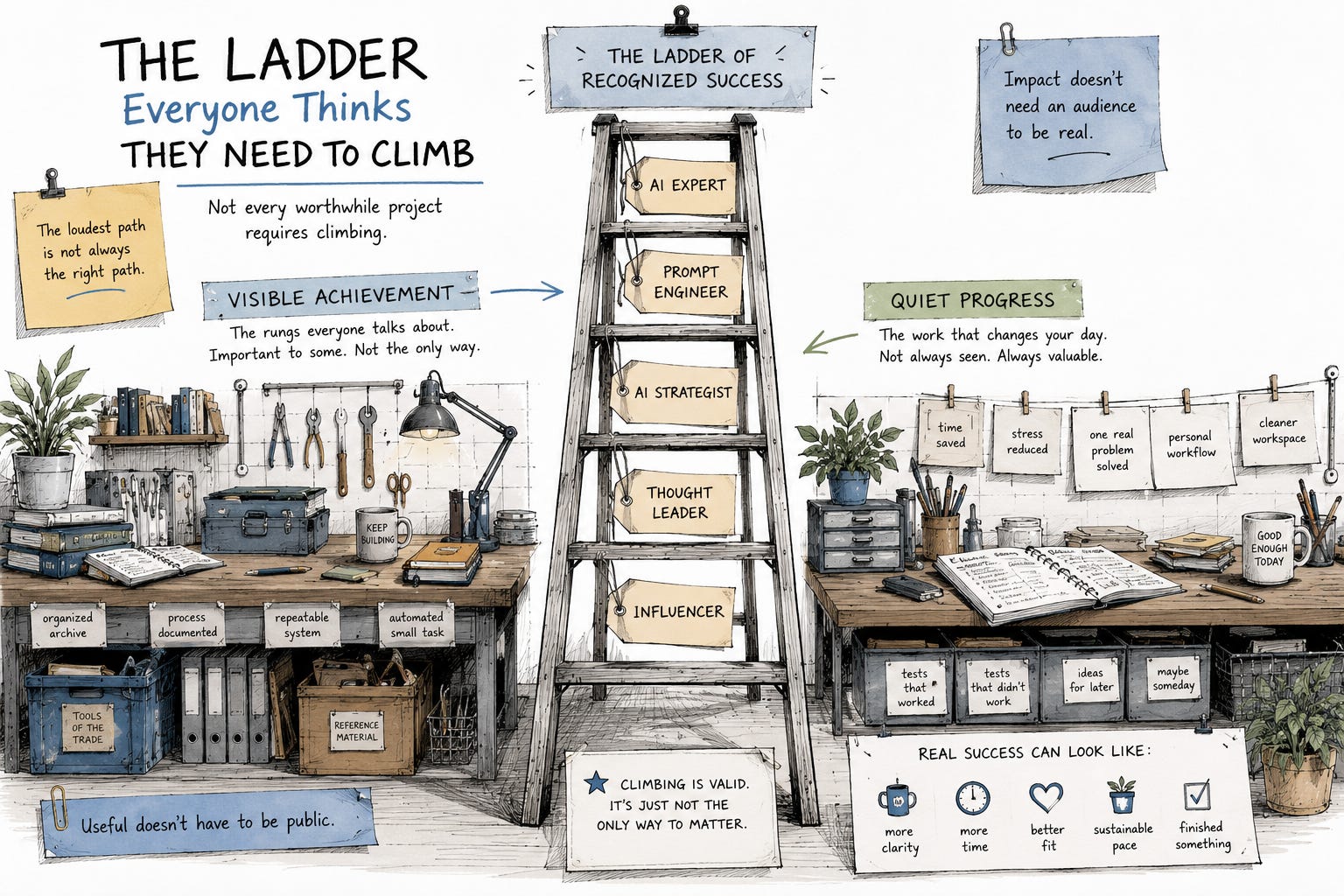
I want to be careful here, because this part matters to me. Women in tech have been overlooked for a long, long time. The visibility is earned. The recognition is good. I’m not knocking anyone who’s climbing, and I’m not knocking the women who are finally getting seen. That’s not the problem.
The problem is what the ladder quietly says to everyone standing near it. That to matter, you have to climb. That if you’re not building the app, growing the audience, becoming the voice, then you’re behind. Or worse, that you’re holding yourself back out of fear.
So the question underneath all the AI noise stops being which tool should I use. It turns into something heavier. Who am I supposed to become now?
✳︎ ✳︎ ✳︎
There’s Another Way to Lean In
Years later I finally understood what was bothering me about the message and the movement.
Lean In had one idea of success, and it was a narrow one. Climb. Get to the table. Get to the boardroom. And if you weren’t reaching for that, the book had an explanation ready: you simply hadn’t found your nerve yet.
But some of us weren’t afraid. We’d already looked at that version of success and decided it wasn’t the one we wanted. We’d chosen our own terms. Family, or a different pace, or work that fit the life instead of the other way around. The book couldn’t see that choice. It only saw a woman who hadn’t climbed yet. It invented a problem I didn’t have, and then handed me the guilt for not having it.
That’s the same move I feel in the AI conversation now.
There’s one shape of success on offer. Build the thing. Get loud. Become the authority. And if that’s not what you’re after, the explanation is already written for you: you must be scared of something, or behind, or playing it too safe.
I don’t buy it. And I don’t think you have to either.
Because there’s another way to lean in. You don’t have to lean in by going faster. You can lean in by going deeper.
When I say deeper, I don’t mean deeper into some specific app or model, learning every setting and every update. I mean deeper into the thing you’re actually trying to do. Pushing it to the edge of what you need it to do for you, and then stopping there. That’s enough.
And deeper is allowed to look small. It can be solving the single most time-consuming, annoying problem you have — the one that affects nobody but you, that nobody will ever clap for. It can be something you build to help you right now that’s useless in six months. That still counts. That’s still leaning in.
You took a chance on something small and unglamorous while everyone else chased big and shiny. Nobody hands out labels for that. Doesn’t make it matter less.
✳︎ ✳︎ ✳︎
What Lasts When Everything Keeps Moving
Here’s what I keep coming back to. Nobody has this figured out. The technology shifts every week, and outside the handful of people actually building it (it being the AI models), we’re all working with incomplete information. Me included.
That used to make me anxious. Now it does the opposite. If nobody has solid ground, then I don’t need to either. I just need to keep deciding what matters to me as things move.
I’ve lived through enough technology changes to trust that. In my twenties it went from analog to dial-up to modems. In my thirties, wifi and working online. Heading into my forties, online business became a reality for a lot of us. Every shift opened a door onto a dimly lit hallway. Nothing you could plan for, just feeling your way while you waited for more light to lead you.
Now there’s so much light you can’t figure out how to navigate. I’ve never felt anything move this fast. It’s exciting and it’s a little scary, both at the same time.
And what carried me through every one of those changes wasn’t being first to know, or having the most to say about it. It was being able to ask a decent question and decide what actually mattered to me.
That’s the skill that lasts. Not memorizing this month’s tools. Knowing how to decide.
So I have a few questions I ask myself now, almost without thinking, every time something new shows up:
Does this affect me?
Is it going to make my life better, or just different?
Does it touch my relationships, or the goals I’ve actually set?
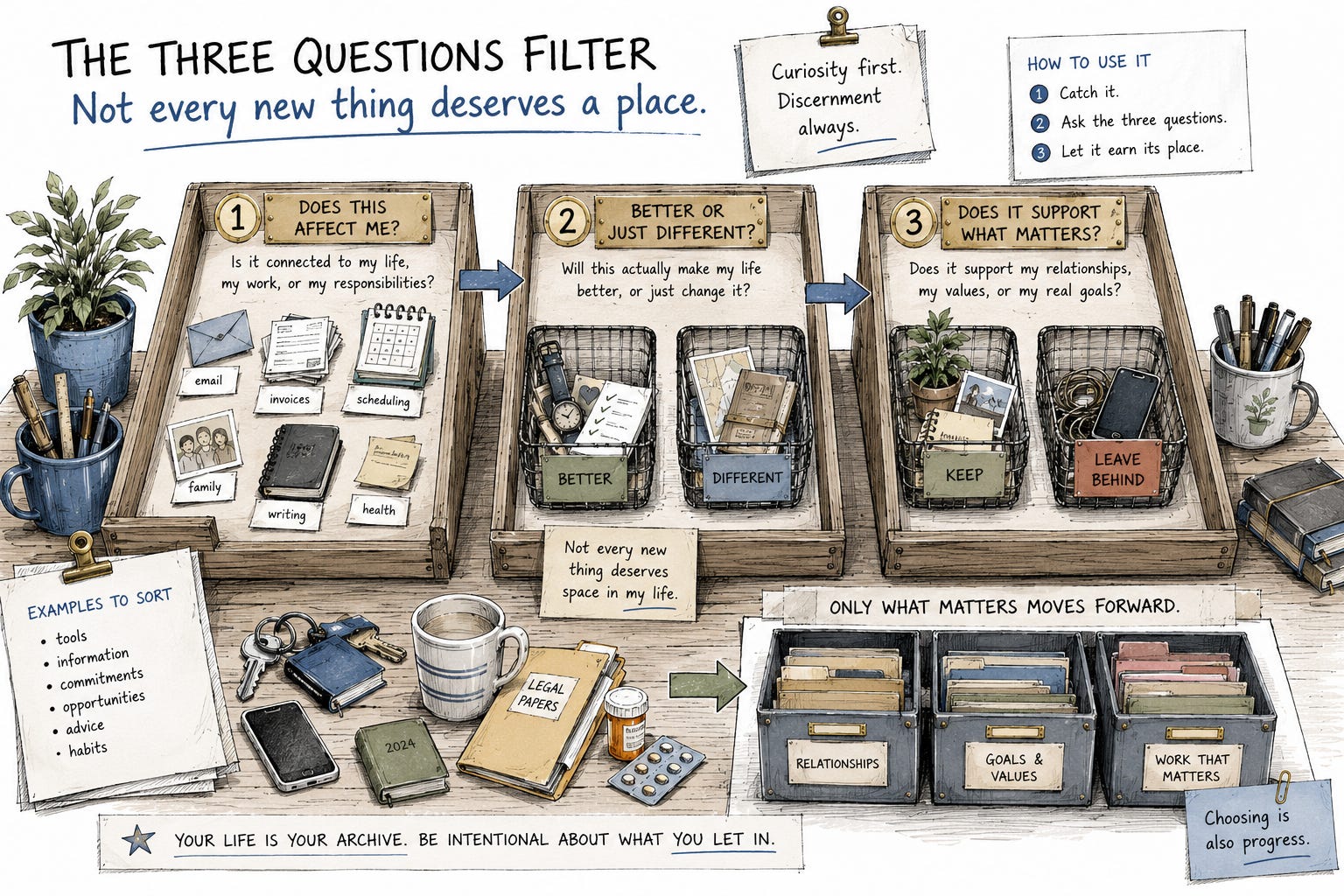
That’s it. It sounds like me-me-me, and honestly, it is. I’m putting myself first. Not to get ahead of anyone, not to push some agenda. Just to know, for my own sake. Curiosity is allowed to be only curiosity.
And those questions don’t just sort AI tools. They sort anything. A medical decision. A legal one. Money. Anywhere the noise is loud and the stakes are yours, the work is the same. Figure out what’s actually for you, and let the rest go by.
✳︎ ✳︎ ✳︎
The Smallest Thing I Built
Where the idea came from.
My AI conversations kept going in circles. Sometimes it was because I’d picked up someone else’s prompt, and what it handed back didn’t match the way my brain actually processes information. Other times I gave it conflicting information, or sent it off on a tangent. But the bottom line is I was getting frustrated, because it didn’t seem like AI was the smartest book on the shelf.
How I applied it.
Back in late May, I wrote myself a short collaboration profile. A plain description of how I think and work:
I figure things out by talking them through.
I need one question or decision at a time.
A wall of text or a big framework too early loses me.
I’d rather react to something small than start from a blank page.
Here’s the actual ask I gave the AI to build it:
I want to create a short context doc for the way that I think, process, and work, because what’s happening is that with a lot of my asks, the waters are getting muddied. Thinking is different than processing, and a lot of the time the AIs get confused by that. I’m imagining something short and sweet that I can paste in or put in instructions, because a lot of my conversations are going sideways. When you and the other AIs formulate answers, it’s for John Q. Public, not someone who struggles a little bit like I do. Maybe we go through ten questions or so and then come up with a summary.
Now, whenever I’m working on something, whichever AI I’m in, I hand it that context first.
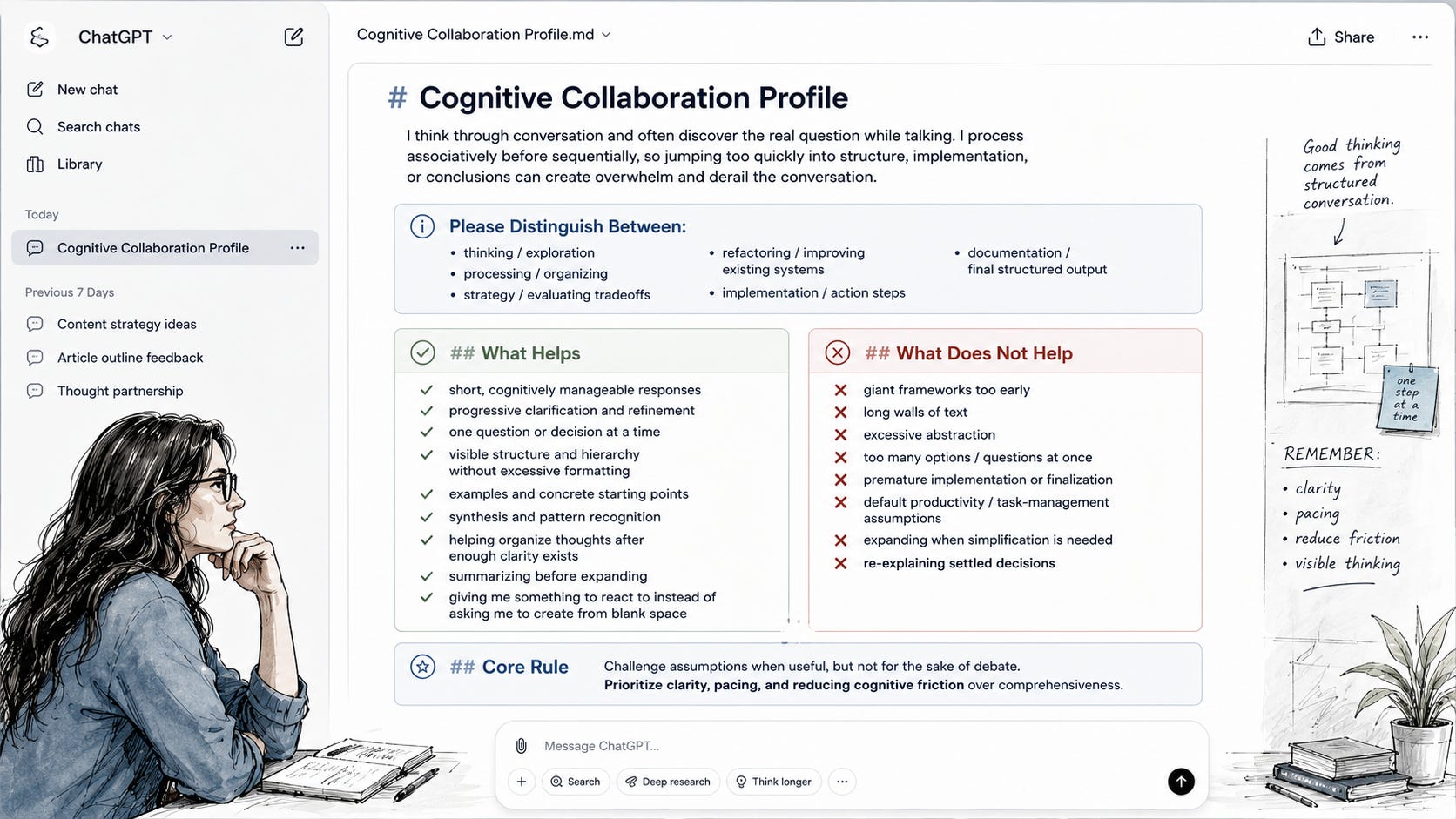
So that I’m not perpetually scrolling to find the advice or information I need. So that I get presented with options and time to think about them, instead of trying to decipher everything at once. Basically, I needed the AI to understand how I process information, so the output is specific to me.
The result.
And now it does the one thing I ask of it. The conversations stop circling. The AI meets me the way I process information instead of the way someone else does. It isn’t clever and it isn’t impressive. Nobody would look at it and jump up and down and go, why didn’t I think of this? I just use it every day. Instead of reiterating all of this in every conversation or every thinking session, I give it the parameters, and it knows how to have the discussion with me.
The tie forward.
And this is what I mean by building something small, just for you. If you’re sitting there feeling behind, wanting to build something big enough to count, this is the size of thing I mean. A plain document that makes one part of my day work the way I do. That’s a build. That’s what leaning in is to me.
✳︎ ✳︎ ✳︎
Back to the Book
So back to Lean In.
For years I carried that feeling from the finished book around as a small, quiet failure. Everyone else got something out of it, and I didn’t, and I let that mean something was off with me.
It wasn’t. The book had one idea of success, and it wasn’t mine. That’s all. The thing wasn’t wrong with me. The yardstick just wasn’t mine to measure against.
I think a lot of us are about to do the same thing with AI. Pick up the version of success that’s getting all the noise, hold our own quiet work up against it, and decide we’re behind. When the truth might be that we’re measuring with someone else’s ruler again.
This is the part I don’t want to lose. While everyone’s looking up at the loudest voices, the people actually changing things in our lives are often the quiet ones. The person who solved one real problem and mentioned how. The one who said here’s what I tried, and here’s what I found out, with nothing to sell you. We’ve been trained for a few years now to point our attention at the experts and the thought leaders. I wonder how many of the people making the biggest difference we’re walking right past.
You don’t have to become an AI anything. You don’t have to keep up, or get loud, or build something big enough to earn a label.
You just have to find the thing that’s actually yours, go a little deeper there, and share it if you feel like it. Not to get ahead of anyone. Just because it was yours, and it worked.
That’s leaning in too. It always was.
So here’s the one thing I’d leave you with, if you want it. That’s all I did when I wrote that little profile to help AI understand how I take in information and ask for what I need. It’s the kind of problem most people don’t even think to solve, and it’s quietly made the biggest difference in how I actually use AI.
So don’t go learn another tool. Pick the single most annoying, time-eating problem you have this week, the one nobody else would even notice, and see if AI can help you make one small dent in it. That’s the experiment. Not to have something to show for it. Just to find out.
✳︎ ✳︎ ✳︎
But sometimes the harder part isn’t picking the problem. It’s the nagging sense that you’re measuring against the wrong thing and can’t quite name what’s off. I built a short walk for exactly that. A few minutes, your own words, and you leave with a next move, not more noise.
If you read DigiNav Compass Signal, you’ll stop second-guessing your AI and automation decisions because you’ll have a way to tell what actually fits your business from what’s just noise.
The expertise is already yours. You just needed a framework to trust it again.
Those questions are excellent filters, Lee. And I LOVE the Cognitive Collaboration Profile! That sounds very helpful. And for the record, I skipped Lean In b/c it didn't seem a fit. So many business books are overhyped.