


I’m settled into the new house.
The boxes are unpacked. The Christmas tree is up. And in a few days, I’m hosting the family Christmas Eve gathering for the first time in the new space. The prep for that alone could fill a week.
But here’s the thing about December: the business doesn’t stop just because life gets loud. It just changes shape.
This week, instead of building new systems or pushing content, I’ve been doing something different. Preparing for a smooth return from holiday. Closing out stalled client projects. Retiring things that aren’t working. And thinking about what 2026 actually looks like.
So this newsletter is going to be different, too. No framework breakdown. No step-by-step. Just a reflection on what I learned this year... mostly by accident.
The Year That Kept Interrupting Itself
2025 was not the year of big projects.
It was the year of buying and selling a house. Surviving a move. Replacing a truck with a car that actually fits my life now. Managing holidays while keeping the business moving. Hosting family while the paint was still drying.
I didn’t have bandwidth for major initiatives. Honestly? I didn’t want to start anything big while everything else was in flux.
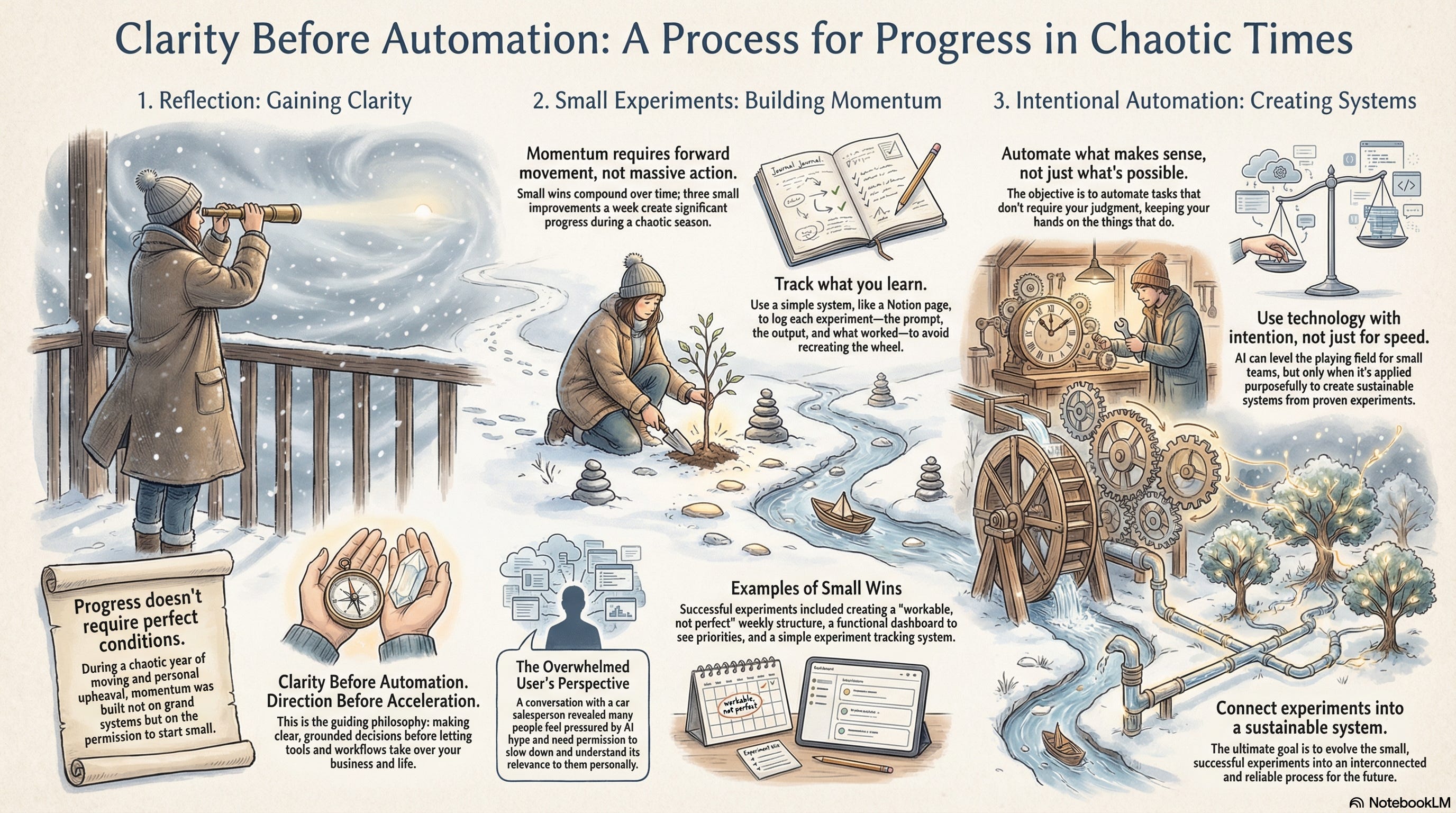
But here’s what I discovered: momentum doesn’t require massive action. It requires forward movement. Any forward movement.
The experiments I ran this month weren’t game-changers on their own. A newsletter triage system that saves 20 minutes of decision fatigue every morning. A self-audit of my prompting habits. A reflection process that helped me think about 2026 without the usual pressure of productivity planning.
None of them would make a headline. But stacked together during a low-bandwidth season? They’re exactly what kept me from stalling out completely.
What Actually Worked (The Experiments Recap)
If you’ve been following along, you saw the “Three Small Wins” piece a few weeks ago. But here’s what happened since:
The Weekly Five finally clicked. I’ve been trying to nail a consistent weekly structure for months. This week, it landed. Not because I found the perfect system. Because I stopped trying to make it perfect and just made it workable.
The Notion dashboard is taking shape. It’s not done. It might never be “done.” But it’s functional enough that I can see what matters and ignore what doesn’t. That’s the point.
The experiment tracking system is paying off. Simple Notion page with toggle dropdowns. For each experiment: the initial prompt, the output, a brief explanation of what worked or didn’t. Now, when I look back, I can see what I’ve already figured out. No more recreating the wheel.
The pattern here? Small wins compound. One tiny improvement doesn’t feel significant. But three small wins this week, plus three next week, plus three the week after? That’s how you end a chaotic season ahead instead of behind.
The Positioning Shift (And Why I Resisted It)
Here’s something I wrestled with all year: everyone is becoming an AI expert.
I pushed back against leaning into “AI and Automation” messaging because the space is crowded with people selling hype. The “10x your business” crowd. The “automate everything” evangelists. The folks promising revolutionary transformation without acknowledging the mess in the middle.
That’s not me. That’s never been me.
But I kept coming back to the same realization: the people I actually help aren’t looking for an AI expert. They’re looking for someone who makes this stuff feel less overwhelming.
So I made a shift. The new tagline:
Clarity before automation. Direction before acceleration.
It’s not about mastering AI. It’s about using it on purpose. Making clear, grounded decisions before tools and workflows quietly take over your business and life.
I updated the Substack. The YouTube channel. The about pages. Recategorized all the content. Got clearer on the road I’m actually taking.
And then something happened that confirmed I made the right call.
The Car Salesperson Who Changed My Perspective
I was at the dealership last week. Buying the car to replace my truck. And I ended up in a conversation with the salesperson about AI.
His reaction? Aversion.
Not because he was anti-technology. Because he didn’t understand how it was helpful. He didn’t feel tech-savvy enough to figure it out. And every time someone mentioned AI, it felt like one more thing he was supposed to master but couldn’t.
He wasn’t resistant to change. He was overwhelmed by the pressure to change without anyone explaining why it mattered to him specifically.
That conversation crystallized everything.
The people who need this work aren’t looking for another AI guru telling them to automate faster. They’re looking for someone who gets that the pressure to adopt AI can feel like one more thing you’re failing at.
“Clarity before automation” isn’t just a tagline. It’s permission to slow down, experiment, and decide what actually fits before committing to tools and systems that might not serve you.
That car salesperson? He’s exactly who I’m talking to. And so are you, if you’ve ever felt like AI was powerful and overwhelming at the same time.
What’s Coming in 2026
I’m not doing the big “goals and intentions” thing this year. (I already did that reflection with AI as a thinking partner. It went... places. Including Claude swearing at me when I asked it to be less sterile.)
But here’s what I’m thinking about:
Continue building the dashboard. Not for the sake of building. For the sake of seeing what matters and ignoring what doesn’t.
Add automations that make sense. Not “automate everything.” Automate the things that don’t require my judgment. Keep my hands on the things that do.
Tighten the content creation process. I’ve been running experiments on this all year. 2026 is about connecting them into a sustainable system.
Embrace the “this is our time” mindset. AI is leveling the playing field in ways most people won’t admit. Solo operators and small teams have access to tools that used to require entire departments. But only if you use them with intention instead of just speed.
That’s the direction. Not a roadmap. Just a bearing.
The Lesson I Keep Relearning
Here’s what 2025 taught me, over and over:
Progress doesn’t require perfect conditions. It requires permission to start small.
I didn’t build grand systems this year. I built small experiments that compounded. I didn’t wait for bandwidth I didn’t have. I used the bandwidth I had on things that moved the needle, even if they moved it slowly.
And when I look back at December... at the chaos of the move, the holidays, the family gatherings, the new house, the new car... I’m not behind.
I’m exactly where I need to be.
One More Thing Before the Holiday
This is the last newsletter of 2025. I’m taking next week off to be present with family and recover from the year.
When I come back in January, there’s more to share. I’m working on a workshop focused on getting your context right before building plans. The dashboard experiments will continue. And the “clarity before automation” positioning will keep evolving as I figure out what serves you best.
But for now? Thank you for being here. For reading. For experimenting alongside me. For being part of this weird, messy, momentum-building year.
Have a good holiday. Rest if you can. And I’ll see you on the other side.
What about you? What’s one thing you learned this year that you didn’t expect? Reply and tell me. I’d love to hear how your year shaped up.
For me, this year was very challenging! I hope 2026 give us a break. I learned that my real value isn’t in doing more or mastering more tools, but in my human judgment—knowing what should be done, not just what can be automated.