

We’ve moved a lot. Like, a lot. And with each move comes the ritual: unpacking boxes, arranging furniture, painting walls. I’m the type who visualizes the entire room before anything gets placed. I see where the couch goes, which wall gets the accent color, how the natural light will hit the space. I can picture it perfectly—the traffic flow, the sightlines, the whole thing.
My vision is usually close. It’s just never quite right.
Enter my husband. I’ll pick out a paint color that looks like it fits, and he’ll take one look and say something like, “This gray looks good in a small swatch but in this big room with three windows it will be ugly and bland.” Then he’ll add some white, remix the color, and suddenly the color works. Not the version in my head—a better version that actually functions in reality.
The running joke in our family: I’ve never picked a paint color that made a wall untouched.
Here’s what I didn’t realize for years: he’s not correcting me. He’s testing my theory against reality and adjusting it based on what he discovers. He treats iteration as part of design, not a sign design failed.
I was treating iteration like a dirty word.
Where Content Planning Becomes the Problem
I learned the hard way that this pattern shows up everywhere—not just in paint colors, but in systems I build.
Most people think the problem with content strategy is that you haven’t planned far enough ahead. So they plan more. They create detailed spreadsheets, map quarterly themes, anticipate every pillar and angle. They let AI generate topics based on business strategy. Then they sit down to execute.
But here’s what I discovered: the problem isn’t that planning is bad. The problem is confusing a complete mental picture with a complete design.
I spent hours mapping out 12 weeks of content for DigiNav. I had the whole thing visualized: brainstorm topics → map to refined stories → pick or create supporting video → write the article. Clean. Systematic. Complete.
I created a spreadsheet with topics, themes, which content pillar each one served, video descriptions—the whole thing. It looked perfect on screen. Organized. Strategic. Like if I just executed this plan exactly, 12 weeks of content would flow out seamlessly.
Then I opened the database in Notion and felt it immediately: this is generic fluff.
Not because the topics were wrong. Not because the framework was broken. But because I was looking at a list of content ideas that could work for anyone. They didn’t spark anything. They didn’t feel like me. They felt like exactly what AI generates when you ask it to plan content from strategy—structurally sound, contextually hollow.
Here’s where most people get stuck: They interpret that disconnect as a planning failure. They should have thought it through more. They need better strategy. So they go back and replan, hoping that more detail will create alignment.
But that’s not what was happening. And that’s not what fixes it.
When the Plan Met Reality
I looked at my beautiful 12-week plan and realized something: I’d planned the content without testing whether the planning process itself actually worked.
I’d done exactly what I do when I visualize a room. I’d created a complete picture in my head and assumed executing it would be the same as building it. Except it wasn’t. Because the moment I started executing, reality showed up.
So I stopped trying to execute the plan and started asking a different question: Why does this feel wrong?
I created a new Claude thread. I added my business context, my content pillars, my framework. And then I said: “Look at this 12-week plan I created. Something feels off. Help me diagnose what it is. This isn’t implementation—let’s talk about it. Ask me questions to clarify and call me out on my stuck points.”
Here’s what Claude came back with: “I find a disconnect. It’s structurally correct, but contextually hollow.”
That sentence stopped me. Because that was exactly it. The plan was structurally correct. It hit all my pillars. It was organized by theme. It showed strategy. But it wasn’t connected to anything I was actually building or thinking about.
Then Claude asked: “What are you actually building and navigating right now? What’s the real difference between a topic that feels generic and a topic that says, ‘Oh, I have something to say about that’?”
And finally: “Should the planner generate topics based on your real-time work rather than a pre-planned calendar?”
That’s when it clicked. The problem wasn’t that I needed to plan better. The problem was that I was treating the plan as a blueprint rather than a hypothesis. I was confusing “I’ve thought this through” with “I’ve tested this and know it works.”
From Generic Topics to Real Angles
The False Start: More Detailed Planning
My first instinct was to fix it by planning better.
So I went back to the original prompt. Made it more detailed. Added more context about my voice and approach. Specified exactly which framework should appear in which piece. Added more specificity about tone, structure, engagement hooks.
That made things worse. More planning didn’t produce better content. It produced more overthought, more constrained content that felt even further from what I actually wanted to say.
I was writing to the system instead of writing to discover what I actually thought, which is exactly the opposite of staying authentically me.
The Turning Point: The Diagnostic Question
Then something shifted. When I asked Claude to help me diagnose instead of fix, it asked me: “What are you actually building, learning, navigating right now?”
And I realized: I am building something. I’m actively working on refining my content automation process. I’m discovering what works and what doesn’t. I’m navigating the tension between planning and executing. I’m building in public, showing the messy middle. That’s real work. That’s material.
But my 12-week content plan didn’t reflect any of that. It was theoretical topics, not real work.
That’s when I understood. I wasn’t generating content topics from thin air—I was trying to. Which meant everything was generic.
My husband doesn’t visualize room color better than I do. He relies on his experience as a commercial painter to test the theory against reality. He observes what actually happens, then adjusts based on data. He treats iteration as part of design.
I was treating my planning the same way I treat visualizing rooms: as if the first picture were the final answer.
The Experiments: Testing Different Approaches
Tried: Let Claude generate 12 weeks of topics upfront based on my business pillars and strategy .
Result: Organized spreadsheet. Generic topics. Nothing sparked. Felt hollow.Tried: Abandon the plan entirely and write intuitively whenever I felt inspired.
Result: Some alive pieces. No coherent strategy across them. Scattered and chaotic.Tried: Identify real work I’m doing, then ask Claude to extract 5-7 different angles from that one project.
Result: Content ideas that felt alive. Grounded in actual work. Strategic without feeling generic. Each angle sparked something.
Number three changed everything.
Angle Extraction Instead of Topic Planning
Here’s what finally clicked: I don’t need a content planner that generates topics from strategy. I need a content angle extractor that takes work I’m already doing and shows me all the different ways I can present it.
Claude said it perfectly: “What you’re actually doing is not talking about planning content. You’re talking about extracting content angles. And that’s different than planning content.”
Think about the difference:
Content Planning: “Based on your business strategy, here are topics you should cover this quarter”
Angle Extraction: “You’re working on X right now. Here are 5-7 different angles you could pull from that work that would matter to different parts of your audience”
They sound similar. They’re completely different.
Content planning starts from nothing. It generates ideas from strategy, which defaults to generic. Angle extraction starts from real work and multiplies it. It takes something alive and shows you all the ways it connects.
When I stopped asking Claude “what should I write about?” and started asking “I’m working on this—what angles can I pull from it?”—everything shifted. The content felt true. It felt grounded. It felt like mine.
Why This Looks Different When You Understand It
When I work with clients building content systems, the conversation usually starts the same way: “I need better content strategy.”
But when I dig deeper, I find they’re doing what I was doing. They’re asking AI to generate topics from strategy rather than extracting angles from the work.
One client told me: “I have plenty of content ideas when I’m working with clients. But when I sit down to plan content, nothing comes to me.”
That’s not a planning problem. That’s a sourcing problem. When you’re in the middle of real work—solving a client problem, building a system, discovering something—you see multiple angles naturally. You see how it connects to different parts of your business. You see how different audiences would relate to it.
But when you sit down to plan content in the abstract, you have nothing to extract angles from. You’re generating from strategy, which always feels generic because it’s not grounded in anything real.
Here’s the principle that applies: Generic content comes from planning without material. Grounded content comes from extracting angles from real work.
How to Actually Plan Without Overplanning
This is where most people trip up. They hear “extract angles from real work” and think it means abandoning planning. That’s wrong. It means planning differently.
The Old Way: Generate topics upfront → organize them → execute them
The Smarter Way: Do real work → extract multiple angles → organize by pillar → execute the angles
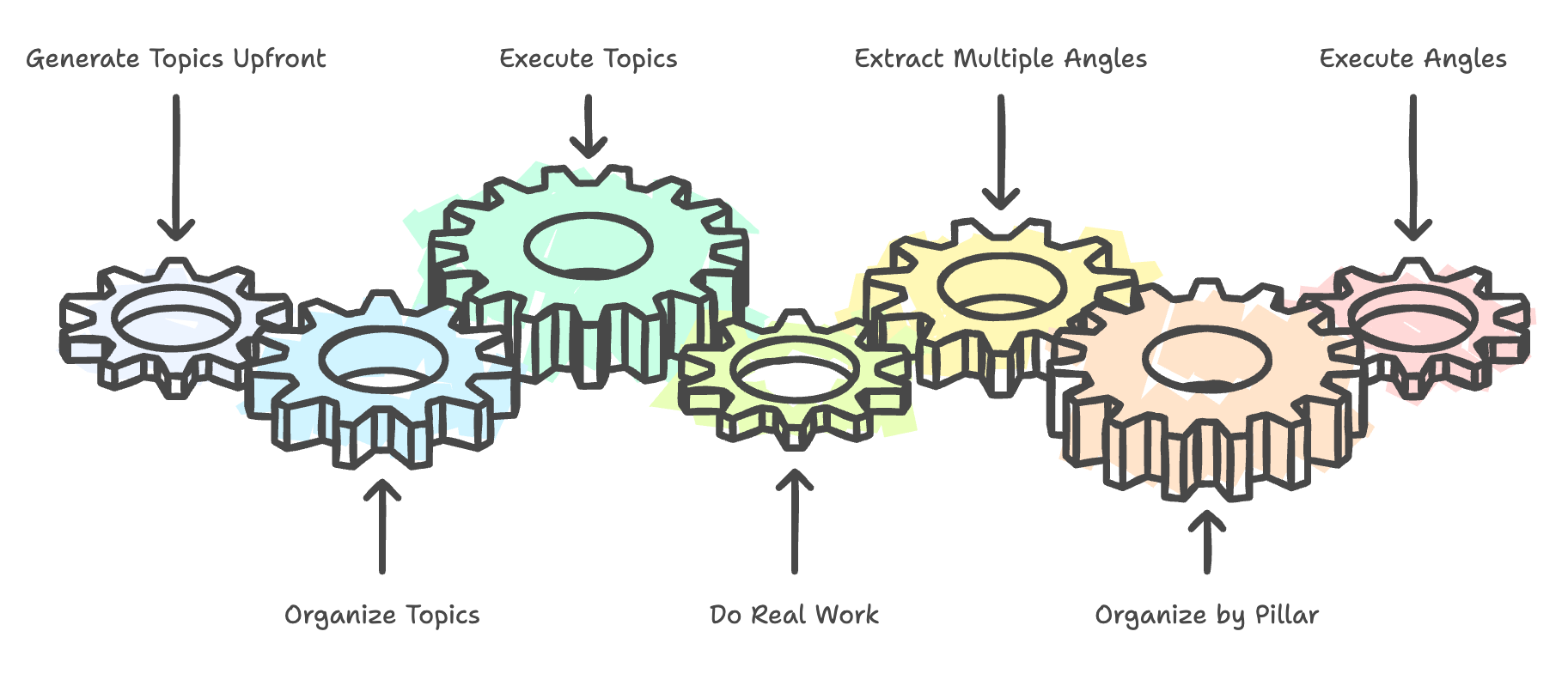
Here’s exactly how:
Step 1: Identify Real Work You’re Actually Doing (No Time Limit)
Don’t try to think of content ideas. Instead, notice what you’re actively building or navigating right now.
Examples:
You’re refining a process in your business
You’re working through a client problem
You’re discovering something that changes how you think
You’re building a system or framework
You’re navigating a tension or challenge
Write it down: “I’m currently working on: [specific real thing]”
Step 2: Ask Claude to Extract Multiple Angles (15 minutes)
Now ask Claude: “I’m working on this [real thing]. Here are the different audiences I serve: [list them]. What are 5-7 different angles I could pull from this work that would matter to each of them?”
You’re not asking it to generate topics. You’re asking it to help you see all the ways your real work connects to different problems people are facing.
Step 3: Evaluate Which Angles Spark Something (5 minutes)
Read through the angles. Notice which ones make you think “oh yeah, I have something to say about that” vs. which ones feel obligatory.
The ones that spark you are the ones grounded in your real thinking. Those are the ones worth writing.
Step 4: Organize Angles by Pillar and Timing (10 minutes)
Take the angles that sparked you and map them:
Which content pillar does this serve?
When does this fit in your business cycle?
What order makes sense?
This is the only planning you need. Not “what should I write about this quarter” but “of the angles I’ve identified from real work, how do I organize them?”
Step 5: Execute One Angle (Time Varies)
Write the piece. Don’t try to work ahead on all seven angles. Just do the next one.
While you’re writing, notice what else you’re discovering. Let that inform what comes next.
Step 6: Repeat With Your Next Real Project
Once you’ve extracted and executed the angles from the first project, move on to the next real work you’re doing. Extract angles from that. Repeat.
Why This Works:
You’re never scrambling for content ideas because you’re mining them from work you’re already doing. You’re never starting from nothing (which is how generic happens). The content stays grounded because it’s anchored in real problems and real building. And you maintain strategy without forcing ideas to fit a predetermined plan.
You’re not abandoning planning—you’re sourcing from reality instead of strategy alone.
The Stakes of Staying in Topic-Planning Mode
If you keep thinking perfect planning comes before real work, here’s what happens:
You generate topics from strategy that feel generic because they’re not grounded in anything
You sit down to write and feel uninspired because there’s no material to extract from
You force yourself to write to the plan instead of writing what you actually think
Your content feels obligated, not owned
Meanwhile, builders who extract angles from real work are creating content that feels alive, specific, and grounded
The real cost of planning topics upfront isn’t the time spent planning. It’s the authenticity lost by generating from strategy instead of extracting from work. It’s the weekly scrambling because you have no material to pull from. It’s the generic feeling that follows you through every piece.
The Permission You Need Right Now
Here’s what I’ve learned about staying authentically you while building strategically: Grounded content doesn’t come from better planning. It comes from extracting angles from real work.
My husband didn’t paint the wall untouched because he had a better mental picture than I did. He painted it untouched because he tested the theory against reality and adjusted based on what he discovered.
Taking time to identify real work before extracting angles isn’t indecision. It’s strategy.
Launching content that comes from actual work rather than forcing it through a predetermined plan isn’t a weakness. It’s how strategic builders actually work.
The content works better because we adjusted based on real material. The system works better because we iterated based on work, not theory.
Not because we planned better the second time.
Because we let reality inform the decision.
One Final Thought
The shift from “generate content topics from strategy” to “extract angles from real work” isn’t a small change in process. It’s a fundamental change in where your ideas come from and why they land.
Your real work is abundant with content angles. You’re just not extracting them yet. You’re trying to generate from thin air instead.
Stop planning your content in the abstract. Start mining it from work you’re actually doing.
Your first piece doesn’t need to be perfect. It needs to be grounded in something real. Everything else follows from there.
Start there.
I love how this assists planning for a Big Idea versus planning stuff. That ‘hollow’ line would slap me too!