

How to make scattered work easier for you and your AI collaborators to resume.
For a while I was running three homes at once: the house we live in, the RV, and wherever my husband and I landed for the winter.
Each one had its own lists, and most were good. The RV opening-and-closing list, which is really the do-not-mess-this-up list. The household list. The winter packing-and-living-away list.
Good lists. Accurate lists. And things still slipped. Not because anything on them was wrong, but because nothing coordinated them.
I'd stand in the kitchen and think, where did I keep that? Not because it was never written down. It almost always was.
What was missing was the handoff between them—a way to see what mattered for the move we were making.
You may have one home and still recognize the business version: email, the calendar, a notes app, two or three project boards, a documents folder, a handful of AI threads you keep meaning to reopen. Every piece can be accurate, and still no single place shows you where the whole thing stands right now.
The same pattern showed up later across two brands and the AI tools I use regularly. Same shape, higher stakes.
✳︎ ✳︎ ✳︎
If you read DigiNav Compass Signal, you’ll stop second-guessing your AI and automation decisions because you’ll have a way to tell what actually fits your business from what’s just noise. The expertise is already yours. You just needed a framework to trust it again.
✳︎ ✳︎ ✳︎
The business version of three homes
The Decision Toolkit had its own version of the problem. The material was all there: articles, experiment notes, worksheets, prompts, drafts, a string of AI conversations. Nothing was lost. Everything was saved. And starting a work session still meant digging.
A project can be that well documented and still be hard to pick back up.
Your version might not be a toolkit. It might be an offer, a course, a client process, a content series, some internal tool you keep meaning to finish. Plenty of material behind it, and no obvious answer to "where does this actually stand today?"
That can look like:
An answer you know you got right, sitting three days deep in an AI thread you can't re-find.
Two or three drafts of the same piece, with no marker for which one is current.
A card on your dashboard that tells you the project exists, but not where to pick it back up.
Every one of those is saved work. And saving something is not the same as being able to pick it back up without rebuilding it in your head first.
That rebuild is the part that quietly eats the session. Too much of the time I had set aside for the Toolkit went to reconstruction before anything new got made. The project didn't need another beginning. It needed a way back in.
✳︎ ✳︎ ✳︎
The work before the work
Come back to a project like that and the same questions run first, before a word gets written or a single decision gets made:
Where did I keep this?
What did we decide?
Which version are we working on?
What started this thread?
What was the next thing I meant to do?
That's the work before the work. On a good day it doesn't even register. It just feels like starting slow.
When it happens often enough, it's easy to decide the problem is you. Maybe you're being inconsistent, or scattered, or bad at follow-through.
But look at what's actually happening. The time set aside to move the project forward goes to reconstruction instead. The session turns into a search party. The friction is in the project, not your character.
An AI collaborator can hit the same wall. It can pick up a thread quickly, but first it needs to know where things stand, what got decided, and which version is current—the same questions again.
Point it at the current state and it continues the project. Leave it guessing and it fills the gaps with its best version of the story, which might not match where things actually are anymore.
Then Kim Doyal, who had offered to put the business through its paces, sent back a Growth Map with one clear instruction: gather what already existed and get it in front of people.
The second part depended on the first. The material was scattered across too many places to pull together on demand. Before the Toolkit could go anywhere, it needed one place to live.
✳︎ ✳︎ ✳︎
One shared home, not one giant list
The fix wasn't a bigger folder. It was giving the Decision Toolkit one place where I could see where it actually stood without reopening its entire history.
The chapters and worksheets live there. So do the AI prompts, the punch list, the decisions we've already made, and a short project status that tells me where to pick back up. When something changes, the current files change with it.
That means I can read through the project myself or ask an AI collaborator for an update based on those files. I'm no longer hoping the right answer is hiding in the right conversation—or reopening a decision because neither of us can find where it landed.
This is closer to what finally worked with our three homes. We didn't stuff the RV list, the household list, and the winter list into one enormous master list. They remained useful for different reasons. What we needed was one place to get our bearings.
A project works the same way. Notes can remain notes. Drafts can remain drafts. The useful part is knowing which ones represent the project now, what has already been decided, and where the work resumes.
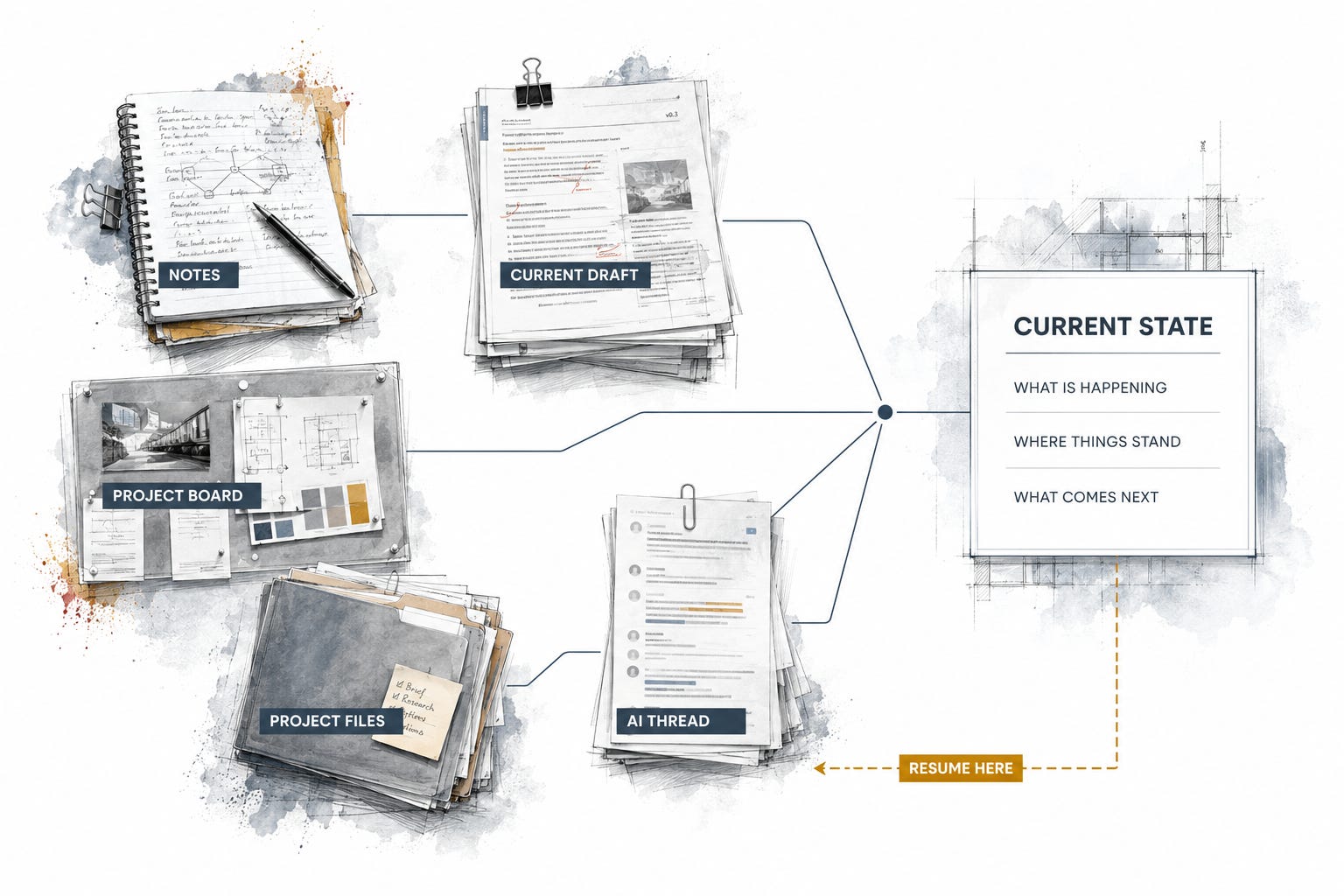
For the Toolkit, that was enough to change the work. The written material and AI prompts are complete. Instead of reconstructing those pieces again, I can use them as the foundation for the next stage: a live online version alongside the PDF and AI-guided options.
But giving a project one home only solves part of the problem. Put it down for two weeks and it can still disappear into the noise. It also needs a way to point you back.
✳︎ ✳︎ ✳︎
Make one project resumable
For the Toolkit, the piece that points me back is a short Project Status. It records where things stand and the exact spot to resume. One card on the dashboard points me back to where I left off. Quick reorientation to keep things moving.
You don't need to build any of that to get the same benefit. You can test one project by hand, without redesigning your whole system.
Pick a project that's stalled. Sometimes the problem isn't motivation. If getting oriented costs nearly as much as the next step, the return path may be what needs attention.
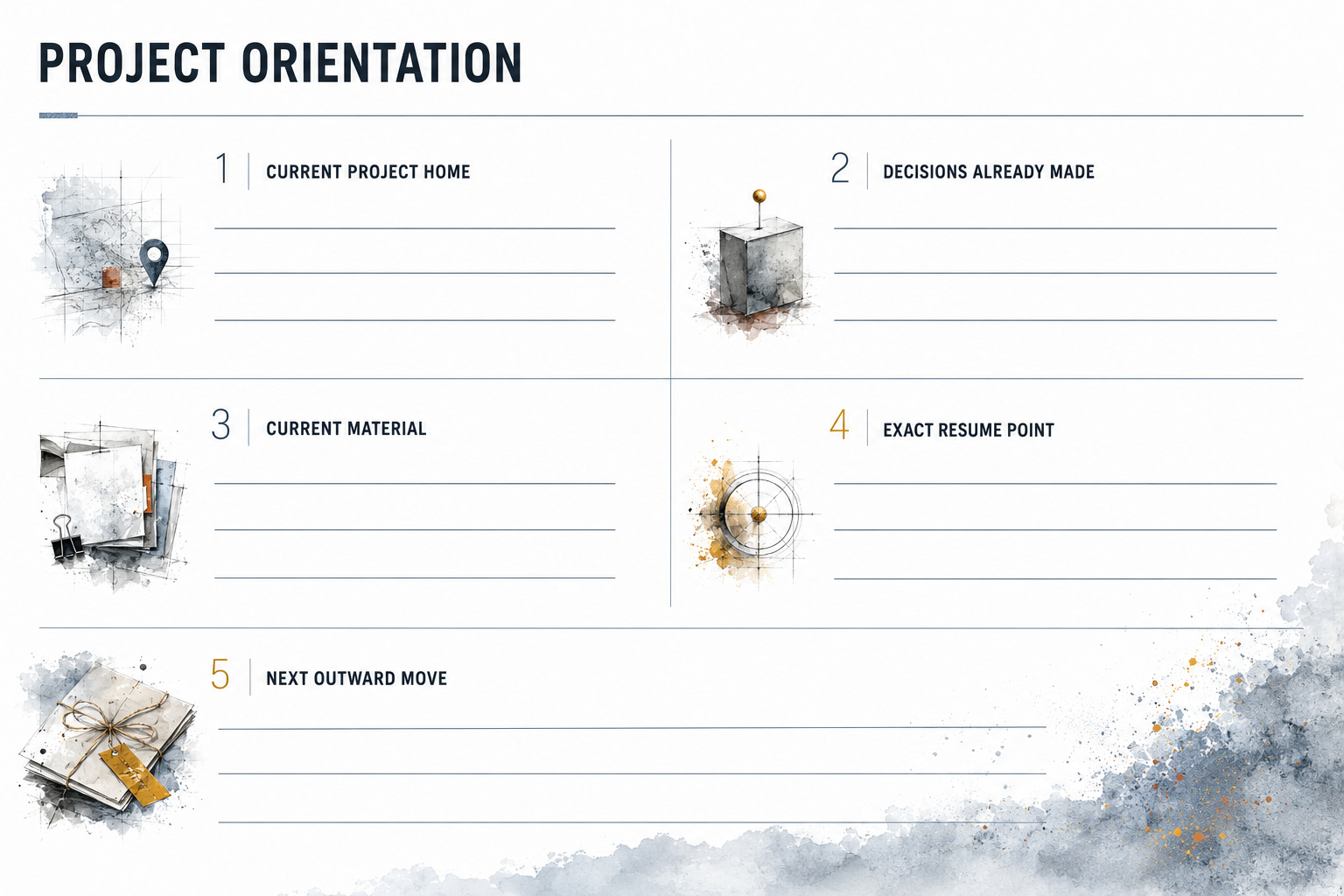
Try this with one stalled project. Answer these five questions:
Where does the current project live?
What has already been decided?
Which material is current?
Where exactly should the work resume?
What's the next move that takes it closer to another person, a customer, or a real-world test?
Want AI to help you get your bearings? Give it the current project files and ask:
Based only on these files, tell me what is current, what has already been decided, what is still open, and where I should pick the work back up. If the files don't answer something, tell me instead of guessing.If all five have quick answers, orientation probably isn't the main thing stopping you, and that's worth knowing on its own.
If one answer is missing, start there. Repair that part of the return path before you add another tool, another dashboard card, or another AI conversation.
And you don't have to gather everything just because it's related. Keep what helps the project answer those five questions. The rest can stay where it is, available if you need it, without competing to be the current version.
A trustworthy way back in
We don't have three homes anymore. We sold the RV and moved, so three sets of lists became two, each with different needs. What stayed useful was the coordination: each place could keep its own list, while I had one place to get my bearings before shifting from one to the other.
DecisionVerse, the shared home I built for that work, is doing the same job now across two brands, a handful of active projects, and the AI collaborators I work with.
Yours might be far simpler. A single project, a couple of notes, one shared doc. The setup was never the point. The test is whether you—and anyone or any AI helping you—can see where the project stands and keep going from there.
So a stalled project may not need more discipline, and it may not need a fresh start. It may just need a trustworthy way back in.
Which of your projects would get easier to finish if you didn't have to rebuild it every time you came back?
✳︎ ✳︎ ✳︎
Right now I’m running a small beta of the Decision Toolkit — a handful of people testing it on one real decision and telling me what actually happened. It’s open to subscribers. If you’d like a spot, subscribing is the first step.