


My brain has always run at full speed. Some people call it ADHD tendencies. I prefer to think of it as superdrive.
For as long as I can remember, someone was telling me to focus, slow down, do one thing at a time. Teachers. Managers. Myself, on a good day.
Now I use AI daily, and honestly? It can be just as scattered. There’s no one to rein me in when a session goes sideways — when I’ve asked four different questions, chased three tangents, and somehow ended up somewhere completely unrelated to where I started.
Until I built myself a mirror.
It started with an article from Mia at ROBOTS ATE MY HOMEWORK. Her framework is smart — she breaks down what’s actually hiding inside every AI session and makes a compelling case that most of us save the wrong thing. We file the polished draft and lose the moment our thinking actually shifted.
She’s right. But I was sitting here building something slightly different, and I think it’s worth naming why.
Mia’s framework asks: what did the session produce worth keeping?
The thing I kept bumping into was a different question: was I clear, honest, and focused going in?
Those are not the same problem.
I spent a session this week designing a debrief process. It started as “let me capture AI breakthroughs” and wandered through Mia’s hierarchy, through knowledge systems, through Obsidian structures — until I stopped and said out loud: we’re thinking about this all wrong.
What I actually wanted wasn’t a knowledge capture system. It was a mirror.
Something that would show me, at the end of a thinking session, how I showed up. Did I have too many asks going at once? Did I drift off on a tangent that went nowhere useful? Was I actually thinking something through — or was I using the conversation to avoid deciding?
That’s not a breakthrough journal. That’s a coaching log.

Here’s the distinction that crystallized for me:
Mia’s framework is output-oriented — it helps you extract what the session produced.
What I built is input-oriented — it helps me evaluate how I used the session.
Both matter. They’re just solving different problems.
The output framework catches the breakthrough after it happens. The input framework catches the bad habit before it becomes a pattern. And for those of us who use AI daily as a thinking partner, the input side is where a lot of invisible time gets lost — not to bad tools, but to unfocused sessions, validation loops, and scope creep that looks like productivity.
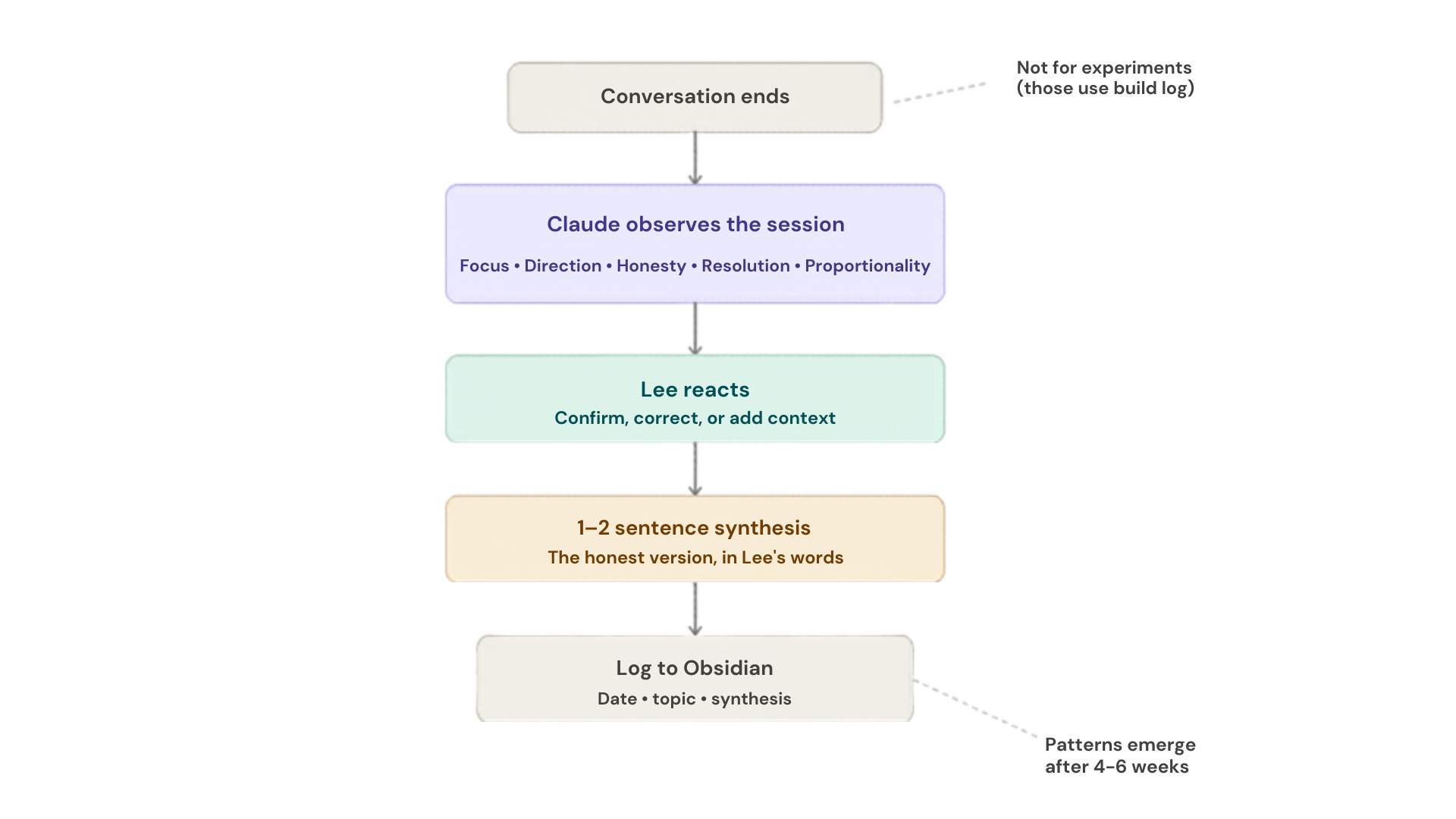
The debrief I landed on is simple. At the end of a general thinking session, Claude observes five things: how focused the session was, whether tangents were useful or distracting, whether I was thinking or seeking validation, whether it reached a real conclusion, and whether the complexity matched the actual size of the problem.
Then I react. Then we write one or two sentences — the honest version — and I log it in Obsidian.
No elaborate capture system. No tagging taxonomy. Just a running record of how I think, so the patterns can eventually show themselves.
I won’t know what my patterns are for a few weeks. That’s kind of the point.
If you’re a daily AI user, you probably already have some version of Mia’s problem — great sessions that evaporate because you didn’t catch what shifted. Her debrief prompt is worth using.
But if you’ve also had that feeling of closing a tab and realizing you can’t quite account for the last 45 minutes — that’s the other side of the same issue. Not what you failed to save. How you showed up in the first place.
That’s worth paying attention to too.
If this resonates, here’s a short prompt to start your own end-of-session habit:
“Look back at this conversation and tell me: how focused was I, did I go on any tangents, and was I actually thinking or just seeking validation?”
Paste it at the end of any session that felt a little sideways. See what comes back.
And if you’re finding your AI sessions are doing more wandering than working, that’s exactly what I help with. Book a session today.

P.S. If you haven't read Mia Kiraki's original piece on catching AI breakthroughs, it's worth your time. Her framework is what sparked this one. Read it here.
This is amazing, Lee, and I would argue that your approach is actually way more valuable!
I tried to differentiate mine from 'just create for me a summary of this conversation, please' because I've noticed that the AI doesn't catch the actual breakthroughs in its summaries.
I appreciate this so much! I will integrate this into my own process as well. Thank you! ❤️❤️