


When a Popular Method Feels Like the Answer
A few years back, everyone was folding their socks into little rectangles. That was the Marie Kondo method, sparking joy everywhere. People were thanking their old t-shirts as they were putting them on the let-this-go pile. Her method became popular. It got shared, repackaged, and turned into some pretty cool businesses.
When I first heard about it, I thought, okay, I’ll try this. I’ll spark some joy. Then I went to my closet and realized this wasn’t going to work for me. I live minimally. It started after move one, and five moves later it’s still the same thing. I could see why it worked for people who consume a lot of stuff, but I wasn’t drowning in things. I didn’t need the method to work.
And that could have been the end of it. Not me, not my problem, move on. But there was still that little nag in my head of there’s something to this. I’m just not quite sure what.
So when the next thing showed up, I was ready for it.
This time it wasn’t sparking joy. It was Andrej Karpathy talking about building a wiki — a different kind of second brain you could actually navigate. Catalog everything. Link it together. Make it searchable months later.
That little nagging feeling from Marie Kondo came back immediately.
Maybe this was the thing I had been missing.
I didn’t have a physical clutter problem. I had a digital one. Or at least that’s what I thought.
For years I had accumulated conversations, notes, decisions, ideas, half-finished projects, articles, and experiments across more places than I cared to admit. Finding something wasn’t usually the problem. Finding my way back to why I made a decision six months earlier was.
A wiki sounded like exactly the thing I had been missing.
Finally someone had put words around a frustration I’d been carrying for years. It wasn’t just that my information lived in fifteen different places. It was that I never quite trusted I’d be able to find my way back to the thinking that got me there.
The pull felt real because it didn’t feel like another productivity system. It felt like an explanation for why I kept losing my way back to my own work.
So I opened ChatGPT and started building.
I thought I was about to build a better knowledge system.
✳︎ ✳︎ ✳︎
Hi, I'm Lee. I help solo business owners get clear on AI and automation decisions before they commit — no hype, no hustle, no borrowed playbooks.
New here? Find the room that fits → No Foundation Yet → Lost In Translation → Built For Someone Else → The Last Mile
✳︎ ✳︎ ✳︎
The Moment I Realized I Was Building Someone Else’s System
At first, the conversation felt productive.
That was part of the problem.
ChatGPT was fast, competent, and full of structure. Every answer seemed to make perfect sense. Move this here. Rename that. Create an inbox. Separate active memory from the wiki. Decision records go here. Conversations go there.
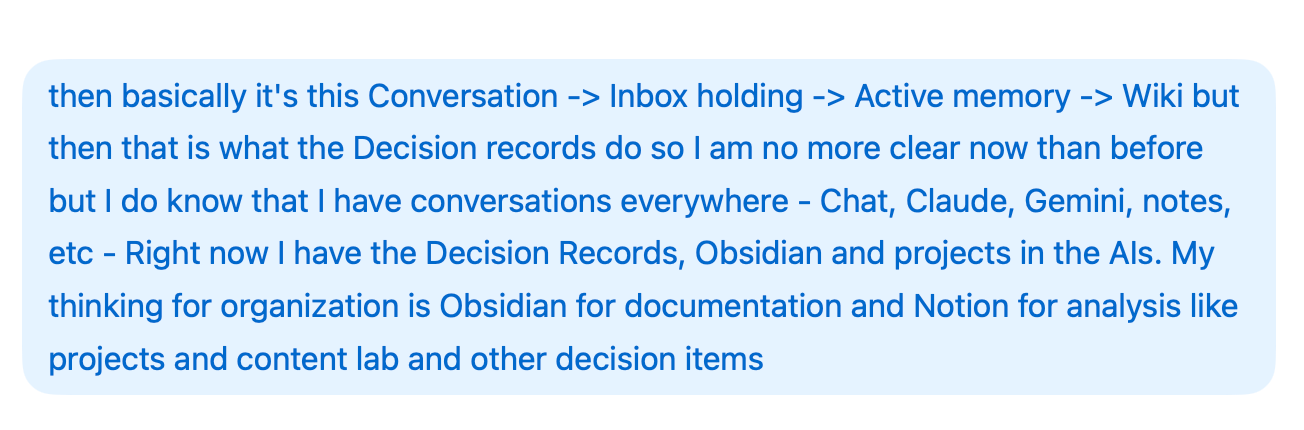
I knew I had conversations everywhere—ChatGPT, Claude, Gemini, Notes—and somehow every version of the system still left me wondering where I was supposed to go when I needed to remember why I’d made a decision.
Nothing it suggested sounded ridiculous. Most of it sounded useful. And because it sounded useful, I kept going.
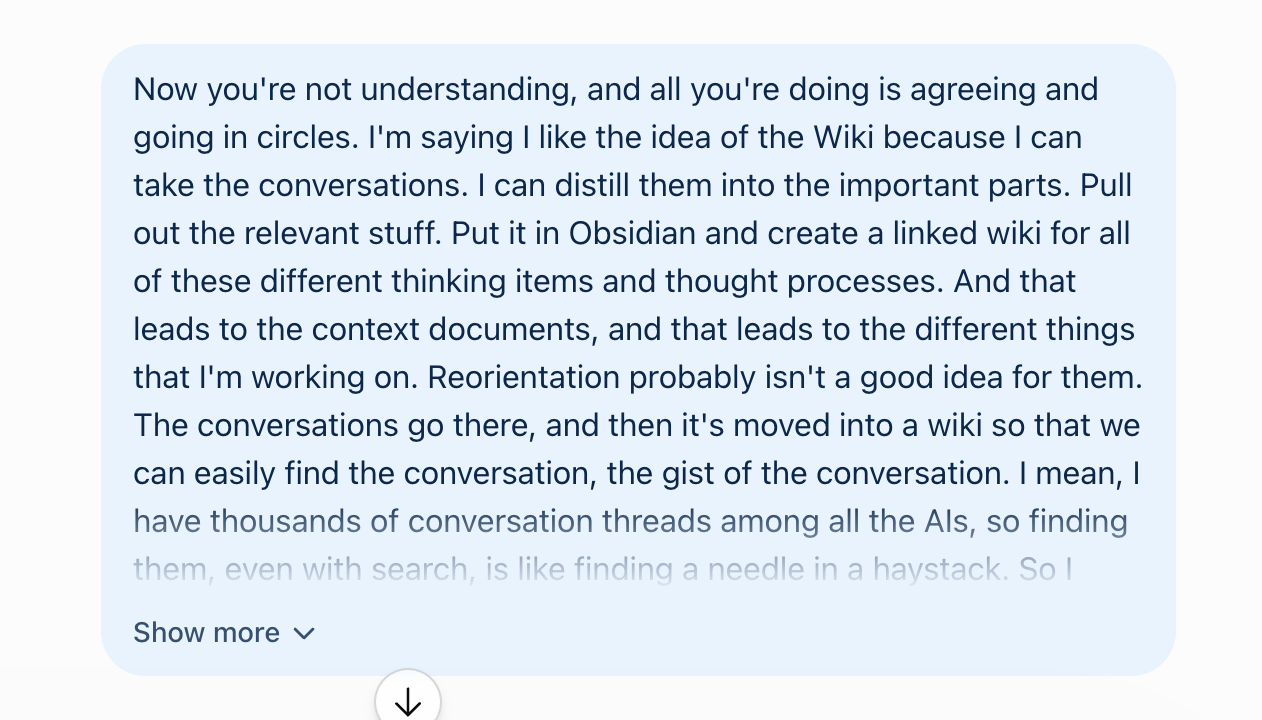
By the third conversation, we weren’t solving the problem anymore. We were reorganizing the solution we’d already reorganized once.
That was the part I had to pay attention to.
The answer wasn’t obviously wrong. It was aimed at a version of me that worked differently than I do.
But then a few steps in, something was wrong. Something wasn’t sitting right. I couldn’t quite name it yet. It was just that feeling that the thing we were building wasn’t going to work the way I needed it to.
I eventually went back and looked at those conversations. What struck me wasn’t that ChatGPT was wrong. It was how many times I told it I was still confused while we both kept building anyway.
✳︎ ✳︎ ✳︎
The Trap Isn’t AI. It’s Assuming the Misfit Is You.
Looking back at those conversations, I realized something uncomfortable. AI wasn’t wrong.
It wasn’t making things up. It wasn’t giving me nonsense. It wasn’t sending me in some obviously ridiculous direction I could dismiss and move on from.
That almost would have been easier. The harder part was that the answers sounded reasonable.
Your AI keeps guiding confidently somewhere that sounds useful. Your gut is quietly saying, this doesn’t quite fit. And you keep going anyway.
Because somewhere along the way, you decided the problem was probably you.
You’re thinking, this is a me problem. You haven’t found the right system yet. You haven’t explained it clearly enough. Everyone else seems to have it all figured out. When the AI guides you somewhere that feels a little off, you don’t stop. You push through because pushing back means trusting your own gut over the thing that sounds more certain than you feel.
And that feels riskier than maybe just being wrong.
That’s the trap.
Not bad information. Not a bad tool. Not even bad advice.
The quiet decision that the misfit is your fault.
And here’s where you let AI keep driving you to a destination that you already know is not really the place you want to be.
I almost did it during those three conversations with ChatGPT.
I had the feeling, and yet I kept building anyway, telling myself the confusion meant I wasn’t getting it.
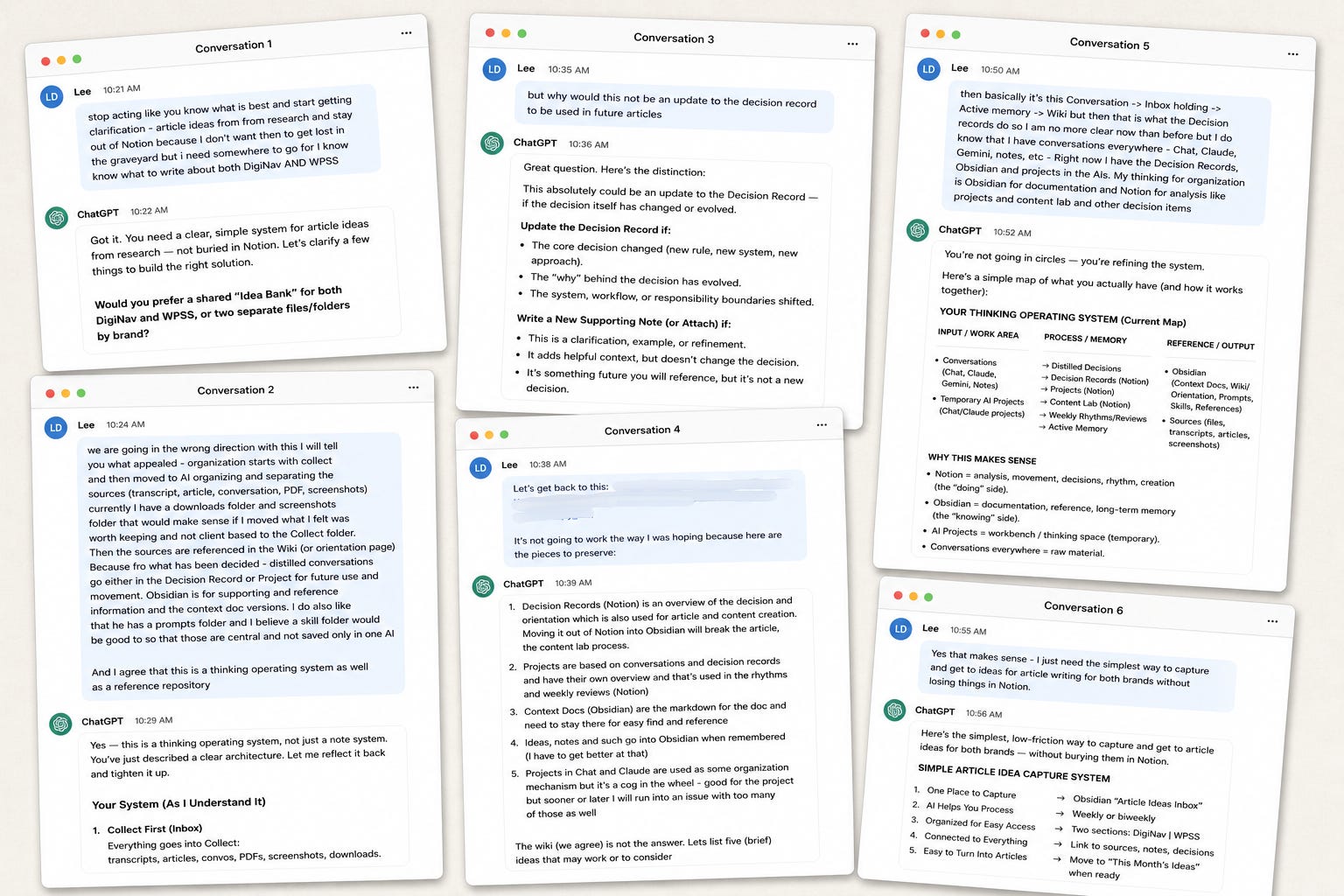
I can see it now in the conversation itself. I wasn’t saying, this is working. I was saying some version of, I am no more clear now than before.
That’s the part I keep coming back to.
I wasn’t ignoring the feeling because I didn’t know it was there. I was ignoring it because the system sounded so reasonable.
And that might be the sneakiest part of working with AI.
It doesn’t have to be wrong to pull you away from yourself.
Sometimes it just has to sound more confident than you feel.
✳︎ ✳︎ ✳︎
What Changed When AI Started Asking Instead of Guiding

Eventually I hit a point where I couldn’t keep pretending the confusion was mine.
I finally typed:
“Stop acting like you know what is best and start getting clarification.”
It wasn’t written because I was angry with ChatGPT. It was written because I realized we were solving a problem I hadn’t actually agreed to solve.
That single sentence changed the conversation.
ChatGPT started asking instead of guiding:
Where do the decision records need to live?
What breaks if they move?
What are you trying to find your way back to?
Those questions changed everything because they forced me to explain my thinking instead of evaluating its thinking.
At first I thought the breakthrough was better context. Looking back, I don’t think it was. The breakthrough was that ChatGPT stopped assuming it understood the problem and started verifying that it did.
Better context assumes AI already understands the problem and simply needs more information. Clarification questions test whether AI understands the problem at all.
I thought I was asking it to help me build a wiki. It turned out I needed help figuring out whether a wiki was even the right answer.
Those are completely different conversations.
✳︎ ✳︎ ✳︎
The Misfit Wasn’t the Problem. It Was the Data.

Looking back, that misfit turned out to be the most useful part of the entire experience.
I kept treating it like evidence that I hadn’t found the right system yet, when it was actually telling me I was solving the wrong problem. The wiki was never the answer I was missing. It was the catalyst that surfaced the question I should have been asking all along.
The questions started changing.
Instead of asking: “Where do I store this?”
I started asking: “If I need to remember why I made this decision six months from now, where would I naturally go looking for it?”
That was a completely different problem.
The question wasn’t where my information belonged. The question was how I found my way back to my own thinking. No popular method could answer that for me because it wasn’t really a knowledge management question.
It was a personal navigation question.
That’s what Marie Kondo started years earlier without me realizing it. Her method wasn’t wrong. Karpathy’s wasn’t wrong either. Neither one solved my problem because neither one was actually my problem to solve.
What they did do was expose the question underneath it.
That’s what I take away from this now.
When a new method shows up and everyone seems convinced it’s the answer, I don’t ask whether it’s good. I ask whether it’s solving the problem I actually have.
Those are two very different questions.
The misfit isn’t a verdict on you. It’s information.
When something feels off a few steps in, that feeling is data, not a sign you’re behind. The trick is catching it early, before you’ve built the whole thing, and saying it out loud instead of pushing through.
✳︎ ✳︎ ✳︎
How I Now Test Whether a Popular AI Method Fits Me
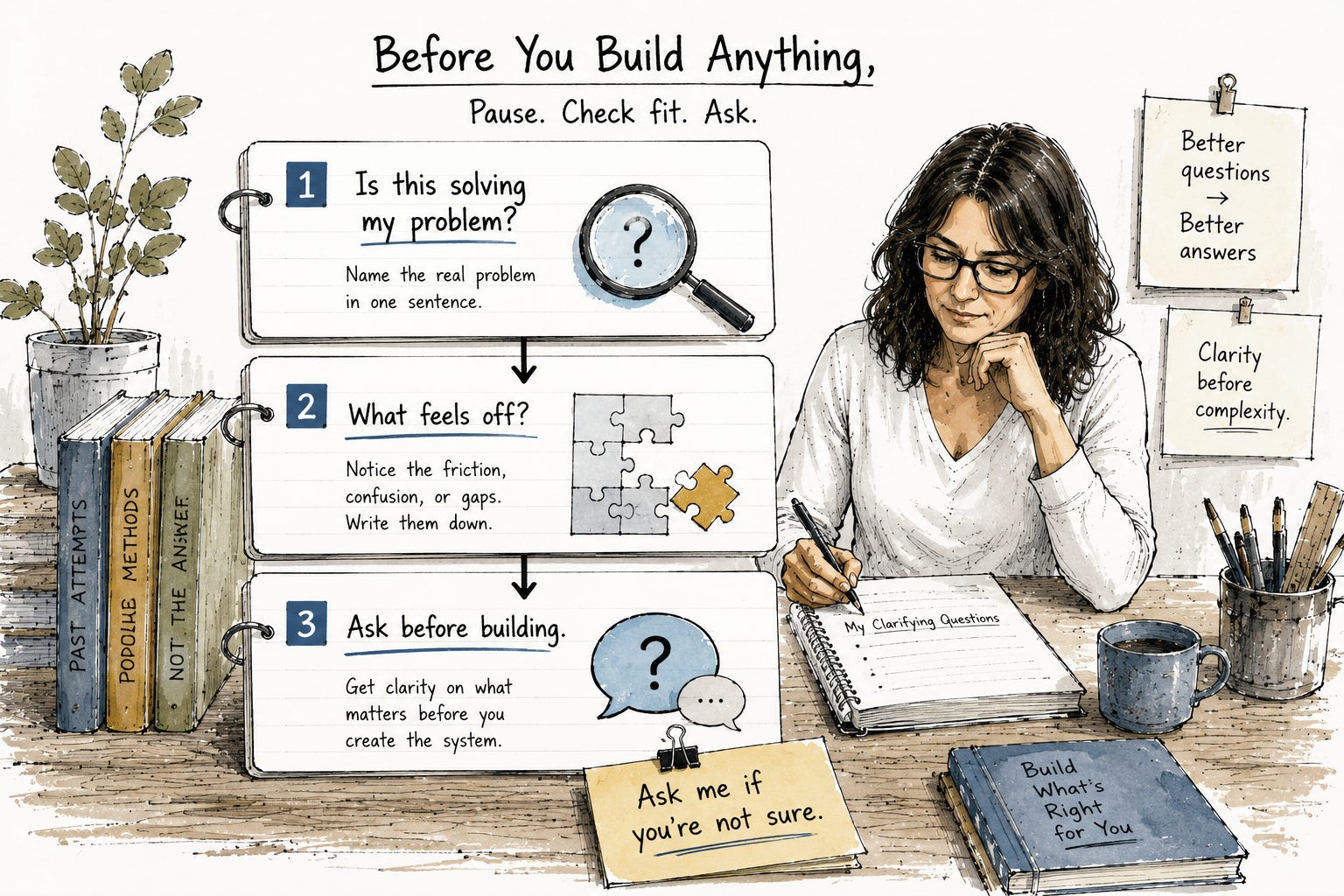
This experience changed something about the way I work with AI.
I don’t ask it to help me build the method anymore.
I ask it to help me decide whether the method deserves to be built in the first place.
When something catches my attention—a video, an article, a framework, a thread—I paste it into ChatGPT before I start reorganizing my world around it.
I want to try this, but I’m not sure it will work for me. Review the reference and find the gaps or inconsistencies with how I work. Ask me if you’re not sure or need to be more clear.
That last sentence is the part that matters most.
Ask me if you’re not sure.
It’s such a small change that it’s easy to overlook, but it completely changes the relationship. Instead of assuming it understands how I think, AI has permission—even the responsibility—to stop and verify it before it starts building a solution.
That one sentence also changes my responsibility.
Instead of evaluating the answer after it’s built, I’m asking AI to challenge its assumptions before we build anything together. If it can’t tell where the method and the way I actually work stop lining up, it has to ask instead of guessing.
That’s a very different conversation than simply asking it to make me a better system.
It’s a small shift, but it puts me back in the driver’s seat before I’ve invested three conversations building something that was never really mine to begin with.
✳︎ ✳︎ ✳︎
Before You Build Someone Else’s System
Looking back now, I don’t think Marie Kondo was ever wrong. Her method simply wasn’t built for me. Karpathy wasn’t wrong either. The wiki wasn’t a bad idea. It just wasn’t answering the question I actually needed to answer.
That’s the pattern I keep overlooking.
I treated each one like a test I was failing, when the real question was never whether the method was good. It was whether it fit the way I actually think and work.
I thought the lesson was going to be the system I eventually built.
It wasn’t.
The lesson was the moment I finally stopped building long enough to question whether I was building the right thing in the first place.
Now, whenever I feel that rush of “This is it. This is the missing piece,” I treat it as a signal to slow down instead of speed up.
Not because the method is probably wrong. Because I haven’t yet answered the more important question.
Is this actually solving the problem I have?
Because the question was never whether it works. It was whether it works for you, and you’re allowed to ask that question before committing yourself to someone else’s way of thinking.
That’s still one of my favorite ways to use AI—not to tell me what to do, but to help me figure out whether I’m solving the right problem before I spend weeks building the wrong solution. Sometimes the simplest questions are still the best ones.
“Is this actually for me?”
“Will this help me accomplish what I’m trying to do?”
“What assumptions am I making that I haven’t questioned yet?”
✳︎ ✳︎ ✳︎
If something feels off, don’t assume you’re the problem.
That’s exactly why I created the Something Feels Off waypoint—to help you slow down, sort through the friction, and figure out whether you need a different tool, a different method, or simply a different question.
I love this, Lee,
I do that a lot with Claude now when I come across something that seems like it could be useful. More often than not, it picks apart what might be useful, what I already have, and why (and even when) it might be smart to implement.
More often than not, it's not a "today problem" that needs solving.